
Enhanced with market attractiveness analysis, total addressable market evaluation, company benchmarking matrices, interactive Excel dashboards, expanded supply chain intelligence, emerging startup coverage, and detailed product insights, The Business Research Company’s 2026 market reports deliver more actionable and strategically valuable research.
Aircraft Propulsion System Market Revenue Outlook: What CAGR Is Expected Through 2030?
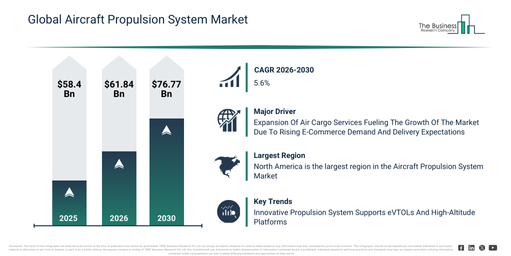
The aircraft propulsion system market has observed significant expansion in recent years. This market is expected to increase from $58.4 billion in 2025 to $61.84 billion in 2026, achieving a compound annual growth rate (CAGR) of 5.9%. The historical growth of this market can be attributed to the extensive utilization of turbojet and turbofan engines in commercial and military aircraft, the advancement of piston and rotary engines for smaller aircraft, the adoption of nacelles and nozzles for optimizing thrust and aerodynamics, the integration of thrust reversers for enhanced landing safety, and an escalating demand for efficient propulsion systems to minimize fuel consumption.
The aircraft propulsion system market is projected to experience robust expansion over the coming years. This market is set to reach $76.77 billion by 2030, exhibiting a compound annual growth rate (CAGR) of 5.6%. This anticipated growth during the forecast period is driven by several factors, including the increasing integration of electric and hybrid-electric propulsion systems, the advancement of scramjet and ramjet technologies for high-speed and hypersonic aircraft applications, an emphasis on developing lightweight and highly efficient propellers and associated components, the incorporation of advanced materials to improve engine durability and overall performance, and a rise in procurement activities for future commercial and defense aircraft initiatives. Key developments anticipated in this period encompass the creation of high-thrust propulsion systems, the evolution of lightweight propulsion components, the adoption of hybrid and distributed propulsion configurations, innovations in high-temperature materials, and progress in supersonic and hypersonic propulsion capabilities.
Download A Free Sample Report For Comprehensive Market Insights:
Aircraft Propulsion System Market Opportunity Drivers: What Is Creating New Revenue Potential?
The future expansion of the aircraft propulsion system market is expected to be propelled by the growth in air cargo services. Air cargo services entail the transportation of goods via aircraft, ensuring prompt and dependable delivery for both domestic and international freight. The demand for air cargo services is increasing due to the booming e-commerce sector, as consumers increasingly seek faster and time-definite delivery options. Aircraft propulsion systems improve air cargo services by enabling quicker, more efficient flights, which is essential for the timely delivery of goods across vast distances. They also enhance fuel efficiency and reliability, thereby supporting cost-effective and consistent cargo operations. For instance, in March 2025, the Bureau of Transportation Statistics, a US-based government agency, reported that air cargo revenue reached 83.82 billion revenue ton-miles in 2024, representing an increase of 4.42% from the 80.27 billion recorded in 2023. Therefore, the expansion of air cargo services is a key factor driving the growth of the aircraft propulsion system market.
Aircraft Propulsion System Market Segment Landscape: Which Areas Lead Market Development?
The aircraft propulsion system market covered in this report is segmented –
1) By Type: Air Breathing Engine, Non-Air Breathing Engine, Other Types
2) By Engine Type: Gas Turbine Engines, Electric Or Hybrid Propulsion, Rocket Propulsion, Piston Engines
3) By Power Output: Less Than 10,000 lbf, 10,000 To 20,000 lbf, 20,000 To 30,000 lbf, Over 30,000 lbf
4) By Application: Aircraft, Missiles, Unmanned Aerial Vehicles, Spacecraft
5) By End User: Commercial, Military, General
Subsegments:
1) By Air Breathing Engine: Turbojet, Turbofan, Turboprop, Ramjet, Scramjet
2) By Non-Air Breathing Engine: Solid Propellant Rocket Engine, Liquid Propellant Rocket Engine, Hybrid Rocket Engine
3) By Other Types: Electric Propulsion System, Ion Propulsion System, Nuclear Propulsion System
Aircraft Propulsion System Market Strategic Trends: What Is Defining The Next Phase Of Growth?
Key players within the aircraft propulsion system market are concentrating on developing sophisticated products, such as lightweight air-cooled electric propulsion systems, with the goal of improving efficiency, reducing emissions, and promoting sustainability. These lightweight air-cooled electric propulsion systems are innovative power units that eliminate the need for heavy liquid cooling systems, thereby decreasing overall mass and complexity while maintaining high performance. For instance, in February 2023, Kite Magnetics, an Australia-based aerospace manufacturing company, introduced its 120-kilowatt KM-120 propulsion system. This system is designed to deliver significant power output while remaining exceptionally lightweight and compact, making it ideal for aircraft like fixed-wing planes, eVTOLs, eSTOLs, and high-altitude platforms. It incorporates advanced air-cooling technology and employs Kite’s proprietary Aeroperm nanocrystalline magnetic material, which substantially minimizes energy loss and increases efficiency. The KM-120 is engineered for straightforward integration into both newly designed aircraft and retrofitted existing models, supporting various electric power sources, including batteries and fuel cells.
Aircraft Propulsion System Market Competitive Landscape: Who Are The Leading Companies?
Major companies operating in the aircraft propulsion system market are General Electric Company, BAE Systems plc, Collins Aerospace, L3Harris Technologies Inc., Safran S.A., Rolls‑Royce Holdings plc, IHI Aerospace Co. Ltd, Shenyang Aircraft Corporation, Bombardier Recreational Products Inc., MTU Aero Engines AG, ArianeGroup SAS, Aerojet Rocketdyne Holdings Inc., Industria de Turbo Propulsores S.A.U., Avio S.p.A., ZeroAvia Inc., H55 SA, Raytheon Technologies Corporation, Kratos Defense & Security Solutions Inc., Busek Co. Inc., Jetoptera Inc., Manta Aircraft SA, Turbotech SAS, United Technologies Corporation.
Access The Complete Aircraft Propulsion System Market Report:
Aircraft Propulsion System Market Global Footprint: Which Region Holds Market Leadership?
North America was the largest region in the aircraft propulsion system market in 2025. The regions covered in the aircraft propulsion system market report are Asia-Pacific, South East Asia, Western Europe, Eastern Europe, North America, South America, Middle East, Africa.
Access a Customized Aircraft Propulsion System Market Report for Deeper Competitive Insights
https://www.thebusinessresearchcompany.com/customise?id=28900&type=smp
Get in touch with us:
The Business Research Company: https://www.thebusinessresearchcompany.com/
Americas: +1 310-496-7795
Asia: +44 7882 955267 & +91 8897263534
Europe: +44 7882 955267
Email us at: marketing@tbrc.info
Follow us on:
LinkedIn: https://in.linkedin.com/company/the-business-research-company
YouTube: https://www.youtube.com/channel/UC24_fI0rV8cR5DxlCpgmyFQ
Global Market Model: https://www.thebusinessresearchcompany.com/global-market-model

Wasay has over a decade of experience in market research, data modelling, and analytics, with prior experience at GlobalData and Decision Tree Consulting Services. At The Business Research Company , he leads research operations across syndicated studies, customized consulting engagements, and the Global Market Model platform. His professional experience includes supporting organizations such as Boston Consulting Group, KPMG, and Ernst & Young. Wasay holds a degree in Electronics and Communications Engineering, postgraduate management qualifications from International Management Institute Belgium and Indian School of Business and Entrepreneurship, and completed the Integrated Program in Business Analytics from Indian Institute of Management Indore.
