Backed by market attractiveness analysis, total addressable market sizing, company benchmarking matrices, interactive Excel dashboards, wider supply chain intelligence, emerging startup coverage, and detailed product-level insights, The Business Research Company’s 2026 market reports are designed to offer research that is more actionable and strategically valuable than ever.
#Low Dielectric Materials Market Forecast: What Value Will The Market Reach By 2030?#_x000D_
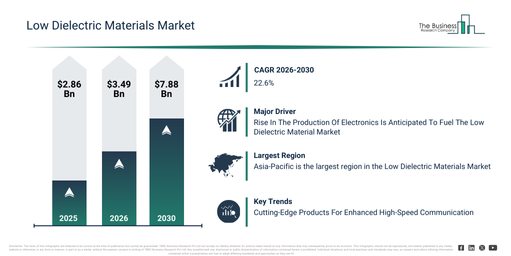
The low dielectric materials market size has experienced significant expansion in recent years. This market is forecast to grow from $2.86 billion in 2025 to $3.49 billion in 2026, achieving a compound annual growth rate (CAGR) of 22.1%. Historically, this growth can be linked to the increase in PCB manufacturing, the escalating requirement for insulation in microelectronics, the advent of high-frequency communication systems, the initial integration of dielectric materials in aerospace, and the rising demand for lightweight polymer materials._x000D_
_x000D_
The low dielectric materials market is anticipated to experience significant expansion in the upcoming years. It is forecast to reach $7.88 billion by 2030, demonstrating a compound annual growth rate (CAGR) of 22.6%. The expected market growth over the forecast period is primarily driven by the increasing rollout of 5G and advanced connectivity, the broader application of dielectric materials in autonomous systems, progress in semiconductor miniaturization, the escalating need for high-speed data transmission components, and a greater emphasis on developing sustainable materials. Prominent trends for this period include the wider adoption of advanced materials for high-frequency electronic applications, a surging demand for eco-friendly and low-loss dielectric materials, enhancements in precision manufacturing for electronic insulation components, the growing integration of low dielectric materials into IoT and connected devices, and the increasing utilization of high-performance polymers for autonomous and smart systems._x000D_
_x000D_
#Get A Free Sample Report With In-Depth Market Insights:#_x000D_
_x000D_
#Low Dielectric Materials Market Growth Backed By Core Demand Fundamentals#_x000D_
The increasing output of electronics is anticipated to boost the expansion of the low-dielectric material market in the future. Electronics is defined as the field of physics and technology concerned with the investigation, design, and use of devices and systems that involve the regulated movement of electrons. These low dielectric materials find application in electronics, serving to lessen signal interference and enhance the effectiveness of electronic components by minimizing the capacitance effect. As an illustration, a report from May 2023 by the Office for National Statistics, a UK-based organization, indicated that in March 2023, the monthly production output saw an increase of 0.7%, with manufacturing being the primary contributor to this growth. More specifically, the manufacturing of computer, electronic, and optical products experienced a 3.3% rise, which positively impacted the overall production index. Consequently, the uptick in electronics production is fueling the low dielectric material market._x000D_
_x000D_
#Low Dielectric Materials Market Segment Breakdown: Which Categories Lead On Revenue?#_x000D_
The low dielectric materials market covered in this report is segmented – _x000D_
_x000D_
1) By Type: Thermoset, Thermoplastic, Ceramics _x000D_
2) By Material Type: Fluoropolymer, Modified Polyphenylene Ether, Polyimide, Cyclic Olefin Copolymer, Cyanate Ester, Liquid Crystal Polymer, Other Material Types_x000D_
3) By Application: PCBs, Antenna, Microelectronics, Wire and Cable, Radome, Other Applications_x000D_
_x000D_
Subsegments:_x000D_
1) By Thermosets: Benzocyclobutene (BCB), Cyanate Ester, Low-k Epoxy Resin, Silicone Resins, Modified Polyimide_x000D_
2) By Thermoplastics: Fluoropolymers (PTFE, FEP, PFA, ETFE), Cyclic Olefin Copolymer (COC/COP), Liquid Crystal Polymer (LCP), Modified Polyphenylene Ether (mPPE), Polyetheretherketone _x000D_
3) By Ceramics: Low-k Advanced Ceramics, Low-k Glass Ceramics, Engineered Porous Low-k Ceramics_x000D_
_x000D_
#Low Dielectric Materials Market Growth Trends Reshaping The Competitive Landscape#_x000D_
Major companies in the low-dielectric material market are concentrating on developing cutting-edge products, such as advanced dielectric and thermal solutions. These innovative materials are designed to incorporate low-loss and high-thermal-conductivity properties, thereby enhancing PCB performance and reliability through improved thermal management and dielectric characteristics for electrical systems. For instance, in September 2024, Ventec International Group, a China-based manufacturer of electronic components, introduced its Pro-bond and Thermal-bond materials. These materials are crucial for advanced multilayer PCBs, which are critical in computing and networking applications, including high-performance motherboards and cellular network power amplifiers. This initiative aims to improve the performance of low-dielectric materials, particularly for high-speed applications in printed circuit boards (PCBs)._x000D_
_x000D_
#Low Dielectric Materials Market Leading Players And Competitive Positioning#_x000D_
Major companies operating in the low dielectric materials market are Daikin Industries Ltd., Nishimura Advanced Ceramics Co Ltd., Idemitsu Kosan Co Ltd., Saudi Basic Industries Corporation (SABIC), Applied Materials Inc., Sumitomo Chemical Co Ltd., Asahi Kasei Corporation, Shin-Etsu Chemical Co Ltd., TDK Corporation, Murata Manufacturing Co Ltd., DuPont (E.I. du Pont de Nemours and Company), The Chemours Company, Showa Denko Materials Co Ltd., JSR Corporation, Zeon Corporation, Tokyo Ohka Kogyo Co Ltd., Hindustan Fluorocarbons Limited, CeramTec GmbH, DNF Co Ltd., Gelest Inc. _x000D_
_x000D_
#View The Full Low Dielectric Materials Market Report:#_x000D_
_x000D_
#Low Dielectric Materials Market Regional Split: Which Areas Are Fueling Growth?#_x000D_
Asia-Pacific was the largest region in the low dielectric materials market in 2025. The regions covered in the low dielectric materials market report are Asia-Pacific, South East Asia, Western Europe, Eastern Europe, North America, South America, Middle East, Africa._x000D_
_x000D_
#Reach Out To Our Team:#_x000D_
_x000D_
The Business Research Company: https://www.thebusinessresearchcompany.com/_x000D_
Americas: +1 310-496-7795_x000D_
Asia: +44 7882 955267 & +91 8897263534_x000D_
Europe: +44 7882 955267_x000D_
Email us at: marketing@tbrc.info_x000D_
_x000D_
#Follow us on:#_x000D_
_x000D_
LinkedIn: https://in.linkedin.com/company/the-business-research-company_x000D_
YouTube: https://www.youtube.com/channel/UC24_fI0rV8cR5DxlCpgmyFQ_x000D_
Global Market Model: https://www.thebusinessresearchcompany.com/global-market-model

Wasay has over a decade of experience in market research, data modelling, and analytics, with prior experience at GlobalData and Decision Tree Consulting Services. At The Business Research Company , he leads research operations across syndicated studies, customized consulting engagements, and the Global Market Model platform. His professional experience includes supporting organizations such as Boston Consulting Group, KPMG, and Ernst & Young. Wasay holds a degree in Electronics and Communications Engineering, postgraduate management qualifications from International Management Institute Belgium and Indian School of Business and Entrepreneurship, and completed the Integrated Program in Business Analytics from Indian Institute of Management Indore.