Featuring market attractiveness scoring, total addressable market sizing, company benchmarking matrices, interactive Excel dashboards, deeper supply chain intelligence, emerging startup tracking, and granular product-level insights, The Business Research Company’s 2026 market reports are built to deliver research that is both more actionable and more strategically valuable.
Optoelectronics Market Size Outlook: How Quickly Will Revenue Expand Through 2030?
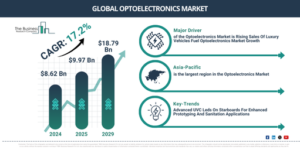
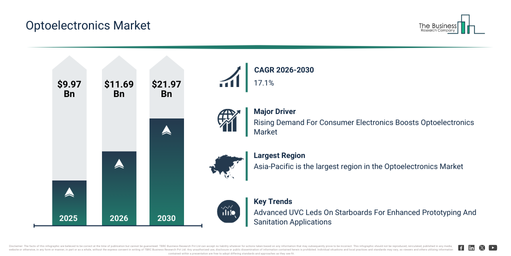
The optoelectronics market has experienced significant expansion in recent years. Its valuation is projected to increase from $9.97 billion in 2025 to $11.69 billion in 2026, exhibiting a compound annual growth rate (CAGR) of 17.2%. Historically, this growth was primarily fueled by factors including its initial application in medical equipment, integration into telecommunication systems, reliance on conventional light sources, early adoption within consumer electronics, and its incorporation with optical communication technologies.
The optoelectronics market is projected to experience substantial growth in the upcoming years. By 2030, this market is anticipated to reach a valuation of $21.97 billion, demonstrating a compound annual growth rate (CAGR) of 17.1%. This expansion during the projection period stems from factors such as the rising utilization in autonomous vehicles, the creation of highly efficient LEDs, wider application in industrial automation, integration with IoT-powered monitoring systems, and progress in high-speed optoelectronic components. Key trends anticipated during this forecast include the incorporation of high-power LEDs and laser diodes, improvements in image sensor technology, the evolution of photovoltaic and optocoupler parts, the increasing use of gallium-based materials, and the broadening application of optoelectronic devices across healthcare and telecommunications sectors.
Get A Free Sample Report With In-Depth Market Insights:
Optoelectronics Market Expansion Drivers: What’s Shaping Future Growth?
The optoelectronics market is projected to expand due to the rising demand for consumer electronics. Consumer electronics are defined as electronic devices and gadgets intended for personal individual use across various daily activities such as entertainment, communication, and productivity. Key optoelectronic components, including organic light-emitting diodes (OLEDs) and liquid crystal displays (LCDs), are vital for creating vibrant and high-resolution screens in electronic devices like smartphones, televisions, laptops, and tablets. For example, data from May 2023, compiled by the Japan Electronics and Information Technology Industries Association, a Japan-based trade body, showed total electronic equipment production in Japan amounted to $6,722 million (¥771,457 million). Additionally, consumer electronics production reached $280 million (¥32,099 million) in May 2023, a notable increase from $230.9 million (¥25,268 million) in May 2022. Consequently, the growing demand for consumer electronics will fuel the growth of the optoelectronics market.
Optoelectronics Market Segment Performance And Emerging Opportunities
The optoelectronics market covered in this report is segmented –
1) By Component: Light-Emitting Diode (LED), Laser Diode, Image Sensors, Optocouplers, Photovoltaic Cells, Other Components
2) By Device Material: Gallium Nitride, Gallium Arsenide, Gallium Phosphide, Silicon Germanium, Silicon Carbide, Indium Phosphide
3) By End-User: Automotive, Aerospace And Defense, Consumer Electronics, Information Technology, Healthcare, Residential And Commercial, Industrial, Other End Users
Subsegments:
1) By Light-Emitting Diode (LED): Standard LEDs, High-Power LEDs, Organic LEDs (OLEDs), Miniature and Micro LEDs
2) By Laser Diode: Infrared Laser Diodes, Red Laser Diodes, Blue Laser Diodes, Ultraviolet Laser Diodes
3) By Image Sensors: Charge-Coupled Device (CCD) Sensors, Complementary Metal-Oxide-Semiconductor (CMOS) Sensors, Hybrid Sensors
4) By Optocouplers: Phototransistor Optocouplers, Photodiode Optocouplers, High-Speed Optocouplers
5) By Photovoltaic Cells: Monocrystalline Silicon Cells, Polycrystalline Silicon Cells, Thin-Film Solar Cells, Bifacial Solar Cells
6) By Other Components: Fiber Optic Components, Optical Interconnects, Light Sensors, Photodetectors
Optoelectronics Market Strategic Trends: What Defines The Next Growth Phase?
Leading companies in the optoelectronics market are prioritizing the development of innovative solutions, such as UVC LEDs integrated onto starboards, to bolster rapid prototyping capabilities for sensors and instruments, while simultaneously addressing various application requirements in sanitation and water quality monitoring. UVC LEDs mounted on starboards specifically describe ultraviolet C light-emitting diodes that are firmly affixed to a starboard, which functions as a circuit board or substrate engineered to enable easy integration and testing across diverse applications. As an illustration, in May 2024, Marktech Optoelectronics, a US-based manufacturing firm, introduced advanced 235 nm and 255 nm UVC LEDs mounted on starboards, crafted to simplify rapid prototyping for sensors, instruments, and sanitizers. These LEDs feature a dual-chip configuration for enhanced power output, are encased in a robust ATLAS hermetic SMD package, and offer various lens options to meet different application needs. Being suitable for a wide array of uses, including water quality sensors and surface sanitizing robots, these UVC LEDs empower engineers to promptly evaluate performance without the intricacies associated with PCB design.
Optoelectronics Market Key Players: Which Companies Lead Industry Competition?
Major companies operating in the optoelectronics market are General Electric Company, Accelink Technologies Co. Ltd., Avago Technologies Limited, BetaLED Inc., Broadcom Inc., Broadex Technologies Co. Ltd., Browave Co. Ltd., Cree Inc., Finisar Corporation, Fujitsu Limited, Hamamatsu Photonics K.K., Micropac Industries Inc., NeoPhotonics Corporation., Omnivision Technologies Inc., ON Semiconductor Corporation, Oplink Communications LLC, OSRAM Licht AG, Panasonic Corporation, Koninklijke Philips N.V., Renesas Electronics Corporation, ROHM Co. Ltd., Samsung Electronics Co. Ltd., Sharp Corporation, Sony Corporation, Texas Instruments Incorporated, Toshiba Corporation, TT Electronics plc, Vishay Intertechnology Inc., Aixtron SE, ASML Holding N.V., Canon Inc., Coherent Inc., EMCORE Corporation
View The Full Optoelectronics Market Report:
Optoelectronics Market Regional Breakdown: Where Is Demand Concentrated?
Asia-Pacific was the largest region in the optoelectronics market in 2025. North America is expected to be the fastest-growing region in the forecast period. The regions covered in the optoelectronics market report are Asia-Pacific, South East Asia, Western Europe, Eastern Europe, North America, South America, Middle East, Africa.
Reach Out To Our Team:
The Business Research Company: https://www.thebusinessresearchcompany.com/
Americas: +1 310-496-7795
Asia: +44 7882 955267 & +91 8897263534
Europe: +44 7882 955267
Email us at: marketing@tbrc.info
Follow us on:
LinkedIn: https://in.linkedin.com/company/the-business-research-company
YouTube: https://www.youtube.com/channel/UC24_fI0rV8cR5DxlCpgmyFQ
Global Market Model: https://www.thebusinessresearchcompany.com/global-market-model

Wasay has over a decade of experience in market research, data modelling, and analytics, with prior experience at GlobalData and Decision Tree Consulting Services. At The Business Research Company , he leads research operations across syndicated studies, customized consulting engagements, and the Global Market Model platform. His professional experience includes supporting organizations such as Boston Consulting Group, KPMG, and Ernst & Young. Wasay holds a degree in Electronics and Communications Engineering, postgraduate management qualifications from International Management Institute Belgium and Indian School of Business and Entrepreneurship, and completed the Integrated Program in Business Analytics from Indian Institute of Management Indore.