Backed by market attractiveness analysis, total addressable market sizing, company benchmarking matrices, interactive Excel dashboards, wider supply chain intelligence, emerging startup coverage, and detailed product-level insights, The Business Research Company’s 2026 market reports are designed to offer research that is more actionable and strategically valuable than ever.
Single-Mode Fiber Cable Market Size Forecast: How Big Could The Market Get By 2030?
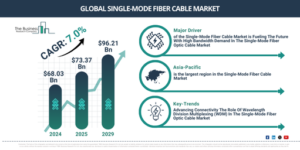
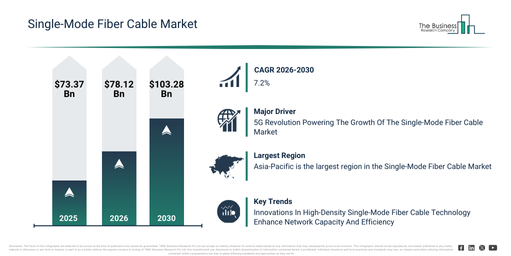
In recent times, the single-mode fiber cable market has observed considerable growth in its overall size. The market is anticipated to expand from $73.37 billion in 2025 to $78.12 billion by 2026, exhibiting a compound annual growth rate (CAGR) of 6.5%. This historical expansion can be ascribed to a heightened demand for broadband connectivity, the flourishing of telecommunication infrastructure, the proliferation of data centers, the integration of enterprise networking solutions, and the evolution of nascent single-mode fiber technologies.
The single-mode fiber cable market is projected to experience substantial expansion over the upcoming years. This market is anticipated to reach a value of $103.28 billion by 2030, demonstrating a compound annual growth rate (CAGR) of 7.2%. Factors contributing to this growth during the forecast period include the rising demand for ftth networks, the expansion of cloud computing and data services, the proliferation of 5g and 6g networks, increased industrial automation, and the implementation of smart city and iot projects. Key trends for the forecast period encompass high-speed long-distance data transmission, the expansion of fiber-to-the-home (ftth), optimization of enterprise networking, the emergence of low signal degradation technologies, and the deployment of high-capacity networks.
Get A Free Sample Report With In-Depth Market Insights:
Single-Mode Fiber Cable Market Growth Backed By Core Demand Fundamentals
The expanding integration of 5G technology is anticipated to drive the single-mode fiber cable market’s expansion in the foreseeable future. As the fifth generation of cellular network technology, 5G offers enhanced download and upload speeds, reduced latency, and greater capacity. Its increasing popularity stems from its ability to deliver ultra-fast speeds and low latency, enabling smooth streaming, gaming, and real-time applications to satisfy escalating connectivity requirements. Single-mode fiber cable serves as a vital element within 5G infrastructure, delivering the high-speed, low-latency, and reliable connectivity vital for this next generation of wireless technology. For instance, in May 2025, according to Ericsson, a Sweden-based telecommunications company, 5G mobile subscriptions are projected to grow from 1.62 billion in 2023 to 6.29 billion by 2030. Consequently, the rising adoption of 5G technology is propelling the single-mode fiber cable market.
Single-Mode Fiber Cable Market Segment Performance And Emerging Opportunities
The single-mode fiber cable market covered in this report is segmented –
1) By Cable Type: Quartz Optical Fiber Cables, Multicomponent Glass Fiber Cables, Plastic Optical Fiber Cables, Other Cable Types
2) By Type: G.652, G.653, G.654, G.655, G.656, G.657
3) By Application: Telecommunication And Networking, Data Centers, Community Antenna Television, Factory Automation And Industrial Networking, Military, Other Applications
Subsegments:
1) By Quartz Optical Fiber Cables: Standard Quartz Single-mode Cables, Low-attenuation Quartz Cables
2) By Multicomponent Glass Fiber Cables: Specialty Glass Single-mode Cables, High-durability Glass Fiber Cables
3) By Plastic Optical Fiber Cables: Step-index Plastic Single-mode Cables, Graded-index Plastic Single-mode Cables
4) By Other Cable Types: Hollow-core Single-mode Fibers, Photonic Crystal Single-mode Fibers, Advanced Specialty Single-mode Fibers
Single-Mode Fiber Cable Market Growth Trends Reshaping The Competitive Landscape
Prominent companies in the single-mode fiber cable market are prioritizing the development of sophisticated solutions, such as high-density unitube optical fiber cables, aiming to boost network capacity, efficiency, and scalability. High-density unitube optical fiber cables utilize multi-core fiber technology to transmit multiple signals concurrently within a single fiber, thereby enhancing bandwidth utilization and decreasing the necessity for supplementary cabling infrastructure. For example, in September 2025, STL, an India-based telecommunications firm, presented its high-density unitube indoor optical fiber cable, incorporating multi-core fiber (MCF), at Connected Britain 2025. Tailored for next-generation networks, this cable integrates multiple cores within a single tube to elevate fiber density, enables accelerated data transmission and greater bandwidth, provides a compact and space-saving design for indoor use, and guarantees superior reliability and simplified installation in challenging network environments, thereby enabling STL to address the increasing need for high-capacity, scalable, and economical fiber optic solutions in urban and enterprise networks.
Single-Mode Fiber Cable Market Key Players: Which Companies Lead Industry Competition?
Major companies operating in the single-mode fiber cable market are Corning Incorporated, Fujikura Ltd., Sumitomo Electric Industries Ltd., Furukawa Electric Co. Ltd., Pirelli & C. S.p.A., Nexans S.A., Hengtong Cable Group, Futong Group, Tongding Group, CommScope Inc., LS Cable & System Ltd., FiberHome Technologies Group, Prysmian Group, Yangtze Optical Fiber and Cable Co. Ltd., Amphenol Corporation, Molex LLC, OFS Furukawa LLC, Belden Inc., Aptiv PLC, YOFC (Yangtze Optical Fiber and Cable Joint Stock Limited Company), HTGD (Hengtong Group Dalian Hengtong Optical Cable Co. Ltd.), Radiall, Shenzhen Tefa Touchplus Information Corp., Fasten Fiber Optics Co. Ltd. (FPC), Alcatel-Lucent (Nokia), Lynn Electronics Corporation, TE Connectivity Ltd., 3M Company, Sterlite Technologies Ltd., Huber + Suhner AG, OFS Fitel LLC, AFL, Accelink Technologies Co. Ltd., Finisar Corporation, ZTT Group, General Cable Corporation, Jiangsu Fasten Advanced Materials Co. Ltd., The Siemon Company, ShanghAI Tarluz Telecom Tech. Co. Ltd., OptiTek Technology Co. Ltd., Fiber Instrument Sales Inc., Telenco Distribution, UNITEK Fiber Optic Systems Inc.
View The Full Single-Mode Fiber Cable Market Report:
Single-Mode Fiber Cable Market Geographic Landscape: Which Region Leads Industry Growth?
Asia-Pacific was the largest region in the single-mode fiber optic cable market in 2025. North America was the second-largest region in the single-mode fiber optic cable market analysis. The regions covered in the single-mode fiber cable market report are Asia-Pacific, South East Asia, Western Europe, Eastern Europe, North America, South America, Middle East, Africa.
Reach Out To Our Team:
The Business Research Company: https://www.thebusinessresearchcompany.com/
Americas: +1 310-496-7795
Asia: +44 7882 955267 & +91 8897263534
Europe: +44 7882 955267
Email us at: marketing@tbrc.info
Follow us on:
LinkedIn: https://in.linkedin.com/company/the-business-research-company
YouTube: https://www.youtube.com/channel/UC24_fI0rV8cR5DxlCpgmyFQ
Global Market Model: https://www.thebusinessresearchcompany.com/global-market-model

Wasay has over a decade of experience in market research, data modelling, and analytics, with prior experience at GlobalData and Decision Tree Consulting Services. At The Business Research Company , he leads research operations across syndicated studies, customized consulting engagements, and the Global Market Model platform. His professional experience includes supporting organizations such as Boston Consulting Group, KPMG, and Ernst & Young. Wasay holds a degree in Electronics and Communications Engineering, postgraduate management qualifications from International Management Institute Belgium and Indian School of Business and Entrepreneurship, and completed the Integrated Program in Business Analytics from Indian Institute of Management Indore.