
Through market attractiveness analysis, total addressable market evaluation, company benchmarking matrices, interactive Excel dashboards, expanded supply chain intelligence, emerging startup coverage, and detailed product insights, The Business Research Company’s 2026 market reports provide more actionable and strategically valuable research.
Artificial Intelligence (AI) In Defense Logistics Market Value Expansion And Long-Term Growth Outlook
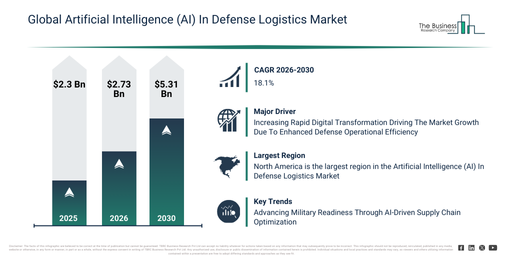
The artificial intelligence (AI) in defense logistics market has experienced rapid growth in recent years. This market is projected to expand from $2.3 billion in 2025 to $2.73 billion in 2026, demonstrating a compound annual growth rate (CAGR) of 18.4%. The historical development in this sector can be attributed to several factors, including the adoption of automated inventory management, the implementation of predictive maintenance, the integration of AI in route planning, the growing complexity of defense supply chains, and the use of autonomous vehicles for logistics operations.
The artificial intelligence (AI) in defense logistics market is projected to experience rapid expansion over the next few years. It is expected to grow to $5.31 billion by 2030, exhibiting a compound annual growth rate (CAGR) of 18.1%. The forecasted growth can be attributed to several factors, including the broadening of AI-driven warehouse automation, the development of real-time asset tracking systems, integration with AI-enabled procurement platforms, the adoption of blockchain for secure logistics, and an increase in the utilization of robotic logistics systems in combat zones. Major trends during this period involve rising requirements for joint and coalition interoperability within AI-enabled defense logistics platforms, a transition towards performance-based and outcome-based logistics contracts across military supply chains, an intensifying focus on supply chain resilience and redundancy for mission-critical defense operations, the expansion of public-private partnerships among defense organizations, prime contractors, and AI-focused SMEs for logistics modernization, and increased investment in specialized training, doctrine, and change management to facilitate AI-enabled logistics decision-making.
Download A Free Sample Report For Comprehensive Market Insights:
Artificial Intelligence (AI) In Defense Logistics Market Growth Factors Supporting Long-Term Expansion
Rapid digital transformation is projected to fuel the expansion of artificial intelligence (AI) within the defense logistics market in the foreseeable future. This transformation involves embedding digital technologies across all business functions, fundamentally reshaping operational methods and value delivery for organizations. Its increasing embrace is largely motivated by the demand for greater operational efficiency in today’s interconnected global landscape, where organizations aim to optimize processes, decrease expenditures, and sustain competitiveness via sophisticated technological solutions. In defense logistics, AI-driven systems facilitate optimized supply chain management, accurate prediction of equipment maintenance, and enhanced resource distribution through immediate data analytics and automated choices. As an illustration, in November 2023, the Central Digital and Data Office, a UK government body overseeing digital transformation within UK government departments, reported that the Government Digital and Data profession’s total size expanded by 19% between April 2022 and April 2023. Consequently, swift digital transformation is stimulating the development of artificial intelligence (AI) in the defense logistics market.
Artificial Intelligence (AI) In Defense Logistics Market Segment Analysis Highlighting Growth Areas
The artificial intelligence (AI) in defense logistics market covered in this report is segmented –
1) By Component: Software, Hardware, Services
2) By Deployment Mode: On-Premises, Cloud
3) By Application: Inventory Management, Fleet Management, Supply Chain Optimization, Transportation Management, Maintenance And Repair, Other Applications
4) By End-User: Army, Navy, Air Force, Other End-Users
Subsegments:
1) By Software: Enterprise Resource Planning (ERP) Software, Warehouse Management System (WMS) Software, Transportation Management System (TMS) Software, Predictive Analytics Software, Fleet Management Software
2) By Hardware: Autonomous Vehicles, Sensor Networks, Robotics Systems, Artificial Intelligence (AI)-Enabled Drones, Data Processing Hardware
3) By Services: System Integration Services, Maintenance And Support Services, Training And Consulting Services, Deployment And Implementation Services, Cybersecurity Services
#Artificial Intelligence (AI) In Defense Logistics Market Growth Trends: What Is Influencing The Future Outlook?
Major companies engaged in the artificial intelligence (AI) in the defense logistics market are prioritizing the development of advanced solutions, such as AI-based supply chain management, to ensure the timely delivery of crucial military supplies. AI-based supply chain management harnesses artificial intelligence to detect, evaluate, and mitigate potential disruptions within military supply chains, while simultaneously guaranteeing continuous and efficient operations. It also enables proactive decision-making by forecasting risks and optimizing logistics in real time. For instance, in March 2025, the Defense Logistics Agency (DLA), a US-based Department of Defense logistics combat support agency, created an AI tool to monitor supply chain risk. This was part of its strategic transition to predictive supply chain operations, with aims to identify unreliable suppliers, predict bottlenecks, and enhance procurement. This AI-driven system utilizes multiple risk assessment models to pinpoint counterfeit, non-conforming, or overpriced items, assisting in the prosecution of vendors who jeopardize the supply chain and ensuring mission readiness.
Artificial Intelligence (AI) In Defense Logistics Market Leading Companies: Who Holds Significant Market Presence?
Major companies operating in the artificial intelligence (AI) in defense logistics market are Microsoft Corporation, The Boeing Company, RTX Corporation, Lockheed Martin Corporation, International Business Machines Corporation (IBM), Northrop Grumman Corporation, SAP SE, BAE Systems plc, Safran S.A., Thales Group, L3Harris Technologies Inc., Leidos Holdings Inc., Booz Allen Hamilton Holding Corporation, Rheinmetall AG, Rafael Advanced Defense Systems Ltd., Palantir Technologies Inc., Anduril Industries Inc., Shield AI Inc., Helsing GmbH, Charles River Analytics Inc., DEFCON AI Inc.
Access The Complete Artificial Intelligence (AI) In Defense Logistics Market Report:
Artificial Intelligence (AI) In Defense Logistics Market Regional Analysis: Which Region Leads By Revenue?
North America was the largest region in the artificial intelligence (AI) in the defense logistics market in 2025. Asia-Pacific is expected to be the fastest-growing region in the forecast period. The regions covered in the artificial intelligence (AI) in defense logistics market report are Asia-Pacific, South East Asia, Western Europe, Eastern Europe, North America, South America, Middle East, Africa.
Access a Customized Artificial Intelligence (AI) In Defense Logistics Market Report for Deeper Competitive Insights
https://www.thebusinessresearchcompany.com/customise?id=28909&type=smp
Get in touch with us:
The Business Research Company: https://www.thebusinessresearchcompany.com/
Americas: +1 310-496-7795
Asia: +44 7882 955267 & +91 8897263534
Europe: +44 7882 955267
Email us at: marketing@tbrc.info
Follow us on:
LinkedIn: https://in.linkedin.com/company/the-business-research-company
YouTube: https://www.youtube.com/channel/UC24_fI0rV8cR5DxlCpgmyFQ
Global Market Model: https://www.thebusinessresearchcompany.com/global-market-model

Wasay has over a decade of experience in market research, data modelling, and analytics, with prior experience at GlobalData and Decision Tree Consulting Services. At The Business Research Company , he leads research operations across syndicated studies, customized consulting engagements, and the Global Market Model platform. His professional experience includes supporting organizations such as Boston Consulting Group, KPMG, and Ernst & Young. Wasay holds a degree in Electronics and Communications Engineering, postgraduate management qualifications from International Management Institute Belgium and Indian School of Business and Entrepreneurship, and completed the Integrated Program in Business Analytics from Indian Institute of Management Indore.
