
Featuring market attractiveness scoring, total addressable market sizing, company benchmarking matrices, interactive Excel dashboards, deeper supply chain intelligence, emerging startup tracking, and granular product-level insights, The Business Research Company’s 2026 market reports are built to deliver research that is both more actionable and more strategically valuable.
Smart EV Charger Market Expansion Outlook: What Revenue Opportunities Are Ahead?
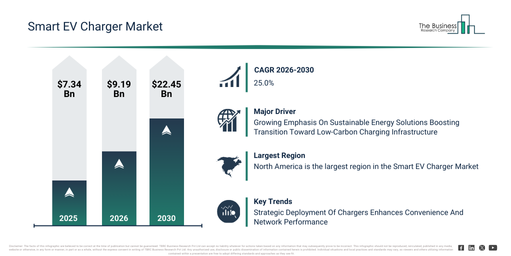
The smart EV charger market has experienced rapid growth in recent years. Its value is projected to increase from $7.34 billion in 2025 to $9.19 billion in 2026, demonstrating a compound annual growth rate (CAGR) of 25.2%. Historically, this expansion was driven by factors such as the early deployment of AC chargers with basic connectivity, an increase in commercial EV charging stations, the adoption of fast charging in urban areas, the initial integration of app-based controls, and the development of low-power wireless charging prototypes.
The smart EV charger market is anticipated to undergo significant expansion in the upcoming years, with projections indicating it will attain a size of $22.45 billion by 2030, growing at a compound annual growth rate (CAGR) of 25.0%. This growth throughout the forecast period can be attributed to factors such as the increasing installation of high-power DC chargers, rising government incentives for smart EV infrastructure, improved integration with renewable energy sources, the expansion of wireless and dynamic charging networks, and the growing adoption of connected fleet and shared mobility solutions. Key trends expected in this period encompass the integration of real-time energy monitoring and dynamic load balancing, the adoption of mobile app-based remote control for EV charging, the deployment of medium and high-power smart chargers in commercial spaces, the broadening of wireless and inductive charging technologies, and the implementation of demand response and grid-friendly charging strategies.
Get A Free Sample Report With In-Depth Market Insights:
Smart EV Charger Market Expansion Drivers: What’s Shaping Future Growth?
The increasing focus on sustainable energy solutions is anticipated to boost the expansion of the smart EV charger market. Sustainable energy solutions denote the adoption of clean, renewable, and low-emission energy systems designed to minimize environmental impact and lessen long-term dependence on fossil fuels. The heightened emphasis on sustainable energy is driven by accelerating global decarbonization goals and government-led renewable transition initiatives, which aim to reduce greenhouse gas emissions. Smart EV chargers support this trend by enabling intelligent energy distribution, optimized charging, renewable energy integration, and effective grid load management, thus helping align EV charging with wider sustainability objectives. For instance, in June 2024, according to the U.S. Energy Information Administration (EIA), a U.S.-based federal government statistical agency, renewable electricity constituted 22% of total U.S. generation in 2023, an increase from 21% in 2022, reflecting a steady rise in clean energy adoption. Consequently, the growing emphasis on sustainable energy solutions is propelling the growth of the smart EV charger market.
Smart EV Charger Market Segment Landscape: Which Areas Lead Development?
The smart ev charger market covered in this report is segmented –
1) By Type, Alternating Current Chargers, Direct Current Chargers, Wireless Chargers
2) By Connectivity, Wi-Fi Enabled, Bluetooth Enabled, Other Connectivity Features
3) By Charging Power, Low Power, Medium Power, High Power
4) By End-User, Commercial Charging Station, Passenger Charging Unit
Subsegments:
1) By Alternating Current Chargers: Slow Charging, Fast Charging, Rapid Charging
2) By Direct Current Chargers: Fast Charging, Ultra Fast Charging, High Power Charging
3) By Wireless Chargers: Inductive Charging, Resonant Charging, Dynamic Charging
Smart EV Charger Market Strategic Trends: What Defines The Next Growth Phase?
Leading firms within the smart EV charger market are prioritizing technological advancements, notably data-driven optimization, with the aim of boosting charging efficiency, elevating user satisfaction, forecasting demand trends, and guaranteeing consistent network performance across various sites. This data-driven optimization in EV charging involves utilizing both current and past data to project energy requirements, fine-tune charging timetables, and improve the entire system’s functionality. As an illustration, in August 2025, the U.S.-based automaker Ford Motor Company introduced its Ford Charge DC Fast Charging Network, initially deploying approximately 1,200 fast chargers at over 320 Ford dealerships throughout the United States and Canada. Every charger incorporates intelligent features like activation via applications, digital payment methods, and continuous performance tracking, all designed to enhance operational effectiveness and ease of use for customers. This endeavor not only broadens Ford’s charging infrastructure but also illustrates the application of data-driven technologies in streamlining charging processes, encouraging electric vehicle adoption, and addressing the increasing need for sustainable transportation.
Smart EV Charger Market Industry Leaders And Competitive Landscape
Major companies operating in the smart ev charger market are Tesla, Inc., ABB Ltd., Siemens AG, Schneider Electric SE, Robert Bosch GmbH, Delta Electronics, Inc., Eaton Corporation plc, Huawei Technologies Co., Ltd., Wallbox N.V., EVBox Group N.V., ChargePoint Holdings, Inc., KEBA AG, Alfen N.V., myenergi Ltd., EO Charging Ltd., AddÉnergie Technologies, Blink Charging Co., Tritium DCFC Ltd., Heliox Energy, Webasto Group, Delta-Q Technologies Corp., BYD Company Ltd., WanBang Digital Energy, Sinexcel, Phihong Technology Co., Ltd.
View The Full Smart EV Charger Market Report:
Smart EV Charger Market Regional Analysis: Which Geography Leads On Revenue?
North America was the largest region in the smart EV charger market in 2025. Asia-Pacific is expected to be the fastest-growing region in the forecast period. The regions covered in the smart ev charger market report are Asia-Pacific, South East Asia, Western Europe, Eastern Europe, North America, South America, Middle East, Africa.
Reach Out To Our Team:
The Business Research Company: https://www.thebusinessresearchcompany.com/
Americas: +1 310-496-7795
Asia: +44 7882 955267 & +91 8897263534
Europe: +44 7882 955267
Email us at: marketing@tbrc.info
Follow us on:
LinkedIn: https://in.linkedin.com/company/the-business-research-company
YouTube: https://www.youtube.com/channel/UC24_fI0rV8cR5DxlCpgmyFQ
Global Market Model: https://www.thebusinessresearchcompany.com/global-market-model

Wasay has over a decade of experience in market research, data modelling, and analytics, with prior experience at GlobalData and Decision Tree Consulting Services. At The Business Research Company , he leads research operations across syndicated studies, customized consulting engagements, and the Global Market Model platform. His professional experience includes supporting organizations such as Boston Consulting Group, KPMG, and Ernst & Young. Wasay holds a degree in Electronics and Communications Engineering, postgraduate management qualifications from International Management Institute Belgium and Indian School of Business and Entrepreneurship, and completed the Integrated Program in Business Analytics from Indian Institute of Management Indore.