Built to provide research that’s more actionable and strategically valuable, The Business Research Company’s 2026 market reports include market attractiveness analysis, total addressable market sizing, company benchmarking matrices, interactive Excel dashboards, broader supply chain intelligence, emerging startup tracking, and in-depth product insights.
Modular Instruments Market Forecast: What Value Will The Market Reach By 2030?
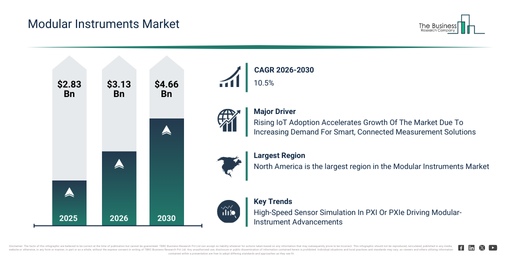
The modular instruments market has experienced substantial expansion in recent years. Its size is anticipated to rise from $2.83 billion in 2025 to $3.13 billion in 2026, exhibiting a compound annual growth rate (CAGR) of 10.8%. This historical growth can be linked to a burgeoning demand for flexible test systems, the increasing integration of automated testing, an uptick in electronics and semiconductor manufacturing, innovations in PXI and VXI platforms, and the ongoing requirement for high-precision measurements.
The modular instruments market size is expected to see rapid growth in the next few years. It will grow to $4.66 billion in 2030 at a compound annual growth rate (CAGR) of 10.5%. The growth in the forecast period can be attributed to expansion of aerospace and defense testing, growth in 5g and telecommunications infrastructure testing, increasing adoption of automotive electronics testing, development of real-time and high-bandwidth measurement solutions, rising demand for integrated and software-controlled modular instruments. Major trends in the forecast period include modular and scalable test system design, high-speed signal measurement and generation, automated and remote test capabilities, multi-functional plug-in modules, compact and space-efficient instrumentation.
Get A Free Sample Report With In-Depth Market Insights:
Modular Instruments Market Demand Drivers Opening New Revenue Streams
The growing uptake of the Internet of Things (IoT) is anticipated to fuel the expansion of the modular instruments market moving ahead. IoT describes a connected system of physical objects equipped with electronics, software, and networking capabilities, enabling them to gather, share, and process data via the internet. Demand for IoT is increasing because it boosts efficiency and ease of use through automation and immediate data processing, leading to more informed choices, less manual work, and improved productivity across sectors like healthcare, transportation, agriculture, and smart homes. Within IoT contexts, modular instruments facilitate adaptable data acquisition and oversight, permitting straightforward integration, personalization, and scaling of sensors and measurement components for various uses. As an example, in September 2024, data from IoT Analytics GmbH, a non-governmental organization based in Germany, indicated that by the close of 2023, there were 16.6 billion connected IoT devices, marking a 15% rise from 2022. Furthermore, projections suggest that the count of connected IoT devices will reach 40 billion by 2030. Consequently, the expanding deployment of the Internet of Things (IoT) is fueling the advancement of the modular instruments market.
Modular Instruments Market Breakdown By Product Type And Application
The modular instruments market covered in this report is segmented –
1) By Product Type: Oscilloscopes, Signal Generators, Spectrum Analyzers, Network Analyzers, Other Product Types
2) By Platform Type: PCI eXtensions For Instrumentation (PXI) Platform, VME eXtensions For Instrumentation (VXI) Platform, AdvancedTCA Extensions For Instrumentation And Test (AXIe) Platform
3) By Application: Telecommunications, Aerospace And Defense, Automotive, Electronics And Semiconductor, Other Applications
4) By End-User: Research And Development, Manufacturing, Other End-Users
Subsegments:
1) By Oscilloscopes: Digital Storage Oscilloscopes, Mixed Signal Oscilloscopes, Sampling Oscilloscopes, Real Time Oscilloscopes, High Bandwidth Oscilloscopes
2) By Signal Generators: Arbitrary Waveform Generators, Function Generators, Radio Frequency Signal Generators, Microwave Signal Generators, Vector Signal Generators, Pulse Pattern Generators
3) By Spectrum Analyzers: Swept Spectrum Analyzers, Real Time Spectrum Analyzers, Radio Frequency Spectrum Analyzers, Microwave Spectrum Analyzers
4) By Network Analyzers: Vector Network Analyzers, Scalar Network Analyzers, Two Port Network Analyzers, Multiport Network Analyzers, Radio Frequency Network Analyzers, Microwave Network Analyzers
5) By Other Product Types: Digitizers And Data Acquisition Modules, Digital Multimeters, Source Measure Units, Programmable Power Supplies, Switching And Signal Conditioning Modules, Timing And Synchronization Modules
Modular Instruments Market Trends Powering Strategic Industry Growth
Leading companies in the modular instruments market are emphasizing technological advancements, such as high-speed PXI/PXIe resolver-simulation modules, to enhance fidelity and throughput in automated verification and hardware-in-the-loop testing. These high-speed resolver-simulation modules are plug-in PXI or PXIe boards engineered to emulate rotary position sensors (resolvers/LVDTs/RVDTs) at very high rotational or electrical speeds, offering multi-channel capability and fault insertion, which provides realistic analog signals for servo-drive and motion-control testing. For instance, in April 2025, Pickering Interfaces, a UK-based company specializing in designing and manufacturing modular signal switching and simulation products, introduced its 41-670 (PXI) and 43-670 (PXIe) high-speed resolver simulation modules. These products offer several advantages, including resolver simulation capabilities of up to 130,000 revolutions per minute, support for multiple bank and channel configurations, and transformer-based analog outputs that deliver precise, real-world signal emulation. Additionally, the modules include integrated relays for creating short or open circuits for fault insertion, thereby enabling high-fidelity hardware-in-the-loop (HIL) and embedded software testing, reducing reliance on external switching, and providing high channel density within a compact modular chassis based on the peripheral component interconnect (PCI) extensions for instrumentation (PXI) and its express variant (PXIe). Collectively, these innovations aim to accelerate the development and validation of advanced servo systems across automotive, aerospace, and defense applications.
Modular Instruments Market Company Landscape And Competitive Strategy
Major companies operating in the modular instruments market are Keysight Technologies Inc., National Instruments Corporation, Rohde & Schwarz GmbH & Co. KG, Fortive Corporation, Advantest Corporation, Anritsu Corporation, Yokogawa Electric Corporation, Viavi Solutions Inc., Pickering Interfaces Ltd., Astronics Corporation, ADLINK Technology Inc., Spectrum Instrumentation GmbH, Gantner Instruments GmbH, Dewesoft, AMETEK Inc., Teradyne Inc., Marvin Test Solutions Inc., Kinetic Systems Inc., Bustec Production Ltd., Chroma ATE Inc., Virginia Panel Corporation, Curtiss-Wright Corporation, Interface Concept SA, Elma Electronic AG, Konrad Technologies GmbH, Aeroflex Inc., Cincoze Co. Ltd.
View The Full Modular Instruments Market Report:
Modular Instruments Market Geographic Landscape: Which Region Leads Industry Growth?
North America was the largest region in the modular instruments market in 2025. The regions covered in the modular instruments market report are Asia-Pacific, South East Asia, Western Europe, Eastern Europe, North America, South America, Middle East, Africa.
Reach Out To Our Team:
The Business Research Company: https://www.thebusinessresearchcompany.com/
Americas: +1 310-496-7795
Asia: +44 7882 955267 & +91 8897263534
Europe: +44 7882 955267
Email us at: marketing@tbrc.info
Follow us on:
LinkedIn: https://in.linkedin.com/company/the-business-research-company
YouTube: https://www.youtube.com/channel/UC24_fI0rV8cR5DxlCpgmyFQ
Global Market Model: https://www.thebusinessresearchcompany.com/global-market-model

Wasay has over a decade of experience in market research, data modelling, and analytics, with prior experience at GlobalData and Decision Tree Consulting Services. At The Business Research Company , he leads research operations across syndicated studies, customized consulting engagements, and the Global Market Model platform. His professional experience includes supporting organizations such as Boston Consulting Group, KPMG, and Ernst & Young. Wasay holds a degree in Electronics and Communications Engineering, postgraduate management qualifications from International Management Institute Belgium and Indian School of Business and Entrepreneurship, and completed the Integrated Program in Business Analytics from Indian Institute of Management Indore.