Delivering more actionable and strategically valuable research, The Business Research Company’s 2026 market reports feature market attractiveness analysis, total addressable market evaluation, company benchmarking matrices, interactive Excel dashboards, expanded supply chain intelligence, emerging startup coverage, and detailed product insights.
Autonomous Cargo Aircraft Market Size Outlook: How Fast Will Revenue Grow Through 2030?
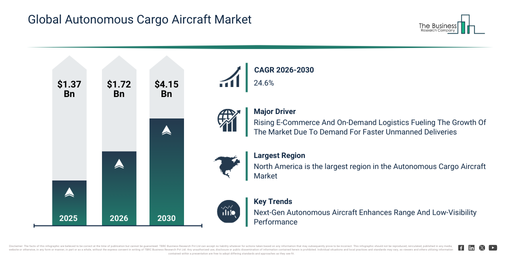
The autonomous cargo aircraft market size has seen substantial growth in recent years. It is expected to expand from $1.37 billion in 2025 to $1.72 billion in 2026, registering a compound annual growth rate (CAGR) of 25.5%. Historically, this expansion is attributable to the development of early unmanned cargo drones for logistics testing, the adoption of autonomous navigation and sensor technologies for flight control, the deployment of urban air mobility (UAM) cargo vehicles for trial operations, the integration of ground control stations (GCS) for remote monitoring, and the increasing utilization of payload modules and detachable cargo pods for flexible transport.
The autonomous cargo aircraft market size is projected to undergo significant expansion in the upcoming years, with an anticipated growth to $4.15 billion in 2030 at a compound annual growth rate (CAGR) of 24.6%. This growth during the forecast period is primarily driven by an increasing need for autonomous cargo aircraft in last-mile delivery and cold chain logistics, the broadening use of UAVs for disaster relief and humanitarian aid delivery services, the adoption of AI-driven route optimization and autonomous flight management, a rising procurement of modular and scalable payload systems, and a concentrated effort on developing regulatory-compliant, long-range, and heavy-lift autonomous cargo platforms. Major trends expected in this period include the expansion of autonomous long-distance cargo delivery routes, a growing acceptance of unmanned aircraft for disaster relief logistics, an increasing demand for detachable cargo pods and modular payload systems, heightened interest in hybrid fixed-wing–VTOL cargo platforms, and the emergence of autonomous freight corridors in remote regions.
Download A Free Sample Report For Comprehensive Market Insights:
#Autonomous Cargo Aircraft Market Demand Drivers Creating New Revenue Opportunities
The growth of the autonomous cargo aircraft market is projected to be propelled by the surge in e-commerce and on-demand logistics moving forward. E-commerce and on-demand logistics denote the digital exchange of goods coupled with swift, adaptable delivery services that cater to customer orders either instantly or within brief timeframes. The expansion of e-commerce and on-demand logistics is fueled by evolving consumer demands for quicker and more convenient delivery experiences. Autonomous cargo aircraft augment e-commerce and on-demand logistics by enabling expedited, unpiloted deliveries across significant distances. They enhance supply chain performance through decreased transit durations and reduced operational expenditures, thus supporting punctual and versatile order fulfillment. For example, in February 2025, the United States Census Bureau, a US-based government agency, indicated that total e-commerce sales in 2024 reached $1,192.6 billion, signifying an 8.1% increase compared to 2023. Therefore, the increasing e-commerce and on-demand logistics are driving the autonomous cargo aircraft market’s expansion.
Autonomous Cargo Aircraft Market Categorization By Product Type And Application
The autonomous cargo aircraft market covered in this report is segmented –
1) By Aircraft Type: Fixed-Wing Autonomous Cargo Aircraft, Vertical Take-Off and Landing (VTOL) Autonomous Aircraft
2) By Payload Capacity: Small, Medium, Large
3) By Autonomy Level: Fully Autonomous, Remotely Piloted Aircraft, Semi-Autonomous
4) By Range: Short-Range, Medium-Range, Long-Range
5) By Application: E-commerce And Retail Logistics, Industrial And Offshore Logistics, Military And Defense, Humanitarian And Disaster Relief
Subsegments:
1) By Fixed-wing Autonomous Cargo Aircraft: Conventional Take-off and Landing (CTOL), Short Take-off and Landing (STOL), High-altitude Long Endurance (HALE), Medium-altitude Long Endurance (MALE)
2) By Vertical Take-Off and Landing (VTOL) Autonomous Aircraft: Multirotor, Tiltrotor, Tilt-wing, Lift + Cruise
Autonomous Cargo Aircraft Market Industry Trends: What Changes Are Reshaping Demand?
Companies operating extensively within the autonomous cargo aircraft market are directing their efforts towards technological progress, specifically in heavy-lift cargo unmanned aerial vehicles (UAVs), to increase payload capacity, expand range, and enhance operational effectiveness across logistics, defense, and humanitarian sectors. Heavy-lift cargo UAVs are unmanned aerial vehicles designed to carry and move substantial and heavy payloads over considerable distances without any human pilot intervention. As an illustration, in January 2025, Windracers, a UK-based aerospace technology company, unveiled the ULTRA MK2, its cutting-edge autonomous cargo aircraft. This aircraft is characterized by a 10-meter wingspan and runs on dual 50 hp Hirth F23 engines, which provides double the power of the earlier model, and can transport up to 150 kg, a 50% increase, while simultaneously cutting the fuel cost per kilogram by half. The ULTRA MK2 functions with complete autonomy, even through poor visibility conditions like night and fog, utilizing Windracers’ specialized autopilot system.
Autonomous Cargo Aircraft Market Company Landscape And Strategic Competition
Major companies operating in the autonomous cargo aircraft market are The Boeing Company, Airbus SE, Northrop Grumman Corporation, BAE Systems plc, Textron Inc., Elbit Systems Ltd., Saab AB, Aerospace CH UAV Co. Ltd., Natilus Inc., Volocopter GmbH, Dronamics EAD, Reliable Robotics Corporation, Xwing Inc., Pyka Inc., Volansi Inc., Elroy Air Inc., EHang Holdings Limited, MightyFly Inc., Sabrewing Aircraft Company Inc., Air White Whale (Changsha) Technology Co. Ltd., Yitong UAV System Co. Ltd.
Access The Complete Autonomous Cargo Aircraft Market Report:
#Autonomous Cargo Aircraft Market Largest Region: Which Geography Holds The Highest Market Share?
North America was the largest region in the autonomous cargo aircraft market in 2025. Asia‑Pacific is expected to be the fastest-growing region in the forecast period. The regions covered in the autonomous cargo aircraft market report are Asia-Pacific, South East Asia, Western Europe, Eastern Europe, North America, South America, Middle East, Africa.
Access a Customized Autonomous Cargo Aircraft Market Report for Deeper Competitive Insights
https://www.thebusinessresearchcompany.com/customise?id=25233&type=smp
Get in touch with us:
The Business Research Company: https://www.thebusinessresearchcompany.com/
Americas: +1 310-496-7795
Asia: +44 7882 955267 & +91 8897263534
Europe: +44 7882 955267
Email us at: marketing@tbrc.info
Follow us on:
LinkedIn: https://in.linkedin.com/company/the-business-research-company
YouTube: https://www.youtube.com/channel/UC24_fI0rV8cR5DxlCpgmyFQ
Global Market Model: https://www.thebusinessresearchcompany.com/global-market-model

Wasay has over a decade of experience in market research, data modelling, and analytics, with prior experience at GlobalData and Decision Tree Consulting Services. At The Business Research Company , he leads research operations across syndicated studies, customized consulting engagements, and the Global Market Model platform. His professional experience includes supporting organizations such as Boston Consulting Group, KPMG, and Ernst & Young. Wasay holds a degree in Electronics and Communications Engineering, postgraduate management qualifications from International Management Institute Belgium and Indian School of Business and Entrepreneurship, and completed the Integrated Program in Business Analytics from Indian Institute of Management Indore.