
Backed by market attractiveness analysis, total addressable market sizing, company benchmarking matrices, interactive Excel dashboards, wider supply chain intelligence, emerging startup coverage, and detailed product-level insights, The Business Research Company’s 2026 market reports are designed to offer research that is more actionable and strategically valuable than ever.
Next-Generation Display Market Value Analysis: What Growth Lies Ahead Over The Forecast Period?
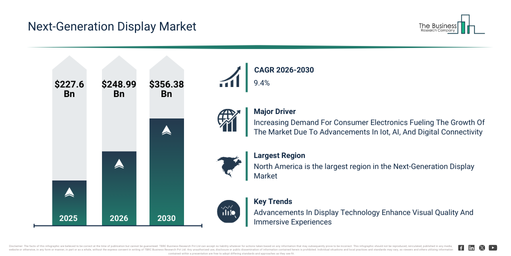
The next-generation display market has experienced significant expansion in recent years. This market is expected to increase from $227.6 billion in 2025 to $248.99 billion in 2026, achieving a compound annual growth rate (CAGR) of 9.4%. The historical development of this market is attributable to a rising demand for high-definition consumer electronics, continuous advancements in LCD and OLED technology, wider mobile device penetration, increasing consumer preference for smart devices, and the adoption of digital signage in retail environments.
The next-generation display market is projected to experience substantial expansion over the coming years. By 2030, this market is anticipated to reach a valuation of $356.38 billion, exhibiting a compound annual growth rate (CAGR) of 9.4%. This anticipated growth during the forecast period is primarily driven by factors such as the increasing embrace of foldable and flexible displays, the incorporation of artificial intelligence to improve display functions, a rising need for displays that are both energy-efficient and sustainable, the expansion of display applications in the automotive and aerospace sectors, and the growing deployment of augmented reality and holographic displays. Key trends observed within this forecast timeframe encompass flexible and foldable displays, ultra-high-resolution displays, innovative energy-efficient display technologies, transparent and holographic display solutions, and robust, long-lasting display panels.
Get A Free Sample Report With In-Depth Market Insights:
Next-Generation Display Market Growth Drivers: What’s Behind The Acceleration?
The anticipated expansion of the next-generation display market is propelled by the rising demand for consumer electronics. These electronics encompass devices intended for daily personal and domestic applications, emphasizing aspects like communication, entertainment, and ease of use. This heightened demand for consumer electronics stems from swift technological progress and an increasing dependence on smart devices in everyday routines. With technological evolution, consumers actively pursue the newest advancements in products such as smartphones, laptops, smart TVs, and wearables, leading to regular upgrades and replacements. Next-generation displays are transforming consumer electronics by providing superior visuals, novel designs, improved energy efficiency, and greater interactivity, thereby influencing the direction of smart devices, entertainment, and digital communication. An illustrative example demonstrates this trend: in May 2023, data from the Japan Electronics and Information Technology Industries Association, a trade body situated in Japan, revealed that overall consumer electronics production hit $204.75 million (¥32,099 million) in May 2023, a rise from $161.17 million (¥25,268 million) recorded in May 2022. Consequently, the escalating demand for consumer electronics is a key factor propelling the expansion of the next-generation display market.
Next-Generation Display Market Segment Analysis And Revenue Potential
The next-generation display market covered in this report is segmented –
1) By Technologies: Quantum Dot Display (QD-LED), Field Emission Display (FED), Laser Phosphor Display (LPD), Organic Light-Emitting Diode (OLED), Organic Light-Emitting Transistor (OLET), Surface-Conduction Electron-Emitter Display (SED), Other Technologies
2) By Material: Substrate, Polarizer, Liquid Crystal, Color Filter, Other Materials
3) By Resolution: 3840×2160, 4096×2160, 3996×2160, 5120×3200, 5120×2160
4) By Application: Industrial, Consumer Electronics, Mobile Phones, Medical, E-Reader, TV And Monitors, Defense And Aerospace, Automotive, Movie And Entertainment, Other Applications
Subsegments:
1) By Quantum Dot Display (QD-LED): QD-OLED, QD-LCD
2) By Field Emission Display (FED): Flat Panel FED, Curved Panel FED
3)By Laser Phosphor Display (LPD): Single-Color LPD, Multi-Color LPD
4) By Organic Light-Emitting Diode (OLED): Flexible OLED, Rigid OLED
5) By Organic Light-Emitting Transistor (OLET): Small Molecule OLET, Polymer OLET
6) By Surface-Conduction Electron-Emitter Display (SED): Full-Color SED, Black-and-White SED
7) By Other Technologies: MicroLED, Electroluminescent Display, Plasma Display
Next-Generation Display Market Trends: What’s Defining The Industry’s Next Phase?
Leading companies in the next-generation display market are concentrating on developing innovative technology, such as OLED technologies, to enhance picture quality, resolution, and user experience. Organic light-emitting diode (OLED) technologies refer to a display method that utilizes organic compounds to emit light when an electric current is applied. For instance, in May 2024, LG Display Co. Ltd., a South Korea-based display manufacturer, introduced a range of next-generation OLED and advanced display technologies. This launch encompasses organic light-emitting diode on silicon (OLEDoS) for vertical reality (VR), large-sized OLED panels featuring improved picture quality, and automotive display solutions optimized for software defined vehicles (SDV). The OLEDoS for VR is being unveiled, providing higher screen brightness and resolution than existing standards. Although it measures only 1.3 inches, approximately the size of a coin, it delivers an exceptionally bright display of 10,000 nits and a sharp resolution of around 4,000 ppi, similar to 4K quality. It also covers over 97% of the DCI-P3 color standard, creating more realistic virtual reality with top-quality visuals.
Next-Generation Display Market Key Players Shaping Industry Direction
Major companies operating in the next-generation display market are Apple Inc, Samsung Electronics, Sony Electronics Inc, Panasonic Corporation Co Ltd, BOE Technology Group Co Ltd, Merck KGaA, LG Display, Sharp Corporation, Koninklijke Philips NV, Corning Incorporated, DuPont Inc, eLux Inc, AUO Corporation, Innolux Corporation, KYOCERA Corporation, Japan Display Inc, Universal Display Corporation (UDC), Xi’an NovaStar Tech Co Ltd, Plessey Semiconductors, FlexEnable Limited, Novaled GmbH, Visionox Company, Nanoco Group plc, JBD Inc, Shoei Electronic Materials Inc
View The Full Next-Generation Display Market Report:
Next-Generation Display Market Geographic Analysis: Where Is Demand Rising Fastest?
North America was the largest region in the next-generation display market in 2025. Asia-Pacific is expected to be the fastest-growing region in the forecast period. The regions covered in the next-generation display market report are Asia-Pacific, South East Asia, Western Europe, Eastern Europe, North America, South America, Middle East, Africa.
Reach Out To Our Team:
The Business Research Company: https://www.thebusinessresearchcompany.com/
Americas: +1 310-496-7795
Asia: +44 7882 955267 & +91 8897263534
Europe: +44 7882 955267
Email us at: marketing@tbrc.info
Follow us on:
LinkedIn: https://in.linkedin.com/company/the-business-research-company
YouTube: https://www.youtube.com/channel/UC24_fI0rV8cR5DxlCpgmyFQ
Global Market Model: https://www.thebusinessresearchcompany.com/global-market-model

Wasay has over a decade of experience in market research, data modelling, and analytics, with prior experience at GlobalData and Decision Tree Consulting Services. At The Business Research Company , he leads research operations across syndicated studies, customized consulting engagements, and the Global Market Model platform. His professional experience includes supporting organizations such as Boston Consulting Group, KPMG, and Ernst & Young. Wasay holds a degree in Electronics and Communications Engineering, postgraduate management qualifications from International Management Institute Belgium and Indian School of Business and Entrepreneurship, and completed the Integrated Program in Business Analytics from Indian Institute of Management Indore.