
Backed by market attractiveness analysis, total addressable market sizing, company benchmarking matrices, interactive Excel dashboards, wider supply chain intelligence, emerging startup coverage, and detailed product-level insights, The Business Research Company’s 2026 market reports are designed to offer research that is more actionable and strategically valuable than ever.
Child Education Insurance Plan Market Size Outlook: How Quickly Will Revenue Expand Through 2030?
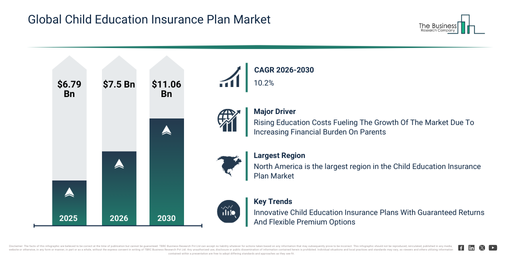
The size of the child education insurance plan market has experienced rapid growth in recent times. Forecasts indicate that it is projected to expand from $6.79 billion in 2025 to $7.5 billion in 2026, exhibiting a compound annual growth rate (CAGR) of 10.5%. This historical growth can be linked to several factors, including heightened awareness regarding the escalating costs of education, an increase in household savings allocated for child education, wider adoption of life insurance in developing nations, the development of structured long-term savings options, and an enhanced involvement of banks and agents in distributing insurance products.
The market for child education insurance plans is projected to experience swift expansion over the coming years. This market is anticipated to reach a valuation of $11.06 billion by 2030, exhibiting a compound annual growth rate (CAGR) of 10.2%. Factors contributing to this growth during the forecast period include the increasing adoption of digital insurance, a greater inclination towards unit-linked education plans, an intensified emphasis on personalized financial planning, the broadening of online insurance distribution channels, and a surging demand for financial security solutions tailored for education. Key trends anticipated within this period involve the increasing uptake of goal-based education planning products, a heightened call for flexible premium and payout arrangements, the expanding integration of digital policy management platforms, the proliferation of investment-linked child education plans, and an intensified commitment to long-term wealth protection.
Get A Free Sample Report With In-Depth Market Insights:
Child Education Insurance Plan Market Industry Drivers: What’s Behind The Revenue Growth?
The increasing expenses associated with education are anticipated to fuel expansion within the child education insurance plan market in the coming years. Education cost encompasses all monetary outlays necessary for a child’s schooling, such as tuition fees, learning materials, travel, and living arrangements. The escalation in educational expenditures stems from higher operational costs for institutions, like faculty compensation and improvements to facilities, which are constantly increasing to align with international academic benchmarks. A child education insurance plan serves to alleviate the strain of escalating education costs, allowing parents to consistently save and safeguard their child’s academic trajectory via long-term financial strategies. As an illustration, a report released in October 2024 by College Board, a US-based non-profit organization, indicated that for the 2024–25 academic year, the average listed tuition and fees for full-time students at private nonprofit four-year colleges stood at $43,350. This represented an increase of $1,610, or 3.9%, from the 2023–24 period, prior to inflation adjustments. Consequently, the escalating cost of education is a significant factor propelling the expansion of the child education insurance plan market.
Child Education Insurance Plan Market Segment Landscape And Growth Outlook
The child education insurance plan market covered in this report is segmented –
1) By Plan Type: Endowment Plans, Unit-Linked Insurance Plans, Other Plan Types
2) By Premium Payment Mode: Monthly, Quarterly, Semi-Annually, Annually
3) By Distribution Channel: Online, Insurance Agents, Banks, Other Distribution Channels
4) By Application: Personal, Enterprise
Subsegments:
1) By Endowment Plans: Endowment Based On Maturity Benefit, Endowment With Waiver Of Premium, Participating Endowment Plans, Non-Participating Endowment Plans, Limited Pay Endowment Plans, Full Term Endowment Plans
2) By Unit Linked Insurance Plans: Unit Linked With Equity Allocation, Unit Linked With Debt Allocation, Balanced Fund Unit Linked Plans, Unit Linked With Goal-Based Tracking, Unit Linked With Automatic Portfolio Rebalancing
3) By Other Plan Types: Hybrid Education Plans, Child Gift Plans With Education Coverage, Savings Linked Education Plans, Money Back Child Plans, Term Based Education Covers
#Child Education Insurance Plan Market Growth Trends: What’s Shaping The Future Outlook?
Leading companies within the child education insurance plan market are concentrating on launching innovative plans, such as non-participating individual savings insurance plans, to deliver guaranteed returns and flexible premium payment choices. A non-participating individual savings insurance plan is a type of life insurance policy that offers predetermined, assured returns without any share in the insurer’s profits or bonuses. As an illustration, in February 2024, Life Insurance Corporation, an India-based insurance firm, launched LIC Amritbaal, a non-linked, non-participating individual savings life insurance plan specifically designed to assist parents in securing a guaranteed financial sum for their child’s higher education and future requirements. This plan provides guaranteed additions of approximately $0.96 (Rs 80) for every $12.00 (Rs 1,000) of the basic sum assured annually throughout the policy term. It offers versatility in premium payment methods, including a one-time (single) premium or limited premium payments over 5, 6, or 7 years. Children can be enrolled starting from 30 days up to 13 years of age, and the policy concludes when the child is between 18 and 25 years old.
Child Education Insurance Plan Market Competitive Landscape: Who Leads The Industry?
Major companies operating in the child education insurance plan market are Allianz SE, AXA S.A., Citigroup Inc., Life Insurance Corporation of India, Metropolitan Life Insurance Company, MetLife Inc., Prudential Financial Inc., Zurich Insurance Group Ltd., Chubb Limited, Massachusetts Mutual Life Insurance Company, Sun Life Assurance Company of Canada, Manulife Financial Corporation, ICICI Prudential Life Insurance Company Limited, HDFC Life Insurance Company Limited, Aditya Birla Sun Life Insurance Company Limited, Kotak Mahindra Life Insurance Company Limited, Reliance Nippon Life Insurance Company Limited, Tata AIA Life Insurance, Bajaj Allianz Life Insurance Company Limited, AIICO Insurance Plc, CBZ Holdings
View The Full Child Education Insurance Plan Market Report:
Child Education Insurance Plan Market Top Region By Revenue And Market Share
North America was the largest region in the child education insurance plan market in 2025. Asia-Pacific is expected to be the fastest-growing region in the forecast period. The regions covered in the child education insurance plan market report are Asia-Pacific, South East Asia, Western Europe, Eastern Europe, North America, South America, Middle East, Africa.
Reach Out To Our Team:
The Business Research Company: https://www.thebusinessresearchcompany.com/
Americas: +1 310-496-7795
Asia: +44 7882 955267 & +91 8897263534
Europe: +44 7882 955267
Email us at: marketing@tbrc.info
Follow us on:
LinkedIn: https://in.linkedin.com/company/the-business-research-company
YouTube: https://www.youtube.com/channel/UC24_fI0rV8cR5DxlCpgmyFQ
Global Market Model: https://www.thebusinessresearchcompany.com/global-market-model

Wasay has over a decade of experience in market research, data modelling, and analytics, with prior experience at GlobalData and Decision Tree Consulting Services. At The Business Research Company , he leads research operations across syndicated studies, customized consulting engagements, and the Global Market Model platform. His professional experience includes supporting organizations such as Boston Consulting Group, KPMG, and Ernst & Young. Wasay holds a degree in Electronics and Communications Engineering, postgraduate management qualifications from International Management Institute Belgium and Indian School of Business and Entrepreneurship, and completed the Integrated Program in Business Analytics from Indian Institute of Management Indore.