Built to provide research that’s more actionable and strategically valuable, The Business Research Company’s 2026 market reports include market attractiveness analysis, total addressable market sizing, company benchmarking matrices, interactive Excel dashboards, broader supply chain intelligence, emerging startup tracking, and in-depth product insights.
Wireless Electric Vehicle (EV) Charging Communication Market Forecast: What Value Will The Market Reach By 2030?
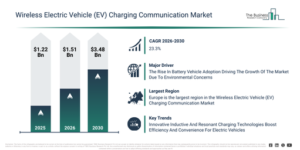
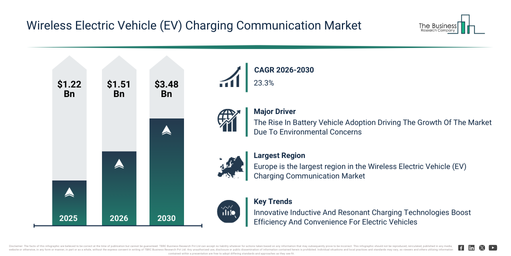
The size of the wireless electric vehicle (EV) charging communication market has experienced significant expansion in recent years. It is forecast to grow from $1.22 billion in 2025 to $1.51 billion in 2026, at a compound annual growth rate (CAGR) of 23.6%. This historical growth can be largely attributed to factors such as rising EV adoption, the development of wireless charging prototypes, government incentives supporting clean energy, the expansion of urban charging infrastructure, and the initial integration of V2X communication standards.
The wireless electric vehicle (EV) charging communication market size is projected to experience significant expansion over the next few years. It is anticipated to reach $3.48 billion by 2030, showing a compound annual growth rate (CAGR) of 23.3%. This growth during the forecast period is attributable to the increasing availability of public wireless charging networks, advancements in AI-powered charging optimization, the growing deployment of V2G-enabled vehicles, integration with intelligent grid systems, and a rising requirement for fleet electrification. Prominent trends for the forecast period involve the wider adoption of wireless charging systems within urban infrastructure, the development of advanced vehicle-to-grid (V2G) communication protocols, the incorporation of real-time fault detection and diagnostics into EV chargers, an increasing need for interoperable charging solutions across various vehicle models, and the expansion of smart charging management platforms.
Get A Free Sample Report With In-Depth Market Insights:
Wireless Electric Vehicle (EV) Charging Communication Market Demand Drivers Opening New Revenue Streams
The expanding embrace of battery-powered vehicles is anticipated to propel the growth of the wireless electric vehicle (EV) charging communication market moving forward. Battery vehicles are defined as electric vehicles that operate solely on rechargeable batteries, storing energy to power an electric motor rather than depending on internal combustion engines. This rising adoption stems from environmental considerations, given that battery vehicles emit fewer greenhouse gases and contribute to reduced air pollution in contrast to traditional fossil-fuel vehicles. Wireless electric vehicle (EV) charging communication boosts the efficiency and ease of use for battery vehicles through seamless, contactless power delivery, live monitoring, and smart energy control. For example, data from February 2024, provided by the U.S. Department of Energy, a federal agency in the US, showed that a review of monthly EV sales across the last three years indicated substantial year-over-year expansion every month. Monthly sales peaked around 100,000 units in 2023, representing a 25% rise from the prior year. Consequently, the growing uptake of battery vehicles fuels the expansion of the wireless electric vehicle (EV) charging communication market.
Wireless Electric Vehicle (EV) Charging Communication Market Breakdown By Product Type And Application
The wireless electric vehicle (EV) charging communication market covered in this report is segmented –
1) By Component: Hardware, Software, Services
2) By Vehicle Type: Passenger Cars, Commercial Vehicles, Two-Wheelers, Other Vehicle Types
3) By Communication Protocol: Vehicle-To-Grid (V2G), Vehicle-To-Everything (V2X), Open Charge Point Protocol (OCPP), Other Communication Protocols
4) By Application: Public Charging, Private Charging, Fleet Charging, Other Applications
5) By End-User: Automotive Original Equipment Manufacturers (OEMs), Charging Infrastructure Providers, Utilities, Other End-Users
Subsegments:
1) By Hardware: Charging Pad, Vehicle Coil, Power Electronics, Communication Module
2) By Software: Charging Management Software, Monitoring And Diagnostics Software, Energy Optimization Software, Security And Authentication Software
3) By Services: Installation Services, Maintenance Services, Consulting Services, Technical Support Services
Wireless Electric Vehicle (EV) Charging Communication Market Trends Powering Strategic Industry Growth
Major companies operating within the wireless electric vehicle (EV) charging communication market are concentrating on developing advanced solutions, such as inductive and resonant wireless charging technologies, to improve charging efficiency, convenience, and interoperability for electric vehicles. Inductive wireless charging facilitates energy transfer via a magnetic field established between a charging pad and a vehicle coil, while resonant wireless charging utilizes tuned resonant circuits to enable efficient energy transfer over slightly extended distances. For instance, in January 2024, Valeo SE, a France-based company involved in designing and manufacturing automobile components, launched a wireless charging system for electric vehicles called Ineez Air Charging to enhance the ease and effectiveness of electric vehicle charging. These Air Charging features an ultra-low operating frequency of around 3 kHz, making the system 50% lighter and simpler compared to traditional wireless chargers while maintaining a high efficiency above 90% from grid to battery. It provides worldwide compatibility with all wall boxes, country grids (1 or 3 phases), and EVs with 400-800V batteries; supports Vehicle-to-Grid (V2G) functionality for 7-22 kW power solutions and is prepared for autonomous vehicles to charge themselves on inductive charging areas.
Wireless Electric Vehicle (EV) Charging Communication Market Company Landscape And Competitive Strategy
Major companies operating in the wireless electric vehicle (EV) charging communication market are Bayerische Motoren Werke Aktiengesellschaft (BMW AG), HyundAI Motor Company, Siemens AG), Continental AG, Qualcomm Incorporated, Valeo SE., Toshiba Corporation, ZTE Corporation, Texas Instruments Incorporated, Delta Electronics Inc., Daihen Corporation, ENRX Group, Telit Cinterion GmbH, InductEV Inc., WiTricity Corporation, Ideanomics Inc., Powermat Technologies Ltd., Electreon Wireless Ltd., HEVO Inc., Mojo Mobility Inc.
View The Full Wireless Electric Vehicle (EV) Charging Communication Market Report:
Wireless Electric Vehicle (EV) Charging Communication Market Geographic Landscape: Which Region Leads Industry Growth?
Europe was the largest region in the wireless electric vehicle (EV) charging communication market in 2025. Asia-Pacific is expected to be the fastest-growing region in the forecast period. The regions covered in the wireless electric vehicle (EV) charging communication market report are Asia-Pacific, South East Asia, Western Europe, Eastern Europe, North America, South America, Middle East, Africa.
Reach Out To Our Team:
The Business Research Company: https://www.thebusinessresearchcompany.com/
Americas: +1 310-496-7795
Asia: +44 7882 955267 & +91 8897263534
Europe: +44 7882 955267
Email us at: marketing@tbrc.info
Follow us on:
LinkedIn: https://in.linkedin.com/company/the-business-research-company
YouTube: https://www.youtube.com/channel/UC24_fI0rV8cR5DxlCpgmyFQ
Global Market Model: https://www.thebusinessresearchcompany.com/global-market-model

Wasay has over a decade of experience in market research, data modelling, and analytics, with prior experience at GlobalData and Decision Tree Consulting Services. At The Business Research Company , he leads research operations across syndicated studies, customized consulting engagements, and the Global Market Model platform. His professional experience includes supporting organizations such as Boston Consulting Group, KPMG, and Ernst & Young. Wasay holds a degree in Electronics and Communications Engineering, postgraduate management qualifications from International Management Institute Belgium and Indian School of Business and Entrepreneurship, and completed the Integrated Program in Business Analytics from Indian Institute of Management Indore.