
Featuring market attractiveness scoring, total addressable market sizing, company benchmarking matrices, interactive Excel dashboards, deeper supply chain intelligence, emerging startup tracking, and granular product-level insights, The Business Research Company’s 2026 market reports are built to deliver research that is both more actionable and more strategically valuable.
Banking Cloud Security Market Poised To Hit $9.95 Billion By 2030 With A 17.6% CAGR
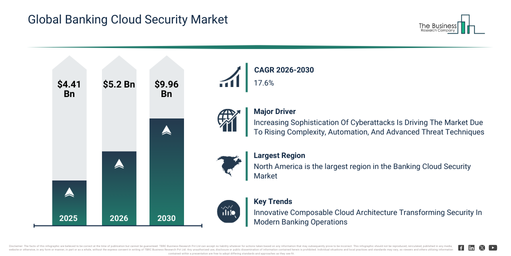
The banking cloud security market size has seen rapid expansion in recent years. It is forecast to grow from $4.41 billion in 2025 to $5.2 billion in 2026, at a compound annual growth rate (CAGR) of 17.9%. The increase observed in the historic period is attributable to the rising adoption of cloud computing within banking operations, an escalating frequency of financial cyberattacks, the broadening of digital banking channels, the enforcement of data protection regulations, and early financial commitments to cloud security platforms.
The banking cloud security market is projected to experience substantial expansion over the coming years. By 2030, its valuation is anticipated to reach $9.96 billion, demonstrating a compound annual growth rate (CAGR) of 17.6%. This projected growth throughout the forecast period stems from factors such as heightened regulatory oversight on financial data stored in the cloud, the increasing embrace of hybrid and multi-cloud infrastructures, the expanding application of AI-powered security analytics, the development of partnerships within the fintech ecosystem, and a rising need for real-time threat surveillance. Key developments expected during this period involve the wider implementation of zero-trust cloud security frameworks, a surge in the adoption of AI-driven threat detection, a growing requirement for cloud security solutions that adhere to regulations, a sharpened emphasis on identity and access governance, and improved integration of cloud-native security platforms.
Get A Free Sample Report With In-Depth Market Insights:
Banking Cloud Security Market Expansion Drivers: What’s Shaping Future Growth?
The anticipated expansion of the banking cloud security market is significantly influenced by the escalating sophistication of cyber attacks. This sophistication indicates a rise in the complexity, accuracy, and advanced methods employed by attackers to penetrate security defenses, incorporating automation, artificial intelligence, social engineering, and covert strategies to avoid detection and exploit system weaknesses. The prevalence of these intricate cyberattacks is fueled by advanced technologies, enabling perpetrators to more effectively bypass security measures and exploit system flaws. Banking cloud security actively combats this heightened sophistication by incorporating advanced encryption, comprehensive threat intelligence, and continuous real-time monitoring to identify and neutralize intricate threats before they can jeopardize financial infrastructures. A notable example is data from July 2024, provided by Check Point Software Technologies, an Israeli cybersecurity firm, which reported a 30% year-on-year increase in global average cyberattacks, reaching around 1,636 attacks per organization weekly. Additionally, ransomware attacks rose by 27%, and cloud-based attacks by 22%, thereby highlighting the expanding intricacy and automated nature of the cyber threat environment. Consequently, the escalating sophistication of cyber attacks is a primary catalyst for the expansion of the banking cloud security market.
Banking Cloud Security Market Segments: Where Is Growth Concentrated?
The banking cloud security market covered in this report is segmented –
1) By Type: Cloud Identity And Access Management Software, Cloud Email Security Software, Cloud Intrusion Detection And Prevention System, Cloud Encryption Software, Cloud Network Security Software
2) By Deployment Mode: Public Cloud, Private Cloud, Hybrid Cloud
3) By Organization Size: Large Enterprises, Small And Medium-Sized Enterprises
4) By End-User: Retail Banks, Commercial Banks, Investment Banks, Fintech Companies, Credit Unions, Insurance Providers
Subsegments:
1) By Cloud Identity And Access Management Software: User Authentication Management, Access Control Policy Management, Identity Governance And Administration, Privileged Access Management, Single Sign-On Management
2) By Cloud Email Security Software: Email Encryption Management, Spam And Phishing Protection, Data Loss Prevention, Email Archiving And Retention, Malware And Ransomware Protection
3) By Cloud Intrusion Detection And Prevention System: Network Traffic Analysis, Anomaly Detection And Response, Signature-Based Detection, Behavioral Monitoring, Threat Intelligence Integration
4) By Cloud Encryption Software: Data-At-Rest Encryption, Data-In-Transit Encryption, Key Management Solutions, Tokenization Services, End-To-End Encryption
5) By Cloud Network Security Software: Firewall Management, Secure Web Gateway, Virtual Private Network Security, Distributed Denial Of Service Protection, Network Segmentation And Monitoring
Banking Cloud Security Market Strategic Trends: What Defines The Next Growth Phase?
Leading companies active in the banking cloud security market are concentrating on developing innovative advancements, such as composable cloud-native architecture, to improve the flexibility, scalability, and seamless integration of secure banking operations across digital platforms. Composable cloud-native architecture defines a modern software design approach that constructs applications from modular, independent, and reusable components, frequently referred to as microservices, deployed in the cloud. Each component can be developed, updated, or scaled independently, which facilitates faster innovation and greater flexibility. For instance, in February 2023, Oracle Corporation, a US-based provider of cloud application services and enterprise software solutions, launched Banking Cloud Services, a suite of six composable cloud-native services designed to assist banks in modernizing their operations. The launch’s offerings include Banking Accounts Cloud Service, Banking Payments Cloud Service, Enterprise Limits and Collateral Management Cloud Service, Origination Cloud Service, Digital Experience Cloud Service, and Banking APIs Cloud Service.
Banking Cloud Security Market Key Participants And Competitive Landscape
Major companies operating in the banking cloud security market are A10 Networks, Google Cloud Platform, Fortinet, Akamai Technologies, CrowdStrike, F5 Networks, Check Point Software Technologies, Zscaler, Okta, Trend Micro, Aruba Networks (HPE), Elastic, Tenable, Rapid7, SentinelOne, Rubrik, Qualys, Netskope, Varonis, BeyondTrust, Druva, Skyhigh Security, Sysdig, Securonix
View The Full Banking Cloud Security Market Report:
Banking Cloud Security Market Global Footprint: Which Region Leads The Market?
North America was the largest region in the banking cloud security market in 2025. Asia-Pacific is expected to be the fastest-growing region in the forecast period. The regions covered in the banking cloud security market report are Asia-Pacific, South East Asia, Western Europe, Eastern Europe, North America, South America, Middle East, Africa.
Reach Out To Our Team:
The Business Research Company: https://www.thebusinessresearchcompany.com/
Americas: +1 310-496-7795
Asia: +44 7882 955267 & +91 8897263534
Europe: +44 7882 955267
Email us at: marketing@tbrc.info
Follow us on:
LinkedIn: https://in.linkedin.com/company/the-business-research-company
YouTube: https://www.youtube.com/channel/UC24_fI0rV8cR5DxlCpgmyFQ
Global Market Model: https://www.thebusinessresearchcompany.com/global-market-model

Wasay has over a decade of experience in market research, data modelling, and analytics, with prior experience at GlobalData and Decision Tree Consulting Services. At The Business Research Company , he leads research operations across syndicated studies, customized consulting engagements, and the Global Market Model platform. His professional experience includes supporting organizations such as Boston Consulting Group, KPMG, and Ernst & Young. Wasay holds a degree in Electronics and Communications Engineering, postgraduate management qualifications from International Management Institute Belgium and Indian School of Business and Entrepreneurship, and completed the Integrated Program in Business Analytics from Indian Institute of Management Indore.