Built to provide research that’s more actionable and strategically valuable, The Business Research Company’s 2026 market reports include market attractiveness analysis, total addressable market sizing, company benchmarking matrices, interactive Excel dashboards, broader supply chain intelligence, emerging startup tracking, and in-depth product insights.
Structural Health Monitoring Market Revenue Growth On Track For A 15% CAGR Through 2030
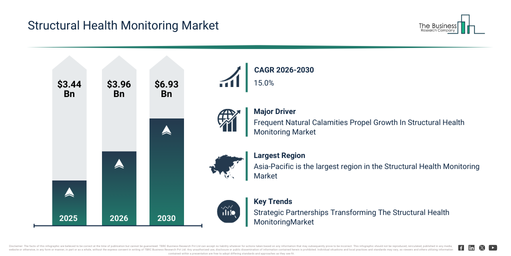
The structural health monitoring market has experienced swift expansion in its size during recent years. Its valuation is projected to increase from $3.44 billion in 2025 to $3.96 billion in 2026, growing at a compound annual growth rate (CAGR) of 15.1%. The market’s growth in the historic period is primarily due to factors such as structural monitoring of bridges and dams, its adoption in large civil infrastructures, the early deployment of wired sensor systems, its usage in industrial machinery maintenance, and its incorporation in wind turbine monitoring.
The structural health monitoring market is projected to experience substantial growth over the coming years, reaching a valuation of $6.93 billion by 2030, driven by a compound annual growth rate (CAGR) of 15.0%. This significant increase is attributable to several factors, including the proliferation of wireless sensor networks, increased spending on predictive maintenance, wider uptake of real-time monitoring solutions, the advancement of digital infrastructure management, and improvements in structural visualization tools. Key trends anticipated during this period involve the integration of AI-driven damage detection systems, the rollout of IoT-enabled monitoring networks, the development of automated structural diagnostic systems, the embrace of sustainable infrastructure monitoring practices, and the expansion of cloud-based structural data platforms.
Get A Free Sample Report With In-Depth Market Insights:
Structural Health Monitoring Market Opportunity Drivers: What’s Unlocking New Revenue Potential?
The structural health monitoring market is anticipated to expand due to the increasing frequency of natural calamities. These are devastating events originating from natural phenomena on Earth. Structural health monitoring plays a crucial role in averting water and flood damage caused by structural failures like collapsed dams, dykes, and pipelines during natural disasters. Consequently, the rising incidence of natural calamities is projected to propel the structural health monitoring market. An illustrative example from January 2024 highlights this trend: a report by the National Centers for Environmental Information (NCEI), a US government agency, indicated that the U.S. experienced 28 separate weather and climate-related disasters in 2023, with each incurring damages of at least $1 billion. This marked an unprecedented annual total for billion-dollar disasters. Thus, the common occurrence of natural disasters is fueling the expansion of the structural health monitoring market.
Structural Health Monitoring Market Segment Outlook: Which Categories Are Growing Fastest?
The structural health monitoring market covered in this report is segmented –
1) By Component: Hardware, Software, Services
2) By Connectivity: Wired, Wireless
3) By Application: Bridges And Dams, Buildings And Stadiums, Vessels And Platforms, Airframes And Wind Turbines, Large Machinery And Equipment
4) By End User: Civil, Aerospace, Defense, Energy, Mining, Other End Users
Subsegments:
1) By Hardware: Sensors, Data Acquisition Systems, Communication Devices, Structural Health Monitoring Systems
2) By Software: Data Analysis Software, Monitoring And Management Software, Visualization Tools
3) By Services: Installation And Integration, Maintenance And Support, Consulting And Advisory Services, Training And Education
Structural Health Monitoring Market Innovation Trends Shaping Future Development
Leading companies within the structural health monitoring market are establishing partnerships to create new products and strengthen their market standing. Strategic partnerships signify a process where organizations combine their respective strengths and resources to achieve mutual advantages and success. As an illustration, in November 2023, the American Bureau of Shipping (ABS), a non-profit organization from the US, teamed up with Seatrium Limited, a shipbuilding and repairing firm located in Singapore, to further develop structural health monitoring (SHM) technologies for offshore structures. This collaboration included bestowing a Structural Health Monitoring Notation upon ADMARINE 686, recognized as the world’s first self-elevating drilling unit (SEDU), acknowledging its ability to monitor and assess crucial structural components. Moreover, Seatrium Offshore Technology, in cooperation with the Technology Centre for Offshore and Marine, Singapore, is constructing a structural digital twin for the SEDU using sensor data, enabling advanced structural health monitoring. This endeavor aligns with the companies’ broader aim to integrate smart technologies into maritime assets, building upon prior acknowledgments for implementing smart technologies and designing smart LNG bunkering vessels.
Structural Health Monitoring Market Leading Companies And Competitive Benchmarking
Major companies operating in the structural health monitoring market are Geokon, Campbell Scientific Inc., COWI A/S, Geocomp Corporation, Acellent Technologies Inc., Sixense, Structural Monitoring Systems Plc, Digitexx Data Systems Inc., Kinemetrics, National Instruments Corporation, Hottinger Baldwin Messtechnik GmbH, SGS Société Générale de Surveillance SA, James Fisher Strainstall, Strainstall Limited, Pure Technologies, RST Instruments Ltd., Smart Structures Inc., Hexagon AB, Hottinger Bruel & Kjaer (HBK) Test and Measurement, General Electric (GE) Sensing & Inspection Technologies, Dynastar SAS, B&K Vibro, ASI Technologies, Applied Acoustic Systems, Agilent Technologies
View The Full Structural Health Monitoring Market Report:
Structural Health Monitoring Market Regional Analysis And Top Geography
Asia-Pacific was the largest region in the structural health monitoring market in 2025. The regions covered in the structural health monitoring market report are Asia-Pacific, South East Asia, Western Europe, Eastern Europe, North America, South America, Middle East, Africa.
Reach Out To Our Team:
The Business Research Company: https://www.thebusinessresearchcompany.com/
Americas: +1 310-496-7795
Asia: +44 7882 955267 & +91 8897263534
Europe: +44 7882 955267
Email us at: marketing@tbrc.info
Follow us on:
LinkedIn: https://in.linkedin.com/company/the-business-research-company
YouTube: https://www.youtube.com/channel/UC24_fI0rV8cR5DxlCpgmyFQ
Global Market Model: https://www.thebusinessresearchcompany.com/global-market-model

Wasay has over a decade of experience in market research, data modelling, and analytics, with prior experience at GlobalData and Decision Tree Consulting Services. At The Business Research Company , he leads research operations across syndicated studies, customized consulting engagements, and the Global Market Model platform. His professional experience includes supporting organizations such as Boston Consulting Group, KPMG, and Ernst & Young. Wasay holds a degree in Electronics and Communications Engineering, postgraduate management qualifications from International Management Institute Belgium and Indian School of Business and Entrepreneurship, and completed the Integrated Program in Business Analytics from Indian Institute of Management Indore.