Built to provide research that’s more actionable and strategically valuable, The Business Research Company’s 2026 market reports include market attractiveness analysis, total addressable market sizing, company benchmarking matrices, interactive Excel dashboards, broader supply chain intelligence, emerging startup tracking, and in-depth product insights.
High Frequency Trading Market Revenue Growth On Track For A 9.9% CAGR Through 2030
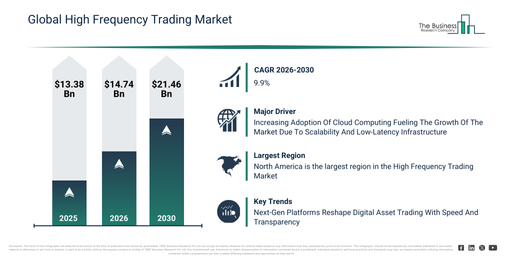
The high frequency trading market has experienced significant growth in its size over recent years. It is projected to expand from $13.38 billion in 2025 to $14.74 billion in 2026, demonstrating a compound annual growth rate (CAGR) of 10.2%. This historical expansion can be attributed to factors such as the proliferation of electronic trading platforms, enhanced market liquidity, the broader adoption of algorithmic trading, the availability of high-speed market data feeds, and foundational investments in low-latency infrastructure.
The high frequency trading market is projected to experience substantial expansion in the coming years. Its valuation is anticipated to reach $21.46 billion by 2030, exhibiting a compound annual growth rate (CAGR) of 9.9%. This projected growth is driven by factors such as enhanced regulatory frameworks, intensified competition for superior speed, the proliferation of cloud-based trading infrastructure, increasing utilization of alternative data, and ongoing progress in network and connectivity technologies. Key trends anticipated during this period encompass the wider integration of ultra-low latency trading infrastructure, a surge in AI-powered trading algorithms, the enlargement of colocation and proximity hosting offerings, the broader implementation of FPGA-based trading systems, and a heightened emphasis on real-time data analytics.
Get A Free Sample Report With In-Depth Market Insights:
High Frequency Trading Market Demand Drivers Opening New Revenue Streams
The growing acceptance of cloud computing is anticipated to drive the expansion of the high frequency trading market. Cloud computing involves providing computational assets such as storage, servers, and software via the internet, facilitating flexible, on-demand availability without requiring physical infrastructure. Its rising adoption stems from its inherent scalability and flexibility, which enable businesses to readily adapt resources as needed, bypassing substantial initial infrastructure expenses. For high-frequency trading, cloud computing improves operations by offering a scalable and low-latency infrastructure, perfectly suited for running intricate trading algorithms. Furthermore, it cuts down operational expenses through real-time data processing and swift deployment, thereby boosting trading speed and overall efficiency. An illustrative example is from December 2023, where Eurostat, a Luxembourg-based government agency, reported that 45.2 % of EU enterprises purchased cloud computing services in 2023, primarily for email hosting, electronic file storage, and office software. Consequently, the rising uptake of cloud computing is fueling the expansion of the high frequency trading market.
High Frequency Trading Market Segmentation: How Does The Market Break Down By Category?
The high frequency trading market covered in this report is segmented –
1) By Execution Type: Direct Market Access (DMA), Algorithmic Execution, High-Speed Trading Systems, Dark Pools, Brokerage Execution
2) By Trading Strategy: Algorithmic Trading, Statistical Arbitrage, Market Making, Trend Following, Mean Reversion
3) By Deployment: Cloud, On Premise
4) By Technology And Infrastructure: Low Latency Systems, Colocation Services, Cloud Computing, Data Feeds, Network And Connectivity Solutions
5) By End Use: Investment Banks, Hedge Funds, Personal Investor, Other End Uses
Subsegments:
1) By Direct Market Access (DMA): Sponsored DMA, Naked DMA, Broker-Assisted DMA, Smart Order Routing DMA, Co-Located DMA Access
2) By Algorithmic Execution: Volume Weighted Average Price (Vwap) Algorithms, Time Weighted Average Price (TWAP) Algorithms, Implementation Shortfall Algorithms, Percentage Of Volume (POV) Algorithms, Iceberg Orders, Sniper And Stealth Algorithms
3) By High-Speed Trading Systems: Low-Latency Trading Platforms, FPGA-Based Trading Systems, Co-Location Services, Microwave And Radio Frequency Transmission Systems, Ultra-Low Latency Data Feeds
4) By Dark Pools: Broker-Dealer Owned Dark Pools, Agency Broker And Exchange-Owned Dark Pools, Independent And Consortium Dark Pools, Crossing Networks, Conditional Order Books
5) By Brokerage Execution: Full-Service Brokerage Execution, Discount Brokerage Execution, Prime Brokerage Execution, Electronic Communication Networks (ECNs), Hybrid Execution Services
High Frequency Trading Market Trends Powering Strategic Industry Growth
Major companies operating in the high frequency trading (HFT) market are prioritizing the development of advanced technological solutions, including institutional-grade decentralized exchange platforms. These platforms are designed to enable extremely fast, secure, and transparent trading for digital assets. Such institutional-grade decentralized exchange platforms are sophisticated trading systems built to meet the high standards of performance, security, and compliance required by professional and institutional investors, facilitating peer-to-peer trading without intermediaries. For example, in July 2025, Bluefin Payment Systems LLC, a US-based system software firm, launched Bluefin v2, also referred to as Bluefin Pro. This platform is an institutional-grade high-frequency trading system established on the Sui blockchain. Bluefin V2 merges the performance capabilities of centralized exchanges with a decentralized infrastructure, allowing for sub-second order execution, high throughput, and minimal fees. It achieves enhanced speed and reliability by utilizing off-chain order books and on-chain settlement, supporting professional traders looking for scalable and transparent DeFi solutions. Furthermore, the platform incorporates sophisticated risk controls and supports multiple liquidity pools, rendering it suitable for complex trading strategies.
High Frequency Trading Market Competitive Overview And Top Companies
Major companies operating in the high frequency trading market are Latour Trading LLC, Susquehanna International Group LLP, Jane Street Group LLC, Two Sigma Investments LP, Jump Trading LLC, Citadel Securities LLC, Optiver Holding B.V., DRW Holdings LLC, Tower Research Capital LLC, Hudson River Trading LLC, XTX Markets Limited, Akuna Capital LLC, Tibra Capital Pty Limited, Allston Trading LLC, Global Trading Systems LLC, RSJ Algorithmic Trading A.S, Headlands Technologies LLC, Teza Technologies LLC, Quantlab Financial LLC, Tradebot Systems Inc., Bluefin Trading LLC
View The Full High Frequency Trading Market Report:
High Frequency Trading Market Geographic Spread And Regional Opportunities
North America was the largest region in the high frequency trading market in 2025. Asia-Pacific is expected to be the fastest-growing region in the forecast period. The regions covered in the high frequency trading market report are Asia-Pacific, South East Asia, Western Europe, Eastern Europe, North America, South America, Middle East, Africa.
Reach Out To Our Team:
The Business Research Company: https://www.thebusinessresearchcompany.com/
Americas: +1 310-496-7795
Asia: +44 7882 955267 & +91 8897263534
Europe: +44 7882 955267
Email us at: marketing@tbrc.info
Follow us on:
LinkedIn: https://in.linkedin.com/company/the-business-research-company
YouTube: https://www.youtube.com/channel/UC24_fI0rV8cR5DxlCpgmyFQ
Global Market Model: https://www.thebusinessresearchcompany.com/global-market-model

Wasay has over a decade of experience in market research, data modelling, and analytics, with prior experience at GlobalData and Decision Tree Consulting Services. At The Business Research Company , he leads research operations across syndicated studies, customized consulting engagements, and the Global Market Model platform. His professional experience includes supporting organizations such as Boston Consulting Group, KPMG, and Ernst & Young. Wasay holds a degree in Electronics and Communications Engineering, postgraduate management qualifications from International Management Institute Belgium and Indian School of Business and Entrepreneurship, and completed the Integrated Program in Business Analytics from Indian Institute of Management Indore.