Featuring market attractiveness scoring, total addressable market sizing, company benchmarking matrices, interactive Excel dashboards, deeper supply chain intelligence, emerging startup tracking, and granular product-level insights, The Business Research Company’s 2026 market reports are built to deliver research that is both more actionable and more strategically valuable.
Food Traceability Market Growth Potential: How Will Market Size Shift Through 2030?
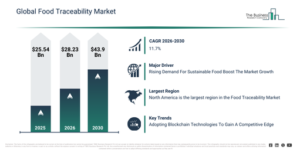
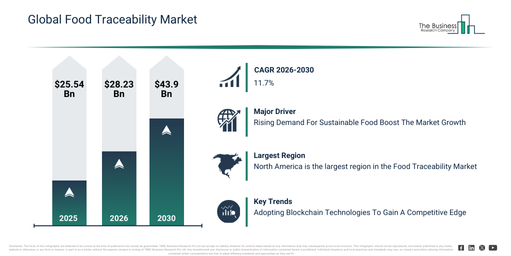
The food traceability market has experienced substantial expansion in recent years. It is projected to increase from $25.54 billion in 2025 to $28.23 billion in 2026, indicating a compound annual growth rate (CAGR) of 10.5%. Historically, this growth can be ascribed to more stringent food safety regulations, heightened consumer demand for product transparency, the expansion of food trade, the increasing adoption of digital record-keeping systems, and the advancement of organized food supply chains.
The food traceability market is projected to experience substantial expansion in the coming years. This market is forecast to reach $43.9 billion in 2030, achieving a compound annual growth rate (CAGR) of 11.7%. This expansion is primarily driven by greater investments in digital traceability platforms, the increasing uptake of smart labeling technologies, the broadening of interconnected supply chain ecosystems, the expanding application of AI-powered traceability analytics, and a heightened emphasis on preventing fraud and verifying authenticity. Key developments anticipated during this period involve the wider adoption of blockchain-based traceability platforms, the increasing deployment of RFID and barcode technologies, the deeper integration of real-time supply chain monitoring, the proliferation of comprehensive food transparency solutions, and a stronger commitment to tracking regulatory compliance.
Get A Free Sample Report With In-Depth Market Insights:
Food Traceability Market Growth Factors Behind Sustained Expansion
The escalating demand for sustainable food is projected to advance the food traceability market moving ahead. Sustainable food refers to practices in food production, distribution, and consumption that ensure safety and health. It is cultivated without toxic pesticides, chemicals, non-essential antibiotics, or growth promotion supplements. Food traceability holds a key position in advocating for sustainable food production by offering consumers data concerning the environmental and social effects linked to their food selections. For example, in April 2024, findings from a survey by the National Association of Convenience Stores, a US-based trade association representing the convenience and fuel retailing industry, showed that 80% of consumers are worried about the environmental impact of their acquisitions, up from 68% in 2023 and 66% in 2022. Therefore, the heightened demand for sustainable food boosts the food traceability market.
Food Traceability Market Segments: Where Is Growth Concentrated?
The food traceability market covered in this report is segmented –
1) By Technology: Radio-Frequency Identification, Barcodes, Positioning System
2) By Application: Fresh Food Produce, Meat, Poultry And Seafood Products, Dairy Products, Beverage Products, Other Applications
3) By End-User: Retailers, Food Manufacturers, Foodservice Providers, Distributors, Consumers
Subsegments:
1) By Radio-Frequency Identification (RFID): Active RFID, Passive RFID, Semi-passive RFID
2) By Barcodes: 1D Barcodes, 2D Barcodes, QR Codes
3) By Positioning System (GPS): GPS Tracking Devices, GPS-Based Location Services
Food Traceability Market Industry Trends Fueling Future Revenue Growth
Leading companies in the food traceability market are implementing blockchain technologies to address various challenges and gain a competitive advantage. Blockchain technologies are extensively utilized in food traceability to enhance transparency and safety across the food supply chain. For instance, in May 2023, OVO Farm Pvt. Ltd., an India-based producer of eggs and egg products, launched a unique blockchain technology that enables the traceability of their eggs at every step of the supply chain, from the farm to the final consumer. OVO Farm, through its main brand Kenko, offers high-quality, fresh, and hygienic eggs, the authenticity of which can be verified by scanning the QR code included on each product. This blockchain technology ensures that the appropriate products reach clients and guarantees quality.
Food Traceability Market Key Participants And Competitive Landscape
Major companies operating in the food traceability market are International Business Machines Corp, Oracle Systems Corporation, Honeywell International Inc, Avery Dennison Corporation, Zebra Technologies Corp, SGS SA, ANTARES VISION S.p.A, OPTEL GROUP, iTradeNetwork Inc, Rfxcel Corporation, TE-FOOD International GmbH, Covectra Inc, SourceTrace Systems India Pvt Ltd, Bext360 Holdings Inc, Traceall Ltd, TrusTrace, FoodLogiQ, Merit-Trax Technologies Inc, Bar Code Integrators Inc, Cognex Corporation
View The Full Food Traceability Market Report:
Food Traceability Market Top Region By Revenue And Market Share
North America was the largest region in the food traceability market in 2025. Asia-Pacific is expected to be the fastest-growing region in the forecast period. The regions covered in the food traceability market report are Asia-Pacific, South East Asia, Western Europe, Eastern Europe, North America, South America, Middle East and Africa.
Reach Out To Our Team:
The Business Research Company: https://www.thebusinessresearchcompany.com/
Americas: +1 310-496-7795
Asia: +44 7882 955267 & +91 8897263534
Europe: +44 7882 955267
Email us at: marketing@tbrc.info
Follow us on:
LinkedIn: https://in.linkedin.com/company/the-business-research-company
YouTube: https://www.youtube.com/channel/UC24_fI0rV8cR5DxlCpgmyFQ
Global Market Model: https://www.thebusinessresearchcompany.com/global-market-model

Wasay has over a decade of experience in market research, data modelling, and analytics, with prior experience at GlobalData and Decision Tree Consulting Services. At The Business Research Company , he leads research operations across syndicated studies, customized consulting engagements, and the Global Market Model platform. His professional experience includes supporting organizations such as Boston Consulting Group, KPMG, and Ernst & Young. Wasay holds a degree in Electronics and Communications Engineering, postgraduate management qualifications from International Management Institute Belgium and Indian School of Business and Entrepreneurship, and completed the Integrated Program in Business Analytics from Indian Institute of Management Indore.