Backed by market attractiveness analysis, total addressable market sizing, company benchmarking matrices, interactive Excel dashboards, wider supply chain intelligence, emerging startup coverage, and detailed product-level insights, The Business Research Company’s 2026 market reports are designed to offer research that is more actionable and strategically valuable than ever.
Fungal Protein Market Revenue Growth On Track For A 7% CAGR Through 2030
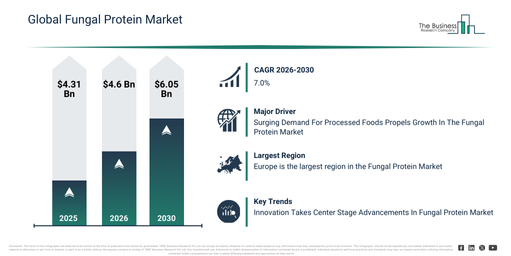
The fungal protein market has experienced robust expansion in recent years. This market is projected to expand from $4.31 billion in 2025 to $4.6 billion in 2026, demonstrating a compound annual growth rate (CAGR) of 6.9%. Historically, this expansion has been driven by factors such as growing consumer interest in plant-based diets, heightened environmental concerns regarding meat consumption, an increase in vegetarian and vegan populations, advancements in food processing technologies, and the accessibility of fermentation-based protein production methods.
The fungal protein market size is projected for substantial growth in the coming years. It is anticipated to reach $6.05 billion by 2030, exhibiting a compound annual growth rate (CAGR) of 7.0%. This projected expansion during the forecast period can be attributed to increasing investments in alternative protein research, a rising demand for sustainable and low-carbon foods, the broadening applications of functional proteins, enhanced acceptance of fungal protein products, and innovations in large-scale fermentation technologies. Key trends during this period include the increasing adoption of alternative protein sources, escalating demand for meat substitutes, the expansion of fungal protein into processed foods, a growing focus on sustainable protein production, and improvements in product texture and flavor.
Get A Free Sample Report With In-Depth Market Insights:
Fungal Protein Market Industry Drivers: What’s Behind The Revenue Growth?
The increasing intake of processed foods is significantly contributing to the expansion of the fungal protein market going forward. Processed food is defined as an edible product that has undergone multiple mechanical or chemical treatments for alteration or preservation purposes. Fungal protein serves as an alternative to meat and other protein sources in processed foods, primarily because it is considerably less environmentally damaging and more sustainable compared to livestock-derived protein. For example, data released in April 2024 by the National Association of Convenience Stores (NACS), a US-based trade association, indicated that total industry foodservice sales constituted 26.9% of in-store sales in 2023, an increase from 25.6% in 2022, and prepared food sales saw a rise of 12.2% per store per month, establishing it as the top in-store category. Consequently, the growing consumption of processed food is projected to propel the fungal protein market.
Fungal Protein Market Segment Landscape: Which Areas Lead Development?
The fungal protein market covered in this report is segmented –
1) By Type: Fusarium Venenatum Extract, Mushrooms
2) By Nature: Organic, Conventional
3) By Application: Food And Beverages, Bakery, Processed Food, Dairy, Other Applications
Subsegments:
1) By Fusarium Venenatum Extract: Whole Biomass, Protein Isolates
2) By Mushrooms: Edible Mushrooms, Medicinal Mushrooms
#Fungal Protein Market Growth Trends: What’s Shaping The Future Outlook?
Leading companies within the fungal protein market are directing their efforts towards devising groundbreaking solutions, such as sophisticated fermentation techniques, to improve protein output, enhance product texture and taste, and extend their utility in alternative food items. Sophisticated fermentation involves utilizing optimized microbial strains, precise bioprocessing, and regulated production frameworks to efficiently create premium proteins, enzymes, or bio-ingredients on a large scale. As an illustration, in August 2024, Calysta, a UK-based biotechnology organization, unveiled a new collection of single-cell protein products originating from natural gas fermentation. This introduction aimed to present an environmentally friendly substitute for conventional animal proteins. This inventive method employs a patented fermentation platform that converts methane into high-quality protein, thereby addressing the rising demand for sustainable food supplies. Calysta’s products, which include FeedKind and Positive Protein, are formulated for use in both animal feed and human food contexts, contributing to environmental sustainability by decreasing reliance on arable land and traditional protein sources.
Fungal Protein Market Industry Leaders And Competitive Landscape
Major companies operating in the fungal protein market are Quorn Foods, Meati Foods, Nature’s Fynd, Solar Foods, MycoTechnology, 3F BIO, Sustainable Bioproducts, White Dog Labs, Prime Roots, MyForest Foods, ENOUGH, Infinite Roots, The Protein Brewery, Mycorena, Better Meat Co, Mushlabs, Libre Foods, Fybraworks Foods, Atlast Food Co, MycoWorks
View The Full Fungal Protein Market Report:
Fungal Protein Market Regional Split: Which Areas Are Fueling Growth?
Europe was the largest region in the fungal protein market in 2025. The regions covered in the fungal protein market report are Asia-Pacific, South East Asia, Western Europe, Eastern Europe, North America, South America, Middle East and Africa.
Reach Out To Our Team:
The Business Research Company: https://www.thebusinessresearchcompany.com/
Americas: +1 310-496-7795
Asia: +44 7882 955267 & +91 8897263534
Europe: +44 7882 955267
Email us at: marketing@tbrc.info
Follow us on:
LinkedIn: https://in.linkedin.com/company/the-business-research-company
YouTube: https://www.youtube.com/channel/UC24_fI0rV8cR5DxlCpgmyFQ
Global Market Model: https://www.thebusinessresearchcompany.com/global-market-model

Wasay has over a decade of experience in market research, data modelling, and analytics, with prior experience at GlobalData and Decision Tree Consulting Services. At The Business Research Company , he leads research operations across syndicated studies, customized consulting engagements, and the Global Market Model platform. His professional experience includes supporting organizations such as Boston Consulting Group, KPMG, and Ernst & Young. Wasay holds a degree in Electronics and Communications Engineering, postgraduate management qualifications from International Management Institute Belgium and Indian School of Business and Entrepreneurship, and completed the Integrated Program in Business Analytics from Indian Institute of Management Indore.