Featuring market attractiveness scoring, total addressable market sizing, company benchmarking matrices, interactive Excel dashboards, deeper supply chain intelligence, emerging startup tracking, and granular product-level insights, The Business Research Company’s 2026 market reports are built to deliver research that is both more actionable and more strategically valuable.
Food Certification Market Expansion Outlook: What Revenue Opportunities Are Ahead?
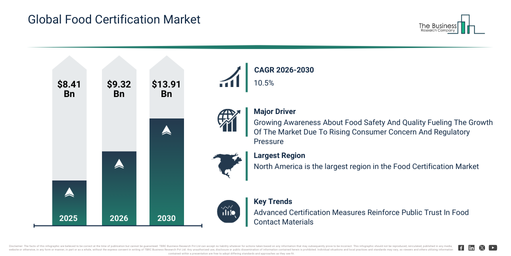
The food certification market has observed rapid expansion in recent years. Its value is expected to rise from $8.41 billion in 2025 to $9.32 billion in 2026, indicating a compound annual growth rate (CAGR) of 10.8%. Historically, this growth has been driven by increased regulatory oversight in food safety, the broadening of food trade, greater consumer awareness about food quality, the adoption of standardized food safety frameworks, and the proliferation of organized food retail.
The food certification market is anticipated to experience substantial growth over the next few years. It is projected to reach $13.91 billion by 2030, exhibiting a compound annual growth rate (CAGR) of 10.5%. This expansion during the forecast period is driven by factors such as increasing demand for sustainability certifications, the rising adoption of digital audit technologies, the expansion of cross-border food exports, a growing focus on supply chain transparency, and increasing regulatory harmonization across regions. Major trends for the forecast period include the increasing adoption of digital certification platforms, a rising demand for traceability and transparency services, a growing emphasis on sustainable and ethical food certifications, the expansion of multi-standard certification audits, and enhanced integration of blockchain-based verification systems.
Get A Free Sample Report With In-Depth Market Insights:
Food Certification Market Growth Factors: What’s Supporting Expansion?
The increasing recognition of food safety and quality is anticipated to fuel the expansion of the food certifications market. This encompasses a broad spectrum of practices, standards, and management systems aimed at guaranteeing food products are hazard-free, consistently adhere to specific quality criteria, and are fit for human consumption across the entire supply chain. The heightened awareness stems from extensive media reporting on foodborne dangers, leading governments and businesses to implement more stringent protocols. Food certification confirms food safety and quality by validating that items comply with predetermined standards, thereby rendering them safe for consumption. This process mitigates health hazards, guarantees adherence to regulations, and fosters consumer confidence, enhancing overall trust in food products. A notable example is data from October 2024 by the World Health Organization (WHO), a specialized agency of the United Nations situated in Switzerland, which reports that roughly 600 million people, or one in ten, annually contract foodborne illnesses. This leads to approximately 420,000 deaths and an estimated annual loss of $110 billion in productivity and medical costs, with children under 5 years old shouldering about 40% of this impact, translating to roughly 125,000 deaths each year. Consequently, increasing consciousness regarding food safety and quality is a key factor propelling the expansion of the food certification market.
Food Certification Market Segment Landscape And Growth Outlook
The food certification market covered in this report is segmented –
1) By Type: International Organization for Standardization 22000, British Retail Consortium (BRC), Safe Quality Food (SQF), International Featured Standards (IFS), HALAL, KOSHER, Free-From Certifications, Hazard Analysis and Critical Control Points (HACCP), Vegan, Others Types
2) By Category: Organic Food Certification, Sustainable Food Certification
3) By Risk: High-Risk Foods, Low-Risk Foods
4) By Application: Bakery Products, Confectionary Products, Baby Foods, Meat And Poultry Products, Convenience Food, Nuts And Dried Fruits, Milk And Dairy Products, Tobacco, Honey, Tea And Coffee
5) By End User: Growers, Manufacturers, Retailers, Food Service Organization, Others Categories
Subsegments:
1) By International Organization For Standardization 22000: Food Safety Management Systems, Quality Management Integration, Supply Chain Certification, Risk Assessment Frameworks
2) By British Retail Consortium: Food Safety Standard, Packaging Material Standard, Storage And Distribution Standard, Consumer Product Standard
3) By Safe Quality Food: Primary Production Certification, Manufacturing Certification, Retail And Foodservice Certification, Storage And Distribution Certification
4) By International Featured Standards: Food Standard, Logistics Standard, Broker Standard, Packaging Standard
5) By Halal: Meat And Poultry Certification, Processed Food Certification, Beverages Certification, Ingredients Certification
6) By Kosher: Meat Certification, Dairy Certification, Pareve Certification, Passover Certification
7) By Free-From Certifications: Gluten-Free Certification, Allergen-Free Certification, Lactose-Free Certification, Additive-Free Certification
8) By Hazard Analysis And Critical Control Points: System Design Certification, Process Verification, Compliance Audit, Risk Management Training
9) By Vegan: Food And Beverage Certification, Ingredient Certification, Cosmetics And Personal Care Certification, Restaurant Certification
10) By Others Types: Organic Certification, Non-Genetically Modified Certification, Fair Trade Certification, Sustainable Sourcing Certification
Food Certification Market Industry Trends: What’s Reshaping Demand?
Major companies in the food certification market are prioritizing the development of novel solutions, such as safe food packaging certification protocols, to enhance consumer safety from chemical exposure in materials that contact food. A safe food packaging certification protocol is a scientifically based evaluation system that confirms food contact packaging materials meet safety standards by assessing and eliminating harmful chemical substances that might transfer to food. For instance, in September 2025, the National Science Foundation (NSF), a US public health and safety organization, launched NSF Protocol 525: Safe Food Packaging Certification. This protocol sets forth rigorous, science-driven criteria for evaluating packaging materials and verifying the absence of hazardous substances like per- and polyfluoroalkyl substances, bisphenol A, heavy metals, and phthalates. This advancement strengthens adherence to regulations, promotes transparency in packaging safety, and builds public confidence by ensuring that food contact materials achieve higher safety standards.
Food Certification Market Competitive Landscape: Who Leads The Industry?
Major companies operating in the food certification market are Société Générale de Surveillance (SGS), Eurofins Scientific, Bureau Veritas, Dekra SE, Intertek Group plc, Mérieux NutriSciences, DNV GL, Underwriters Laboratories (UL), TÜV Nord Group, ALS Limited, Lloyd’s Register (LR), AsureQuality, NSF International, SCS Services, Control Union Certifications, FoodChain ID Group Inc., BRCGS, Eagle Certification Group, Groupe Ecocert, The Non‑GMO Project, Biocert, Taiwan Quality Food Association, ISOQAR (Alcumus ISOQAR), Food Alliance
View The Full Food Certification Market Report:
Food Certification Market Top Region By Revenue And Market Share
North America was the largest region in the food certification market in 2025. Asia-Pacific is expected to be the fastest-growing region in the forecast period. The regions covered in the food certification market report are Asia-Pacific, South East Asia, Western Europe, Eastern Europe, North America, South America, Middle East and Africa.
Reach Out To Our Team:
The Business Research Company: https://www.thebusinessresearchcompany.com/
Americas: +1 310-496-7795
Asia: +44 7882 955267 & +91 8897263534
Europe: +44 7882 955267
Email us at: marketing@tbrc.info
Follow us on:
LinkedIn: https://in.linkedin.com/company/the-business-research-company
YouTube: https://www.youtube.com/channel/UC24_fI0rV8cR5DxlCpgmyFQ
Global Market Model: https://www.thebusinessresearchcompany.com/global-market-model

Wasay has over a decade of experience in market research, data modelling, and analytics, with prior experience at GlobalData and Decision Tree Consulting Services. At The Business Research Company , he leads research operations across syndicated studies, customized consulting engagements, and the Global Market Model platform. His professional experience includes supporting organizations such as Boston Consulting Group, KPMG, and Ernst & Young. Wasay holds a degree in Electronics and Communications Engineering, postgraduate management qualifications from International Management Institute Belgium and Indian School of Business and Entrepreneurship, and completed the Integrated Program in Business Analytics from Indian Institute of Management Indore.