Built to provide research that’s more actionable and strategically valuable, The Business Research Company’s 2026 market reports include market attractiveness analysis, total addressable market sizing, company benchmarking matrices, interactive Excel dashboards, broader supply chain intelligence, emerging startup tracking, and in-depth product insights.
Food Cold Chain Market Size And Revenue Outlook Through 2030
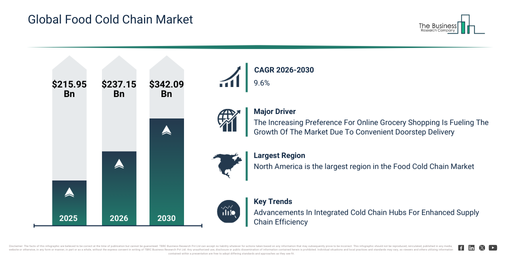
The food cold chain market’s size has demonstrated strong growth in recent years. It is projected to expand from $215.95 billion in 2025 to $237.15 billion in 2026, achieving a compound annual growth rate (CAGR) of 9.8%. This historical growth can be ascribed to the increasing consumption of frozen and processed foods, the development of organized food retail, a rising demand for year-round food availability, advancements in refrigerated transport infrastructure, and heightened food safety regulations.
The food cold chain market size is projected to experience substantial expansion over the coming years. It is anticipated to attain a size of $342.09 billion in 2030, registering a compound annual growth rate (CAGR) of 9.6%. This anticipated expansion during the forecast period is primarily driven by factors such as the increasing prevalence of online grocery deliveries, growing investments in cold storage infrastructure, the extension of pharmaceutical-grade cold chains into food applications, a heightened emphasis on carbon-neutral logistics, and the broader implementation of smart cold chain technologies. Key developments expected within this period include the wider deployment of IoT-based temperature monitoring systems, an escalating demand for multi-temperature warehousing solutions, the increasing embrace of energy-efficient refrigeration technologies, the broadening of last-mile cold chain logistics, and a strengthened commitment to food safety compliance.
Get A Free Sample Report With In-Depth Market Insights:
Food Cold Chain Market Development Factors: What’s Supporting Demand?
The expanding consumer preference for online grocery shopping is anticipated to drive the development of the food cold chain market. Online grocery shopping encompasses the purchase of both perishable and ambient food items through digital channels such as websites or mobile applications, offering options like home delivery or click-and-collect fulfillment. This shift towards online grocery is largely attributed to the time-saving convenience of receiving groceries at one’s doorstep. The growing inclination for online grocery shopping consequently generates a demand for efficient food cold chain systems, given that consistent temperature management is vital for preserving the freshness and safety of perishable goods like fruits, vegetables, dairy, and meat during their storage, transit, and delivery. For illustration, a report in August 2025 from the Singapore Department of Statistics, a government data portal based in Singapore, indicated that the online share of supermarket and hypermarket sales in 2023 significantly increased from 11.3% (Jan 2023) to 13.4% (Feb 2023) and further to 13.6% (Mar 2023), thereby demonstrating a clear rise in e-grocery engagement within the category. Thus, the increasing preference for online grocery shopping is serving as a significant driver for the growth of the food cold chain market.
Food Cold Chain Market Segment Analysis Spotlighting Growth Areas
The food cold chain market covered in this report is segmented –
1) By Type Of Cold Chain: Refrigerated Transportation, Cold Storage, Ice Cream Logistics, Temperature-Controlled Warehousing
2) By Technology: Blast Freezing, Vapor Compression, Programmable Logic Controller (PLC), Evaporating Cooling, Cryogenic Systems, Other Technologies
3) By Distribution Channel: Direct Sales, Distributors And Wholesalers, Online Sales, Third-Party Logistics Providers (3PL)
4) By Application: Fruits And Vegetables, Dairy And Frozen Desserts, Fish, Meat, And Seafood, Bakery And Confectionery, Other Applications
Subsegments:
1) By Refrigerated Transportation: Road Transport, Rail Transport, Sea Transport, Air Transport, Last-Mile Delivery, Intermodal Transport
2) By Cold Storage: Chilled Storage, Frozen Storage, Deep-Freeze Storage, Controlled Atmosphere Storage, Blast Freezing Rooms
3) By Ice Cream Logistics: Hardening And Blast Freezing, Deep-Freeze Storage, Frozen Line-Haul Transport, Frozen Last-Mile Delivery, Temperature-Validated Packaging, Store Replenishment Distribution
4) By Temperature-Controlled Warehousing: Public Refrigerated Warehousing, Contract Refrigerated Warehousing, Multi-Temperature Warehousing, Bonded Cold Warehousing, Cross-Dock Warehousing, Online Grocery Fulfillment Warehousing
Food Cold Chain Market Transformation Trends: What Innovations Are Driving Change?
Major companies engaged in the food cold chain market are prioritizing the development of cold chain infrastructure to enhance operational efficiency, reduce delivery times, and ensure the temperature-controlled handling of perishable products across the entire supply chain. Cold chain infrastructure refers to the organized system comprising temperature-regulated storage facilities, transportation equipment, and monitoring technologies, all designed to keep perishable goods safe and fresh from their point of production to their ultimate delivery. For example, in July 2025, Maersk A/S, a Denmark-based logistics entity, launched its Integrated Packing and Cold Storage Hub in Olmos, Peru. The Olmos facility operates as an advanced fruit logistics hub, meticulously designed to optimize the export operations of the region. It integrates key logistics functions such as processing, cold storage, and depot warehousing within the extensive Maersk supply chain network. Additionally, the hub offers supplementary services, including container depot management, refrigerated inland transport, and on-site customs processing, to ensure a fully integrated and highly efficient customer experience.
Food Cold Chain Market Leading Companies: Who Holds The Strongest Market Presence?
Major companies operating in the food cold chain market are DHL Supply Chain, DSV A/S, XPO Logistics Inc., Nichirei Logistics Group, Americold Logistics LLC, NewCold Advanced Cold Logistics, ColdEX Logistics Pvt. Ltd., Celcius Logistics Pvt. Ltd., Crystal Logistic Cool Chain Ltd., Rinac Pvt. Ltd., Interstate Cold Storage, Siddhi Cold Chain Pvt. Ltd., ColdStar Logistics Pvt. Ltd., ALC Cold Chain Logistics Pvt. Ltd., WareIQ Solutions Pvt. Ltd., Indicold Private Ltd., Reefer Express Pvt. Ltd., Arihant Cold Storage Pvt. Ltd., Godamwale Cold Storage Pvt. Ltd., Kaveri Cold Chain Logistics Pvt. Ltd.
View The Full Food Cold Chain Market Report:
Food Cold Chain Market Regional Analysis: Which Geography Leads On Revenue?
North America was the largest region in the food cold chain market in 2025. Asia-Pacific is expected to be the fastest-growing region in the forecast period. The regions covered in the food cold chain market report are Asia-Pacific, South East Asia, Western Europe, Eastern Europe, North America, South America, Middle East and Africa.
Reach Out To Our Team:
The Business Research Company: https://www.thebusinessresearchcompany.com/
Americas: +1 310-496-7795
Asia: +44 7882 955267 & +91 8897263534
Europe: +44 7882 955267
Email us at: marketing@tbrc.info
Follow us on:
LinkedIn: https://in.linkedin.com/company/the-business-research-company
YouTube: https://www.youtube.com/channel/UC24_fI0rV8cR5DxlCpgmyFQ
Global Market Model: https://www.thebusinessresearchcompany.com/global-market-model

Wasay has over a decade of experience in market research, data modelling, and analytics, with prior experience at GlobalData and Decision Tree Consulting Services. At The Business Research Company , he leads research operations across syndicated studies, customized consulting engagements, and the Global Market Model platform. His professional experience includes supporting organizations such as Boston Consulting Group, KPMG, and Ernst & Young. Wasay holds a degree in Electronics and Communications Engineering, postgraduate management qualifications from International Management Institute Belgium and Indian School of Business and Entrepreneurship, and completed the Integrated Program in Business Analytics from Indian Institute of Management Indore.