Enhanced with market attractiveness analysis, total addressable market evaluation, company benchmarking matrices, interactive Excel dashboards, expanded supply chain intelligence, emerging startup coverage, and detailed product insights, The Business Research Company’s 2026 market reports deliver more actionable and strategically valuable research.
Aerospace Avionics Market Expected To Reach $103.95 Billion By 2030 At 4.32% CAGR
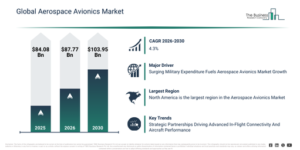
The aerospace avionics market has shown consistent expansion in size recently. It is forecast to increase from $84.08 billion in 2025 to $87.77 billion in 2026, demonstrating a compound annual growth rate (CAGR) of 4.4%. Historically, this growth can be attributed to the rising integration of advanced weather systems to improve situational awareness in commercial and military aviation, stricter regulatory mandates propelling the demand for reliable flight recorders and cockpit voice recorders, an uptick in aircraft deliveries increasing the requirement for avionics displays and integrated cockpit systems, the proliferation of fuel system upgrades aimed at enhancing efficiency and safety across aging fleets, and the creation of digital flight control and monitoring systems that bolster operational reliability.
The aerospace avionics market size anticipates consistent expansion over the forthcoming years. This market is projected to reach $103.95 billion by 2030, exhibiting a compound annual growth rate (CAGR) of 4.3%. Factors contributing to this growth during the forecast period include the rapid incorporation of digital and connected avionics architectures for the next generation, an increasing need for sophisticated situational awareness and predictive weather analysis tools, heightened investment in fuel-efficient and hybrid-electric aircraft which fosters advancements in avionics-integrated fuel systems, a greater embrace of AI-powered monitoring and health-management systems for aircraft, and an elevated requirement for modular and upgradable avionics to facilitate enduring fleet modernization and adherence to regulations. Key trends anticipated in this period encompass the expanded integration of advanced flight control and monitoring systems, a growing call for improved safety and redundancy in avionics architectures, the proliferation of modular and upgradable avionics components, a greater utilization of lightweight and compact avionics hardware, and the development of avionics specifically designed for future aircraft models.
Download A Free Sample Report For Comprehensive Market Insights:
Aerospace Avionics Market Industry Drivers: What Is Driving Revenue Growth?
Increasing military spending is projected to boost the expansion of the aerospace avionics market in the future. This spending represents the financial resources a nation or its government dedicates to its armed forces and associated operations. Such expenditure goes towards modernizing defense forces, equipping them with avionics systems like communication, navigation, and mission systems, thereby improving military aircraft effectiveness. For example, a report released in April 2024 by the Stockholm International Peace Research Institute (SIPRI), an international research institute located in Sweden, indicated that global military spending reached $2.443 trillion in 2023, representing a 6.8% real-term rise from 2022. Consequently, the uptick in military expenditure is fueling the expansion of the aerospace avionics market.
Aerospace Avionics Market Segment Breakdown: Which Categories Generate The Most Revenue?
The aerospace avionics market covered in this report is segmented –
1) By Systems: Flight Control System, Communication System, Navigation System, Monitoring System, Others Systems
2) By Application: Commercial Aviation, Military Aviation, Business Jets And General Aviation
3) By Distribution Channel: OEM, Aftermarket
Subsegments:
1) By Flight Control System: Autopilot Systems, Fly-By-Wire Systems, Flight Management Systems (FMS)
2) By Communication System: Radio Communication Systems, Satellite Communication Systems, Data Link Communication Systems
3) By Navigation System: Global Navigation Satellite Systems (GNSS), Inertial Navigation Systems (INS), Ground-Based Navigation Systems
4) By Monitoring System: Engine Monitoring Systems, Environmental Control Systems, Health Management Systems
5) By Other Systems: Surveillance Systems, Display Systems, Electronic Warfare Systems
#Aerospace Avionics Market Growth Trends: What Is Influencing The Future Outlook?
Key companies operating within the aerospace avionics market are strategically forming partnerships to enhance aircraft safety, efficiency, and performance. Such a strategic partnership represents a collaboration between businesses to combine their strengths, resources, or technologies for mutual benefit, while simultaneously pursuing long-term goals and fostering innovation. For instance, in September 2025, Panasonic Avionics, a US-based inflight entertainment industry company, collaborated with Intellian Technologies, a US-based provider of satellite communication antennas and ground gateway solutions, to unveil a groundbreaking, high-performance, cost-effective low Earth orbit (LEO)-Ku terminal system. This system is designed to connect to Eutelsat’s OneWeb LEO network, aiming to significantly improve airline Wi-Fi service. The terminal is equipped with Intellian’s new LEO-Ku aviation antenna, which features an integrated modem and controller in a radome-free design, delivering speeds up to 195 Mbps with less than 100 milliseconds latency. This lightweight, modular system can be installed overnight and supports multi-constellation operation, offering airlines a faster, more reliable, and future-proof in-flight connectivity solution that also assists in reducing fuel burn and advancing sustainability goals.
Aerospace Avionics Market Key Players And Strategic Industry Positioning
Major companies operating in the aerospace avionics market are Thales Group, L3Harris Technologies Inc., Airbus SAS, Boeing Co., BAE Systems Inc., Northrop Grumman Corporation, Saab AB, Leonardo S.p.A., Elbit Systems Ltd., General Dynamics Corporation, General Electric Company, Cobham PLC, Honeywell International Inc., Raytheon Technologies, Safran S.A., Lockheed Martin Corporation, Garmin Ltd., Meggitt PLC, Curtiss-Wright Corporation, Teledyne Technologies Incorporated, Moog Inc., Astronics Corporation, TransDigm Group Incorporated, Kratos Defense & Security Solutions Inc., Avidyne Corporation, FreeFlight Systems, Becker Avionics International Group, Flight Data Systems Pty. Ltd., Innovative Solutions & Support Inc.
Access The Complete Aerospace Avionics Market Report:
Aerospace Avionics Market Regional Distribution: Which Areas Drive Market Expansion?
North America was the largest region in the aerospace avionics market in 2025. Asia-Pacific is expected to be the fastest-growing region in the forecast period. The regions covered in the aerospace avionics market report are Asia-Pacific, South East Asia, Western Europe, Eastern Europe, North America, South America, Middle East, Africa.
Access a Customized Aerospace Avionics Market Report for Deeper Competitive Insights
https://www.thebusinessresearchcompany.com/customise?id=5712&type=smp
Get in touch with us:
The Business Research Company: https://www.thebusinessresearchcompany.com/
Americas: +1 310-496-7795
Asia: +44 7882 955267 & +91 8897263534
Europe: +44 7882 955267
Email us at: marketing@tbrc.info
Follow us on:
LinkedIn: https://in.linkedin.com/company/the-business-research-company
YouTube: https://www.youtube.com/channel/UC24_fI0rV8cR5DxlCpgmyFQ
Global Market Model: https://www.thebusinessresearchcompany.com/global-market-model

Wasay has over a decade of experience in market research, data modelling, and analytics, with prior experience at GlobalData and Decision Tree Consulting Services. At The Business Research Company , he leads research operations across syndicated studies, customized consulting engagements, and the Global Market Model platform. His professional experience includes supporting organizations such as Boston Consulting Group, KPMG, and Ernst & Young. Wasay holds a degree in Electronics and Communications Engineering, postgraduate management qualifications from International Management Institute Belgium and Indian School of Business and Entrepreneurship, and completed the Integrated Program in Business Analytics from Indian Institute of Management Indore.