Enhanced with market attractiveness analysis, total addressable market evaluation, company benchmarking matrices, interactive Excel dashboards, expanded supply chain intelligence, emerging startup coverage, and detailed product insights, The Business Research Company’s 2026 market reports deliver more actionable and strategically valuable research.
Aerospace Electronics Market Size, Value And Growth Trends Through 2030
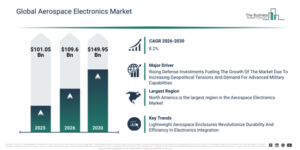
The aerospace electronics market size has seen strong growth in recent years. It is projected to expand from $101.05 billion in 2025 to $109.6 billion in 2026, at a compound annual growth rate (CAGR) of 8.5%. Historically, this growth can be attributed to factors such as the increasing adoption of integrated modular avionics (IMA) in modern aircraft, the development of aircraft health monitoring systems for predictive maintenance, a rising demand for reliable mission computers and engine control electronics, the implementation of advanced cockpit voice recorders and navigation displays, and government and defense investment in high-performance aerospace electronic systems.
The aerospace electronics market is projected to undergo significant growth in the coming years, with its size expected to reach $149.95 billion by 2030, exhibiting a compound annual growth rate (CAGR) of 8.2%. This growth during the forecast period can be attributed to the increasing integration of advanced actuation and control systems, the expansion of electrical wiring interconnect systems (EWIS) for next-generation aircraft, a rising demand for miniaturized and high-efficiency power supply units, the adoption of smart and connected avionics to enhance situational awareness, and the growing procurement of aerospace electronics for unmanned and space-based platforms. Prominent trends anticipated in this period include an escalating demand for integrated modular avionics (IMA) architectures, a wider adoption of advanced aircraft health monitoring electronics, a growing necessity for miniaturized high-reliability aerospace components, the expansion of mission-critical electronic subsystems in defense platforms, and a higher integration of power-efficient avionics for next-generation aircraft.
Download A Free Sample Report For Comprehensive Market Insights:
Aerospace Electronics Market Expansion Supported By Key Demand Factors
Increased spending within the defense sector is anticipated to drive expansion in the aerospace electronics market. The defense sector encompasses governmental bodies and industries dedicated to creating, manufacturing, and maintaining military equipment and services. This rise in defense investment stems from growing geopolitical instability, where heightened dangers from terrorism, cyber warfare, and localized disputes necessitate nations increasing their defense budgets to improve capabilities and strengthen strategic deterrence. Aerospace electronics bolster the defense sector by facilitating sophisticated communication, navigation, monitoring, and electronic warfare, consequently enhancing targeting accuracy, enabling immediate data exchange, and boosting overall mission success. A notable example is the UK, where, as reported by the House of Commons Library, a research and information service, in May 2025, defense spending is forecast to rise from $62.16 billion (£53.9 billion) in 2023-24 to $65.61 billion (£56.9 billion) in 2024-25, and further to $68.96 billion (£59.8 billion) in 2025-26, indicating an average annual real-terms growth of 2.4% throughout this timeframe. Consequently, the increased investments in the defense sector are driving forward the aerospace electronics market.
Aerospace Electronics Market Segment Analysis And Revenue Opportunities
The aerospace electronics market covered in this report is segmented –
1) By Product Type: Communication Systems, Navigation Systems, Flight Control Systems, Avionics, Power Management Systems
2) By Component: Sensors, Microcontrollers, Antennas, Display Systems, Computing Systems
3) By Application: Commercial Aviation, Military Aviation, Space Exploration, Unmanned Aerial Vehicles (UAVs)
4) By End-User: Original Equipment Manufacturer (OEM), Aftermarket
Subsegments:
1) By Communication Systems: Satellite Communication (SATCOM) Systems, VHF Or UHF Radio Systems, Data Link Communication Systems, Intercom Systems
2) By Navigation Systems: Global Positioning Systems (GPS), Inertial Navigation Systems (INS), Terrain Awareness And Warning Systems (TAWS), Automatic Direction Finders (ADF)
3) By Flight Control Systems: Fly-by-Wire (FBW) Systems, Autopilot Systems, Flight Management Systems (FMS), Automatic Flight Control Systems (AFCS)
4) By Avionics: Surveillance And Collision Avoidance Systems, Flight Data Recorders (FDR), Weather Radar Systems, Electronic Warfare Systems
5) By Power Management Systems: Power Distribution Units (PDU), Auxiliary Power Units (APU), Battery Management Systems (BMS), Power Conversion Units
Aerospace Electronics Market Growth Trends Influencing Competitive Dynamics
Leading entities within the aerospace electronics market are prioritizing the creation of sophisticated products, including innovative hermetic packages, with the goal of decreasing the mass and enhancing the resilience of essential aerospace electronic systems amidst challenging conditions. These hermetic packages denote sealed containers designed to safeguard electronic parts from external elements like humidity, atmospheric gases, particulate matter, and varying pressures. As an illustration, SCHOTT AG, a global glass enterprise headquartered in Germany, introduced lightweight microelectronic packages in September 2023. These were tailored for the aerospace sector, addressing the stringent needs of aviation and space uses where minimal weight is crucial for effectiveness and economic viability. SCHOTT’s recently developed lightweight microelectronic packages for aerospace applications achieve a weight reduction of up to two-thirds compared to conventional kovar-based packages, accomplished through the primary use of aluminum. Even with their lighter mass, these packages deliver strong hermetic safeguarding for delicate avionics and electronic components, guaranteeing enduring dependability under the rigorous circumstances found in aerospace settings. Their high versatility makes them apt for various applications, such as microwave and RF packages, DC/DC converter packages, and hermetic sensor packages, serving both aircraft and satellites.
Aerospace Electronics Market Leading Players Shaping Industry Direction
Major companies operating in the aerospace electronics market are RTX Corporation, The Boeing Company, Lockheed Martin, Airbus SE, Panasonic Holdings Corporation, General Dynamics Corporation, Northrop Grumman Corporation, Honeywell International Inc., GE Aerospace, BAE Systems, Safran S.A., Eaton Corporation, Thales Group, L3Harris Technologies Inc., Parker Hannifin Corporation, Leonardo S.p.A., Ametek Inc., Elbit Systems, Teledyne Technologies Incorporated, TransDigm Group Incorporated
Access The Complete Aerospace Electronics Market Report:
Aerospace Electronics Market Regional Analysis: Which Region Leads By Revenue?
North America was the largest region in the aerospace electronics market in 2025. Asia-Pacific is expected to be the fastest-growing region in the forecast period. The regions covered in the aerospace electronics market report are Asia-Pacific, South East Asia, Western Europe, Eastern Europe, North America, South America, Middle East, Africa.
Access a Customized Aerospace Electronics Market Report for Deeper Competitive Insights
https://www.thebusinessresearchcompany.com/customise?id=11877&type=smp
Get in touch with us:
The Business Research Company: https://www.thebusinessresearchcompany.com/
Americas: +1 310-496-7795
Asia: +44 7882 955267 & +91 8897263534
Europe: +44 7882 955267
Email us at: marketing@tbrc.info
Follow us on:
LinkedIn: https://in.linkedin.com/company/the-business-research-company
YouTube: https://www.youtube.com/channel/UC24_fI0rV8cR5DxlCpgmyFQ
Global Market Model: https://www.thebusinessresearchcompany.com/global-market-model

Wasay has over a decade of experience in market research, data modelling, and analytics, with prior experience at GlobalData and Decision Tree Consulting Services. At The Business Research Company , he leads research operations across syndicated studies, customized consulting engagements, and the Global Market Model platform. His professional experience includes supporting organizations such as Boston Consulting Group, KPMG, and Ernst & Young. Wasay holds a degree in Electronics and Communications Engineering, postgraduate management qualifications from International Management Institute Belgium and Indian School of Business and Entrepreneurship, and completed the Integrated Program in Business Analytics from Indian Institute of Management Indore.