
Built to provide research that’s more actionable and strategically valuable, The Business Research Company’s 2026 market reports include market attractiveness analysis, total addressable market sizing, company benchmarking matrices, interactive Excel dashboards, broader supply chain intelligence, emerging startup tracking, and in-depth product insights.
Aircraft Engine Fuel Systems Market Growth Potential: How Will Market Size Shift Through 2030?
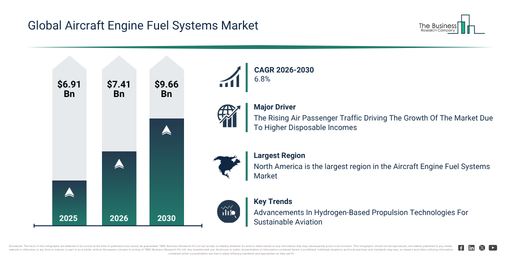
The aircraft engine fuel systems market has experienced robust growth in recent years. It is projected to increase from $6.92 billion in 2025 to $7.42 billion in 2026, reflecting a compound annual growth rate (CAGR) of 7.3%. This historical expansion can be attributed to several factors including growth in global aircraft production, increasing demand for fuel efficient engines, stringent aviation safety regulations, expansion of commercial aviation networks, and rising investments in military aircraft modernization.
The market for aircraft engine fuel systems is projected to experience substantial expansion over the upcoming years. This market is anticipated to reach $9.67 billion by 2030, exhibiting a compound annual growth rate (CAGR) of 6.8%. Several factors contribute to this projected growth during the forecast period, including the increased embrace of sustainable aviation fuels, the wider implementation of next-generation aircraft platforms, a surge in investments directed towards electronic fuel control systems, the broadening scope of aircraft fleet replacement initiatives, and the escalating need for high-performance engine systems. Key trends characterizing the forecast period encompass a greater acceptance of advanced fuel metering technologies, an escalating requirement for lightweight fuel system parts, the progressive incorporation of systems compatible with alternative fuels, an intensified emphasis on improving fuel efficiency within aircraft engines, and an expansion in aftermarket services for fuel system maintenance and upgrades.
Get A Free Sample Report With In-Depth Market Insights:
Aircraft Engine Fuel Systems Market Demand Drivers Opening New Revenue Streams
The anticipated increase in air passenger traffic is projected to fuel the expansion of the aircraft engine fuel systems market in the coming period. Air passenger traffic is defined as the overall count of individuals transported by airlines via both domestic and international routes within a given timeframe, acting as a crucial measure of the demand for air travel. This growth in air passenger traffic stems from increased disposable incomes, enabling a greater number of individuals to afford flights for both professional and recreational purposes. The surge in air passenger movement is stimulating a need for new aircraft and more frequent flight operations, which consequently elevates the requirement for sophisticated aircraft engine fuel systems that improve fuel efficiency, system reliability, and overall engine performance. As an illustration, in October 2024, data from the Department of Transportation, a US-based government department, showed that in August 2024, 647,205 flights were conducted, marking a 2.61% increase compared to the 630,761 flights recorded in August 2023. Consequently, the growing volume of air passenger traffic is fostering expansion within the aircraft engine fuel systems market.
Aircraft Engine Fuel Systems Market Segmentation: How Does The Market Break Down By Category?
The aircraft engine fuel systems market covered in this report is segmented –
1) By Component: Pumps, Valves, Filters, Gauges, Other Components
2) By Engine Type: Turbofan, Turboprop, Turboshaft, Piston Engine
3) By Fuel Type: Aviation Turbine Fuel, Jet Fuel, Biofuels, Synthetic Fuels, Conventional Fuels
4) By Technology: Full Authority Digital Engine Control Based Systems, Hydromechanical Systems, Electronic Fuel Control Systems, Hybrid Fuel Management Systems
5) By End User: Original Equipment Manufacturers, Aftermarket, Defense Organizations, Commercial Airlines
Subsegments:
1) By Pumps: Fuel Boost Pumps, Fuel Transfer Pumps, Fuel Metering Pumps, Engine Driven Fuel Pumps
2) By Valves: Fuel Shutoff Valves, Fuel Control Valves, Pressure Relief Valves, Check Valves
3) By Filters: Fuel Inlet Filters, Fine Fuel Filters, Water Separator Filters, Cartridge Fuel Filters
4) By Gauges: Fuel Pressure Gauges, Fuel Flow Gauges, Fuel Quantity Gauges, Fuel Temperature Gauges
5) By Other Components: Fuel Nozzles, Fuel Manifolds, Fuel Lines, Fuel Sensors
Aircraft Engine Fuel Systems Market Trends Powering Strategic Industry Growth
Leading companies within the aircraft engine fuel systems market are concentrating on creating sophisticated technological solutions, including hydrogen-powered fuel cell propulsion systems, aiming to decrease aviation emissions, enhance fuel efficiency, and facilitate the shift towards sustainable air travel. Such a system represents a contemporary aircraft energy method, transforming liquid hydrogen into electrical power through fuel cells to operate electric motors, thereby generating significantly fewer emissions compared to conventional jet fuel engines. An illustration of this is MTU Aero Engines AG, a Germany-based aircraft engine manufacturer, introducing its Flying Fuel Cell (FFC) in June 2023, which is an innovative aviation fuel cell technology intended for upcoming zero-emission aircraft. This system employs liquid hydrogen, kept in advanced fuel tanks, and converts it into electrical energy via highly efficient fuel cells, which subsequently drives an electric propulsion motor. Operation of this technology results in the elimination of direct carbon dioxide, nitrogen oxide, and particulate emissions, releasing only water vapor. The complete solution incorporates advanced hydrogen fuel storage, comprehensive fuel management, sophisticated control systems, and electric propulsion components, all contributing to superior energy efficiency and a substantial reduction in the environmental footprint of aviation.
Aircraft Engine Fuel Systems Market Competitive Overview And Top Companies
Major companies operating in the aircraft engine fuel systems market report are Allen Aircraft Products Inc, AMETEK Inc., Crane Company, Curtiss-Wright Corporation, Currawong Engineering Pty Ltd, Eaton Corporation plc, GE Aerospace, GKN Aerospace, Honeywell International Inc., ITT Inc., Liebherr Group, Moog Inc., Ontic Engineering & Manufacturing Ltd, Parker Hannifin Corp, Porvair plc, Robertson Fuel Systems LLC, Rolls-Royce Holdings plc, RTX Corporation, Safran S.A., Secondo Mona S.p.A., Weldon Pump LLC, Woodward Inc.
View The Full Aircraft Engine Fuel Systems Market Report:
Aircraft Engine Fuel Systems Market Global Footprint: Which Region Leads The Market?
North America was the largest region in the aircraft engine fuel systems market in 2025. Asia-Pacific is expected to be the fastest-growing region in the forecast period. The regions covered in the aircraft engine fuel systems market report are Asia-Pacific, South East Asia, Western Europe, Eastern Europe, North America, South America, Middle East, Africa.
Reach Out To Our Team:
The Business Research Company: https://www.thebusinessresearchcompany.com/
Americas: +1 310-496-7795
Asia: +44 7882 955267 & +91 8897263534
Europe: +44 7882 955267
Email us at: marketing@tbrc.info
Follow us on:
LinkedIn: https://in.linkedin.com/company/the-business-research-company
YouTube: https://www.youtube.com/channel/UC24_fI0rV8cR5DxlCpgmyFQ
Global Market Model: https://www.thebusinessresearchcompany.com/global-market-model

Wasay has over a decade of experience in market research, data modelling, and analytics, with prior experience at GlobalData and Decision Tree Consulting Services. At The Business Research Company , he leads research operations across syndicated studies, customized consulting engagements, and the Global Market Model platform. His professional experience includes supporting organizations such as Boston Consulting Group, KPMG, and Ernst & Young. Wasay holds a degree in Electronics and Communications Engineering, postgraduate management qualifications from International Management Institute Belgium and Indian School of Business and Entrepreneurship, and completed the Integrated Program in Business Analytics from Indian Institute of Management Indore.