
Backed by market attractiveness analysis, total addressable market sizing, company benchmarking matrices, interactive Excel dashboards, wider supply chain intelligence, emerging startup coverage, and detailed product-level insights, The Business Research Company’s 2026 market reports are designed to offer research that is more actionable and strategically valuable than ever.
Automotive Powertrain Systems Market Size, Value And Growth Trajectory Through 2030
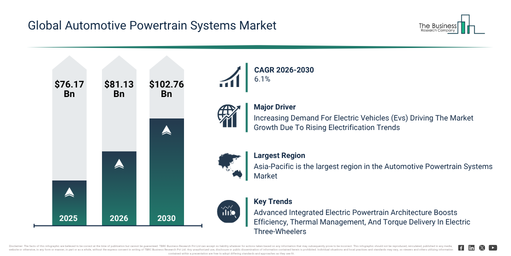
The automotive powertrain systems market size has experienced robust growth in recent years. It is anticipated to expand from $76.18 billion in 2025 to $81.14 billion in 2026, exhibiting a compound annual growth rate (CAGR) of 6.5%. The expansion observed in the historic period stemmed from factors including increasing global vehicle production volumes, a growing demand for fuel efficiency improvements, rising adoption of advanced transmission technologies, the expansion of passenger and commercial vehicle markets, and increasing investments in automotive powertrain innovations.
The automotive powertrain systems market size is anticipated to experience robust growth in the upcoming years, expanding to $102.76 billion by 2030, driven by a compound annual growth rate (CAGR) of 6.1%. This expansion during the forecast period is fueled by the increasing adoption of electric vehicle platforms, a rising need for hybrid vehicle systems, a heightened emphasis on emission reduction targets, augmented investments in next-generation battery technologies, and an expanding market for high-performance mobility solutions. Significant developments expected within this period include a greater embrace of lightweight powertrain components, an increasing demand for fuel-efficient powertrain systems, the wider integration of multi-speed transmission technologies, ongoing advancements in high-performance drivetrain systems, and the broader application of modular powertrain platform designs.
Get A Free Sample Report With In-Depth Market Insights:
Automotive Powertrain Systems Market Growth Momentum: What Factors Are Shaping Demand?
The escalating need for electric vehicles (EVs) is anticipated to propel the advancement of the automotive powertrain systems market moving forward. Electric vehicles are automobiles powered by electric motors, utilizing energy stored in rechargeable batteries instead of internal combustion engines. The surge in demand for EVs is attributed to strict emission regulations, as governments are implementing more rigorous carbon reduction targets to combat global warming. Automotive powertrain systems empower electric vehicles by integrating and optimizing the motor, inverter, transmission, and control units to efficiently transform electrical energy into motion while maximizing performance, range, and energy efficiency. For instance, in January 2025, according to the Cox Automotive, a US-based system software company, in 2024, full-year electric vehicle sales totaled 1.3 million, marking a 7.3% rise compared to the revised figures for 2023. Therefore, the increasing demand for electric vehicles (EVs) is stimulating the growth of the automotive powertrain systems market.
Automotive Powertrain Systems Market Segment Outlook: Which Categories Are Growing Fastest?
The automotive powertrain systems market covered in this report is segmented –
1) By Powertrain Type: Internal Combustion Engine, Hybrid Electric Vehicle, Plug In Hybrid Electric Vehicle, Battery Electric Vehicle, Fuel Cell Electric Vehicle
2) By Component Type: Engine, Transmission, Drivetrain, Exhaust System, Battery Systems
3) By Vehicle Type: Passenger Vehicles, Commercial Vehicles, Two Wheelers, Heavy Duty Vehicles
4) By Fuel Type: Gasoline, Diesel, Electric, Hydrogen
5) By End User: Original Equipment Manufacturers, Fleet Operators, Aftermarket, Logistics And Transportation Companies, Construction Equipment Manufacturers
Subsegments:
1) By Internal Combustion Engine: Gasoline Powertrain, Diesel Powertrain, Natural Gas Powertrain, Flex Fuel Powertrain
2) By Hybrid Electric Vehicle: Mild Hybrid, Full Hybrid, Series Hybrid, Parallel Hybrid
3) By Plug In Hybrid Electric Vehicle: Series Plug In Hybrid, Parallel Plug In Hybrid, Range Extended Plug In Hybrid
4) By Battery Electric Vehicle: Single Motor Battery Electric Vehicle, Dual Motor Battery Electric Vehicle, All Wheel Drive Battery Electric Vehicle, High Performance Battery Electric Vehicle
5) By Fuel Cell Electric Vehicle: Hydrogen Fuel Cell Passenger Vehicles, Hydrogen Fuel Cell Commercial Vehicles, Heavy Duty Fuel Cell Vehicles, Fuel Cell Buses
Automotive Powertrain Systems Market Trends Redefining Industry Growth
Leading firms within the automotive powertrain systems sector are concentrating on creating novel solutions, specifically integrated electric powertrain architectures, with the goal of boosting vehicle efficiency, optimizing thermal control, and elevating torque output for electric and hybrid mobility uses. These integrated electric powertrain architectures represent sophisticated drivetrain systems, consolidating electric motor, controller, and transmission components into a cohesive, highly efficient module. This design facilitates superior energy usage, minimizes mechanical power loss, and offers greater system compactness when contrasted with traditional multi-component powertrain configurations. An example is TSUYO Manufacturing Pvt Ltd, an India-based electric vehicle powertrain solutions company, which in February 2026, unveiled its Gen 3.0 IPM motor and controller architecture for electric three-wheelers in New Delhi. This launch introduced an advanced integrated powertrain system aimed at enhancing performance and efficiency in commercial electric vehicles. The system incorporates an interior permanent magnet (IPM) motor, characterized by externally positioned hall sensors and split-phase cabling, which collectively contribute to better heat dissipation and ensure stable operation even when subjected to high loads. Furthermore, it comprises an aluminum controller housing designed to boost thermal performance and is equipped with LED-based fault diagnostics for continuous, real-time monitoring.
Automotive Powertrain Systems Market Leading Companies And Competitive Benchmarking
Major companies operating in the automotive powertrain systems market report are Robert Bosch GmbH, Magna International Inc., Mitsubishi Electric Corporation, Cummins Inc., Valeo S.A., Eaton Corporation plc, Schaeffler AG, Nidec Corporation, BorgWarner Inc., Marelli Holdings Co Ltd., Dana Incorporated, Dauch Corporation, Garrett Motion Inc., AVL List GmbH, Lucid Group Inc., Punch Powertrain N.V., Hofer Powertrain GmbH, Mahle GmbH, Hyundai Mobis Co. Ltd., Aisin Corporation, Denso Corporation, ZF Friedrichshafen AG, JTEKT Corporation
View The Full Automotive Powertrain Systems Market Report:
Automotive Powertrain Systems Market Global Footprint: Which Region Leads The Market?
Asia-Pacific was the largest region in the automotive powertrain systems market in 2025. Asia-Pacific is expected to be the fastest-growing region in the forecast period. The regions covered in the automotive powertrain systems market report are Asia-Pacific, South East Asia, Western Europe, Eastern Europe, North America, South America, Middle East, Africa.
Reach Out To Our Team:
The Business Research Company: https://www.thebusinessresearchcompany.com/
Americas: +1 310-496-7795
Asia: +44 7882 955267 & +91 8897263534
Europe: +44 7882 955267
Email us at: marketing@tbrc.info
Follow us on:
LinkedIn: https://in.linkedin.com/company/the-business-research-company
YouTube: https://www.youtube.com/channel/UC24_fI0rV8cR5DxlCpgmyFQ
Global Market Model: https://www.thebusinessresearchcompany.com/global-market-model

Wasay has over a decade of experience in market research, data modelling, and analytics, with prior experience at GlobalData and Decision Tree Consulting Services. At The Business Research Company , he leads research operations across syndicated studies, customized consulting engagements, and the Global Market Model platform. His professional experience includes supporting organizations such as Boston Consulting Group, KPMG, and Ernst & Young. Wasay holds a degree in Electronics and Communications Engineering, postgraduate management qualifications from International Management Institute Belgium and Indian School of Business and Entrepreneurship, and completed the Integrated Program in Business Analytics from Indian Institute of Management Indore.