Through market attractiveness analysis, total addressable market evaluation, company benchmarking matrices, interactive Excel dashboards, expanded supply chain intelligence, emerging startup coverage, and detailed product insights, The Business Research Company’s 2026 market reports provide more actionable and strategically valuable research.
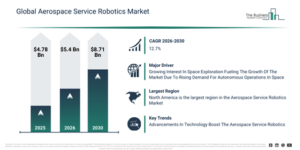
Aerospace Service Robotics Market Forecast Highlighting Growth From $5.4 Billion To $8.71 Billion
The aerospace service robotics market size has experienced significant expansion in recent times. Projections indicate it will expand from $4.78 billion in 2025 to $5.4 billion in 2026, demonstrating a compound annual growth rate (CAGR) of 13.0%. This historical growth stemmed from several factors, including the increasing implementation of robotic systems for aircraft inspection and maintenance, the advancement of autonomous ground support equipment in aerospace operations, a growing need for precision assembly and repair robotics, the incorporation of advanced sensors and artificial intelligence for enhancing operational efficiency, and the deployment of service robots in satellite servicing and cargo handling.
The aerospace service robotics market is projected to experience substantial expansion in the coming years, with its valuation set to reach $8.71 billion by 2030, exhibiting a compound annual growth rate (CAGR) of 12.7%. This anticipated growth during the forecast period is fueled by several factors, including the increasing implementation of fully autonomous aerospace service robots, the broadening application of robotics for logistics and material handling within aerospace facilities, a heightened emphasis on AI-driven capabilities for predictive maintenance, the creation of versatile robotic systems for tasks like inspection, assembly, and repair, and the growing integration of robotic solutions in both defense and commercial space initiatives. Key trends anticipated over this period encompass the expanded utilization of autonomous inspection robots, a greater uptake of robotic ground support systems, an increase in satellite servicing robots, the growing use of robots for assembly and fastening operations, and a more robust integration of multi-sensor robotic platforms.
Download A Free Sample Report For Comprehensive Market Insights:
Aerospace Service Robotics Market Growth Factors Supporting Long-Term Expansion
An increasing fascination with space exploration is anticipated to drive expansion in the aerospace service robotics market in the future. Space exploration involves investigating and examining outer space utilizing crewed and uncrewed spacecraft, satellites, and advanced technological solutions. This interest is escalating, driven by technological progress that facilitates more economical missions and the pursuit of novel resources beyond our planet. The heightened enthusiasm for space exploration fuels the requirement for aerospace service robotics, as there is a greater need for automated systems to execute intricate operations in dangerous or distant extraterrestrial settings, where human involvement is either restricted or perilous. For example, data from March 2024 by the National Aeronautics and Space Administration, a US-based independent agency, indicates that NASA’s budget is forecast to increase from $25.384 billion in 2024 to $26.40 billion in 2027. Consequently, this expanding interest in space exploration is a key factor propelling the growth of the aerospace service robotics market.
Aerospace Service Robotics Market Categorization By Product Type And Application
The aerospace service robotics market covered in this report is segmented –
1) By Type: Articulated, Cylindrical, Selective Compliance Assembly Or Articulated Robot Arms (SCARA), Cartesian, Other Types
2) By Operational Environment: Airborne Robotics, Ground-Based Robotics, Space-Based Robotics
3) By Technology: Artificial Intelligence Integration, Machine Learning Algorithms, Sensor Technology
4) By Application: Drilling And Fastening, Inspection, Welding, Painting And Coating, Other Applications
5) By End-User: Commercial Aviation, Military Aviation, Space Exploration
Subsegments:
1) By Articulated: 4-Axis Articulated Robots, 6-Axis Articulated Robots, High-Payload Articulated Robots, Compact Articulated Robots, Collaborative Articulated Robots
2) By Cylindrical: Vertical Cylindrical Robots, Horizontal Cylindrical Robots, Medium Reach Cylindrical Robots, Precision Cylindrical Robots
3) By Selective Compliance Articulated Robot Arm: Compact Selective Compliance Articulated Robot Arm Robots, High-Speed Selective Compliance Articulated Robot Arm Robots, Heavy-Payload Selective Compliance Articulated Robot Arm Robots, Cleanroom Selective Compliance Articulated Robot Arm Robots
4) By Cartesian: 2-Axis Cartesian Robots, 3-Axis Cartesian Robots, Gantry-Type Cartesian Robots, Modular Cartesian Robots
5) By Other Types: Delta Robots, Parallel Robots, Spherical Robots, Dual-Arm Robots, Mobile Manipulator Robots
Aerospace Service Robotics Market Industry Trends Shaping Future Revenue Growth
Leading firms within the aerospace service robotics market are concentrating on creating advanced solutions, including worm-like robots, to improve maintenance and inspection procedures. These worm-inspired robots are robotic systems characterized by their soft bodies, significant flexibility, and ability to navigate constricted or limited areas. As an example, in September 2023, GE Aerospace, a US-based aerospace company, introduced Sensiworm, a robot modeled after worm movements, engineered for the specific purpose of inspecting jet engines without their removal from the aircraft. This groundbreaking robot employs untethered soft robotics to explore the intricate internal structures of jet engines. It possesses capabilities to identify flaws and precisely gauge the thickness of thermal barrier coatings. Sensiworm is able to transmit live video and real-time data to operators, thereby boosting inspection efficiency by offering instant insights into the engines’ status. Its adaptable design allows it to navigate through narrow passages and complex shapes present in engine parts.
Aerospace Service Robotics Market Company Landscape And Strategic Competition
Major companies operating in the aerospace service robotics market are Airbus SE, Mitsubishi Electric Automation Inc., Northrop Grumman Corporation, ABB Ltd, BAE Systems plc, Baker Hughes Company, Safran S.A., Leonardo S.p.A., Kawasaki Heavy Industries Ltd., Fanuc Corporation, Space Exploration Technologies Corp., KUKA AG, Yaskawa Electric Corporation, Maxar Technologies Inc., Stäubli International AG, Güdel AG, Electroimpact Inc., Doosan Robotics Inc., Honeybee Robotics Ltd., TAL Manufacturing Solutions Limited.
Access The Complete Aerospace Service Robotics Market Report:
Aerospace Service Robotics Market Regional Outlook: Where Are The Largest Opportunities Located?
North America was the largest region in the aerospace service robotics market in 2025. Europe is expected to be the fastest-growing region in the forecast period. The regions covered in the aerospace service robotics market report are Asia-Pacific, South East Asia, Western Europe, Eastern Europe, North America, South America, Middle East, Africa.
Access a Customized Aerospace Service Robotics Market Report for Deeper Competitive Insights
https://www.thebusinessresearchcompany.com/customise?id=25207&type=smp
Get in touch with us:
The Business Research Company: https://www.thebusinessresearchcompany.com/
Americas: +1 310-496-7795
Asia: +44 7882 955267 & +91 8897263534
Europe: +44 7882 955267
Email us at: marketing@tbrc.info
Follow us on:
LinkedIn: https://in.linkedin.com/company/the-business-research-company
YouTube: https://www.youtube.com/channel/UC24_fI0rV8cR5DxlCpgmyFQ
Global Market Model: https://www.thebusinessresearchcompany.com/global-market-model

Wasay has over a decade of experience in market research, data modelling, and analytics, with prior experience at GlobalData and Decision Tree Consulting Services. At The Business Research Company , he leads research operations across syndicated studies, customized consulting engagements, and the Global Market Model platform. His professional experience includes supporting organizations such as Boston Consulting Group, KPMG, and Ernst & Young. Wasay holds a degree in Electronics and Communications Engineering, postgraduate management qualifications from International Management Institute Belgium and Indian School of Business and Entrepreneurship, and completed the Integrated Program in Business Analytics from Indian Institute of Management Indore.