
Backed by market attractiveness analysis, total addressable market sizing, company benchmarking matrices, interactive Excel dashboards, wider supply chain intelligence, emerging startup coverage, and detailed product-level insights, The Business Research Company’s 2026 market reports are designed to offer research that is more actionable and strategically valuable than ever.
Commercial Aircraft Manufacturing Market Expansion Outlook: What Revenue Opportunities Are Ahead?
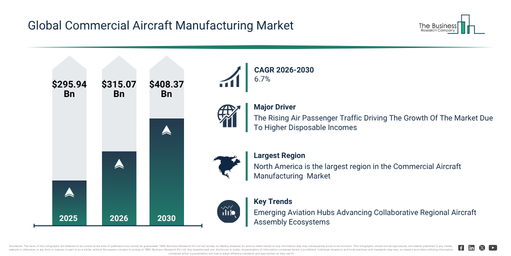
The commercial aircraft manufacturing market has experienced strong growth in recent years. It is forecast to grow from $295.95 billion in 2025 to $315.07 billion in 2026, achieving a compound annual growth rate (CAGR) of 6.5%. Historically, this growth can be attributed to several factors including the rise in global air passenger traffic, the expansion of low cost carrier networks, increasing international trade activities, a growing demand for aircraft replacement, and the growth in airline fleet expansion programs.
The commercial aircraft manufacturing market is projected to experience substantial expansion in the coming years. Its value is anticipated to reach $408.37 billion by 2030, demonstrating a compound annual growth rate (CAGR) of 6.7%. This anticipated growth during the forecast period stems from factors such as heightened demand for fuel-efficient aircraft, a surge in aircraft fleet modernization efforts, increased demand for air cargo transport, greater investments in advanced aircraft technologies, and the broadening of nascent aviation markets. Key trends expected during the same period encompass the wider adoption of lightweight composite materials in aircraft construction, an increase in the manufacturing of fuel-efficient aircraft models, a rising need for long-range and high-capacity aircraft, enhanced investments in technologies improving aircraft safety and performance, and the expansion of aircraft fleet modernization and replacement schemes.
Get A Free Sample Report With In-Depth Market Insights:
Commercial Aircraft Manufacturing Market Growth Drivers: What’s Behind The Acceleration?
The escalating air passenger traffic is anticipated to propel the expansion of the commercial aircraft manufacturing market moving forward. This traffic, defined as the cumulative number of individuals transported by airlines via domestic and international services over a given timeframe, serves as a crucial metric for air travel demand. The surge in air passenger traffic is largely attributable to increased disposable incomes, enabling more individuals to afford air travel for both business and leisure. Consequently, this upward trend in passenger movement generates a continuous need for new aircraft deliveries, accelerating production volumes, fostering fleet enlargement among airlines, and bolstering development within the commercial aircraft manufacturing industry. Illustratively, the Department of Transportation, a US-based government department, indicated in October 2024 that August 2024 saw 647,205 flights operated, which signified a 2.61% increase compared to the 630,761 flights in August 2023. Thus, the growing air passenger traffic is indeed driving the growth of the commercial aircraft manufacturing market.
Commercial Aircraft Manufacturing Market Breakdown By Product Type And Application
The commercial aircraft manufacturing market covered in this report is segmented –
1) By Aircraft Type: Narrow Body Aircraft, Wide Body Aircraft, Regional Aircraft, Freighter Aircraft, Business Jets, Turboprop Aircraft
2) By Range: Short Haul Aircraft, Medium Haul Aircraft, Long Haul Aircraft
3) By End User: Passenger Airlines, Cargo Airlines, Aircraft Leasing Companies, Charter Operators, Government And Public Service Operators, Other End Users
Subsegments:
1) By Narrow Body Aircraft: Single Class Narrow Body Aircraft, Dual Class Narrow Body Aircraft, Short Range Narrow Body Aircraft, Medium Range Narrow Body Aircraft, High Density Narrow Body Aircraft
2) By Wide Body Aircraft: Twin Aisle Passenger Aircraft, Long Range Wide Body Aircraft, Ultra Long Range Wide Body Aircraft, High Capacity Wide Body Aircraft, Extended Range Wide Body Aircraft
3) By Regional Aircraft: Regional Jet Aircraft, Regional Turboprop Aircraft, Short Range Regional Aircraft, Medium Capacity Regional Aircraft, Low Capacity Regional Aircraft
4) By Freighter Aircraft: Dedicated Cargo Aircraft, Converted Passenger To Cargo Aircraft, Express Freight Aircraft, Heavy Cargo Aircraft, Medium Cargo Aircraft
5) By Business Jets: Light Business Jets, Midsize Business Jets, Super Midsize Business Jets, Large Cabin Business Jets, Ultra Long Range Business Jets
6) By Turboprop Aircraft: Passenger Turboprop Aircraft, Cargo Turboprop Aircraft, Regional Turboprop Aircraft, Utility Turboprop Aircraft, Short Takeoff And Landing Turboprop Aircraft
Commercial Aircraft Manufacturing Market Trends: What’s Defining The Industry’s Next Phase?
Leading companies in the commercial aircraft manufacturing market are increasingly focusing on establishing collaborative production ecosystems, such as regional aircraft final assembly lines. This strategy aims to enhance domestic manufacturing capacities, lessen reliance on imports, and meet the growing air travel demand in emerging aviation markets. A regional aircraft final assembly line describes a production site where pre-manufactured components like fuselage sections, wings, avionics, and engines are integrated into complete aircraft. This method enables quicker production cycles and localized manufacturing without requiring full end-to-end aircraft design or component fabrication, unlike the traditional vertically integrated manufacturing dominated by global OEMs. For instance, in January 2026, the India-based conglomerate Adani Group partnered with Empresa Brasileira de Aeronáutica S.A., an aerospace manufacturer from Brazil, to set up a commercial aircraft assembly line in India dedicated to regional passenger aircraft. This endeavor is intended to assemble Embraer’s regional jets with seating capacities of up to approximately 150 passengers, marking a crucial step towards localized aircraft production in the country. The facility is projected to bolster India’s fast-expanding civil aviation sector by facilitating a more efficient aircraft supply for short- and medium-haul routes, while also promoting the development of aerospace supply chains, maintenance services, and pilot training ecosystems.
Commercial Aircraft Manufacturing Market Company Landscape And Competitive Strategy
Major companies operating in the commercial aircraft manufacturing market report are Airbus SE, Avions de Transport Régional, Bombardier Inc., Commercial Aircraft Corporation of China Ltd., Dassault Aviation, Embraer S.A., Pilatus Aircraft Ltd., Textron Inc., The Boeing Company, Yakovlev Corporation
View The Full Commercial Aircraft Manufacturing Market Report:
Commercial Aircraft Manufacturing Market Top Region: Where Does Most Revenue Come From?
North America was the largest region in the commercial aircraft manufacturing market in 2025. Asia-Pacific is expected to be the fastest-growing region in the forecast period. The regions covered in the commercial aircraft manufacturing market report are Asia-Pacific, South East Asia, Western Europe, Eastern Europe, North America, South America, Middle East, Africa.
Reach Out To Our Team:
The Business Research Company: https://www.thebusinessresearchcompany.com/
Americas: +1 310-496-7795
Asia: +44 7882 955267 & +91 8897263534
Europe: +44 7882 955267
Email us at: marketing@tbrc.info
Follow us on:
LinkedIn: https://in.linkedin.com/company/the-business-research-company
YouTube: https://www.youtube.com/channel/UC24_fI0rV8cR5DxlCpgmyFQ
Global Market Model: https://www.thebusinessresearchcompany.com/global-market-model

Wasay has over a decade of experience in market research, data modelling, and analytics, with prior experience at GlobalData and Decision Tree Consulting Services. At The Business Research Company , he leads research operations across syndicated studies, customized consulting engagements, and the Global Market Model platform. His professional experience includes supporting organizations such as Boston Consulting Group, KPMG, and Ernst & Young. Wasay holds a degree in Electronics and Communications Engineering, postgraduate management qualifications from International Management Institute Belgium and Indian School of Business and Entrepreneurship, and completed the Integrated Program in Business Analytics from Indian Institute of Management Indore.