Backed by market attractiveness analysis, total addressable market sizing, company benchmarking matrices, interactive Excel dashboards, wider supply chain intelligence, emerging startup coverage, and detailed product-level insights, The Business Research Company’s 2026 market reports are designed to offer research that is more actionable and strategically valuable than ever.
Sake Market Size Forecast: How Big Could The Market Get By 2030?
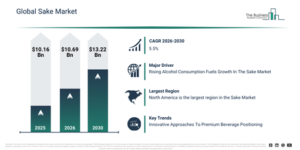
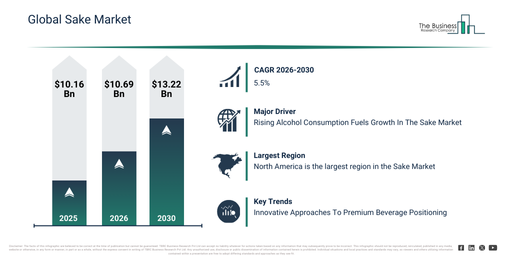
The sake market has shown robust expansion in recent years. It will grow from $10.16 billion in 2025 to $10.69 billion in 2026 at a compound annual growth rate (CAGR) of 5.2%. This historic growth can be attributed to factors such as the cultural significance of sake in Japan, established domestic consumption patterns, the transfer of traditional brewing knowledge, stable rice cultivation for brewing purposes, and the rise of on-premise consumption channels.
The sake market size is projected to experience substantial growth in the coming years. It is expected to grow to $13.22 billion in 2030 at a compound annual growth rate (CAGR) of 5.5%. This growth in the forecast period can be attributed to factors such as increasing interest in Japanese cuisine, the expansion of premium alcoholic beverage demand, rising exports to Western markets, a growing focus on brand storytelling, and innovation in sake flavor profiles. Key trends for the forecast period include the premiumization of traditional sake varieties, rising demand for craft and artisanal sake, the growing popularity of flavored and infused sake, the expansion of international sake consumption, and an enhanced focus on authentic brewing practices.
Get A Free Sample Report With In-Depth Market Insights:
Sake Market Growth Backed By Core Demand Fundamentals
Greater alcohol intake is anticipated to drive the future expansion of the sake market. Alcohol, a transparent, volatile liquid produced through sugar fermentation, typically serves as a leisure drink. A rise in alcohol intake stems from factors like social customs, promotional strategies, and evolving lifestyles. This growing alcohol intake aids the sake market by stimulating demand for traditional Japanese rice wine among both domestic and international purchasers. As an example, in November 2025, data from the Organisation for Economic Co-operation and Development (OECD), a France-based intergovernmental organization, indicated that average alcohol consumption in OECD countries hit 8.5 litres of pure alcohol per individual in 2023, with some member states surpassing 11.5 litres. Consequently, heightened alcohol consumption is propelling the sake market.
Sake Market Segment Outlook: Which Categories Are Growing Fastest?
The sake market covered in this report is segmented –
1) By Type: Ordinary sake, Junmai, Honjozo, Junmai Ginjo, Ginjo, Junmai Daiginjo
2) By Range: Premium, Medium, Low
4) By Application: Commercial Use, Home Use
Subsegments:
1) By Ordinary Sake: Futsushu (Regular Sake), Table Sake
2) By Junmai: Junmai Sake (Pure Rice Sake), Tokubetsu Junmai (Special Junmai Sake)
3) By Honjozo: Honjozo Sake (With A Small Amount Of Distilled Alcohol), Tokubetsu Honjozo (Special Honjozo Sake)
4) By Junmai Ginjo: Junmai Ginjo Sake (Rice Polished To At Least 60%), Tokubetsu Junmai Ginjo
5) By Ginjo: Ginjo Sake (Rice Polished To At Least 60% With Added Alcohol), Tokubetsu Ginjo
6) By Junmai Daiginjo: Junmai Daiginjo Sake (Rice Polished To At Least 50%), Tokubetsu Junmai Daiginjo
Sake Market Innovation Trends Shaping Future Development
Leading companies in the sake market are concentrating on developing advanced, premium-grade product lines, such as terroir-driven everyday junmai daiginjo, to enhance consumer access to sophisticated sake quality for regular dining and casual drinking occasions. This premium sake, terroir-driven everyday junmai daiginjo, is crafted using meticulously polished, locally sourced rice and regional water to convey a strong sense of place, yet it is positioned for approachable, frequent consumption, delivering elegant aromas and clean umami in everyday settings. For instance, in August 2025, Tsunan Sake Brewery Co., Ltd., a Japan-based sake brewery, introduced GO TERRACE, a junmai daiginjo designed for daily premium enjoyment, made with Uonuma-grown Koshihikari rice and mountain spring water, featuring floral aromatics, gentle sweetness, and snowmelt-like umami. GO TERRACE improves the casual drinking experience by merging high-quality craftsmanship with accessibility for regular meal pairings and social occasions.
Sake Market Leading Companies And Competitive Benchmarking
Major companies operating in the sake market are Gekkeikan Sake Co., Ltd., Takara Shuzo Co., Ltd., Asahi Shuzo Co., Ltd. (Dassai), Tatsuuma-Honke Brewing Co., Ltd., Ozeki Co., Ltd., Hakkaisan Brewery Co., Ltd., Dewazakura Sake Brewery Co., Ltd., Kokuryu Brewery Co., Ltd., Tatenokawa Shuzo Co., Ltd., Tosatsuru Sake Brewing Co., Ltd., Homare Sake Brewery Co., Ltd., Sohomare Sake Brewery Co., Ltd., Shiragiku Shuzo Co., Ltd., Hananomai Brewing Co., Ltd., Daisekkei Sake Brewing Co., Ltd., Matsuse Sake Brewery Co., Ltd., Azuma Shuzo Co., Ltd., Dojima Sake Brewery Co., Ltd., Wakaze Sake Brewery, Nara Toyosawa Shuzo Co., Ltd
View The Full Sake Market Report:
Sake Market Largest Region: Which Geography Holds The Biggest Share?
North America was the largest region in the sake market in 2025. The regions covered in the sake market report are Asia-Pacific, South East Asia, Western Europe, Eastern Europe, North America, South America, Middle East and Africa.
Reach Out To Our Team:
The Business Research Company: https://www.thebusinessresearchcompany.com/
Americas: +1 310-496-7795
Asia: +44 7882 955267 & +91 8897263534
Europe: +44 7882 955267
Email us at: marketing@tbrc.info
Follow us on:
LinkedIn: https://in.linkedin.com/company/the-business-research-company
YouTube: https://www.youtube.com/channel/UC24_fI0rV8cR5DxlCpgmyFQ
Global Market Model: https://www.thebusinessresearchcompany.com/global-market-model

Wasay has over a decade of experience in market research, data modelling, and analytics, with prior experience at GlobalData and Decision Tree Consulting Services. At The Business Research Company , he leads research operations across syndicated studies, customized consulting engagements, and the Global Market Model platform. His professional experience includes supporting organizations such as Boston Consulting Group, KPMG, and Ernst & Young. Wasay holds a degree in Electronics and Communications Engineering, postgraduate management qualifications from International Management Institute Belgium and Indian School of Business and Entrepreneurship, and completed the Integrated Program in Business Analytics from Indian Institute of Management Indore.