
Built to provide research that’s more actionable and strategically valuable, The Business Research Company’s 2026 market reports include market attractiveness analysis, total addressable market sizing, company benchmarking matrices, interactive Excel dashboards, broader supply chain intelligence, emerging startup tracking, and in-depth product insights.
Electric Aircraft Sensors Market Revenue Growth On Track For A 12.4% CAGR Through 2030
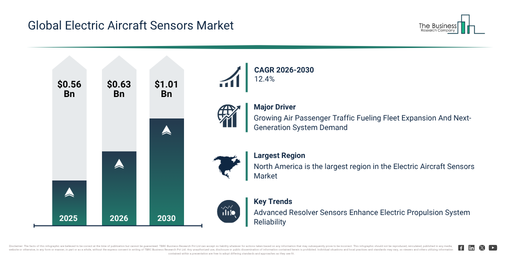
The electric aircraft sensors market size has seen rapid growth in recent years. It is forecast to increase from $0.56 billion in 2025 to $0.63 billion in 2026, achieving a compound annual growth rate (CAGR) of 12.8%. The growth observed in the historic period stems from various factors, including the expansion in aerospace electrification initiatives, an increasing uptake of conventional aircraft sensor systems, a heightened focus on flight safety monitoring, the expansion of defense aviation programs, and a growing demand for aircraft performance optimization.
The electric aircraft sensors market is projected to experience swift expansion in the coming years. By 2030, this market is anticipated to reach a valuation of $1.01 billion, demonstrating a compound annual growth rate (CAGR) of 12.4%. Several factors will contribute to this growth during the projection period, including the proliferation of electric and hybrid aircraft development programs, a greater uptake of autonomous flight systems, increased capital expenditure in eVTOL aircraft platforms, the widening scope of sustainable aviation initiatives, and the enhanced incorporation of AI-powered predictive maintenance systems. Key trends predicted for this period encompass a heightened need for sophisticated real-time health monitoring systems within electric aircraft, a growing embrace of high-precision multiparameter sensing technologies tailored for battery and propulsion systems, the expanding incorporation of light and compact sensor designs into aerospace platforms, a sharper emphasis on predictive maintenance and the identification of faults in electric aviation systems, and an increasing requirement for highly dependable sensors for eVTOL and unmanned aircraft uses.
Get A Free Sample Report With In-Depth Market Insights:
Electric Aircraft Sensors Market Demand Drivers Opening New Revenue Streams
Future expansion of the electric aircraft sensors market is anticipated to be propelled by increasing air passenger traffic. This traffic represents the total number of individuals traveling on commercial flights over a specific period and distance, serving as a primary metric for assessing global aviation demand and airline operational volume. The rise in air passenger traffic results from expanding global tourism networks, which encourage consumers to travel internationally and increase the overall demand for commercial flights. Electric aircraft sensors support this growing air passenger traffic by providing real-time diagnostic data that enables commercial airlines to optimize flight safety, reduce structural downtime, and enhance the operational reliability of next-generation electric aviation systems. For instance, in January 2024, according to the International Air Transport Association, a Switzerland-based global airline trade association, full-year 2023 global passenger traffic rose 36.9% compared to 2022 levels. Therefore, the expanding air passenger traffic is driving the growth of the electric aircraft sensors market.
Electric Aircraft Sensors Market Segment Landscape: Which Areas Lead Development?
The electric aircraft sensors market covered in this report is segmented –
1) By Product Type: Pressure Sensors, Temperature Sensors, Force Sensors, Torque Sensors, Speed Sensors, Other Product Types
2) By Technology Type: Micro Electromechanical Systems Technology, Fiber Optic Technology, Piezoelectric Technology
3) By Distribution Channel Type: Direct Sales, Authorized Distributors, Online Platforms
4) By Application Type: Fully Electric Aircraft, Hybrid-Electric Aircraft, Electric Vertical Takeoff And Landing (eVTOL) Aircraft, Unmanned Electric Aircraft
5) By End User Type: Aircraft Manufacturers, Maintenance Repair And Overhaul Services, Airlines, Defense Organizations
Subsegments:
1) By Pressure Sensors: Absolute Pressure Sensors, Differential Pressure Sensors, Gauge Pressure Sensors, Barometric Pressure Sensors
2) By Temperature Sensors: Resistance Temperature Detectors, Thermocouples, Thermistors, Infrared Temperature Sensors
3) By Force Sensors: Load Cells, Piezoelectric Force Sensors, Strain Gauge Force Sensors, Capacitive Force Sensors
4) By Torque Sensors: Reaction Torque Sensors, Rotary Torque Sensors, Optical Torque Sensors, Magnetoelastic Torque Sensors
5) By Speed Sensors: Wheel Speed Sensors, Rotational Speed Sensors, Linear Speed Sensors, Laser Doppler Velocimeters
6) By Other Product Types: Position Sensors, Vibration Sensors, Current And Voltage Sensors, Flow Sensors
Electric Aircraft Sensors Market Trends Powering Strategic Industry Growth
Leading companies in the electric aircraft sensor market are concentrating on developing sophisticated solutions, particularly resolver-based position sensors, to improve motor control precision, enhance flight safety, and ensure the reliable operation of next-generation electric aircraft. These electromechanical sensing devices, resolver-based position sensors, accurately measure the rotational position and speed of electric propulsion systems, thus enabling precise motor control and real-time feedback crucial for critical flight operations. For example, in April 2024, Honeywell International Inc., a US-based aerospace and industrial technology company, disclosed its selection by Lilium N.V., a Germany-based electric aircraft manufacturer, to supply propulsion unit position sensors for the Lilium Jet. Honeywell specifically engineered these sensors, referred to as resolvers, for the aircraft’s electric propulsion system to precisely detect engine position and secure the accurate alignment vital for safe takeoff and flight operations.
Electric Aircraft Sensors Market Industry Leaders And Competitive Landscape
Major companies operating in the electric aircraft sensors market report are Amphenol Corporation, Analog Devices Inc., AMETEK Inc., Aviage Systems LLC, BWSENSING GmbH, Crane Company, Curtiss-Wright Corporation, Eaton Corporation plc, Garmin Ltd., Honeywell International Inc., Liebherr-Aerospace, Moog Inc., Parker Hannifin Corporation, RTX Corporation, Safran Electronics & Defense SAS, Sensata Technologies Holding plc, Standex Electronics Inc., TE Connectivity Ltd., Thales S.A., United Electric Controls Company, Woodward Inc.
View The Full Electric Aircraft Sensors Market Report:
Electric Aircraft Sensors Market Top Region: Where Does Most Revenue Come From?
North America was the largest region in the electric aircraft sensors market in 2025. Asia-Pacific is expected to be the fastest-growing region in the forecast period. The regions covered in the electric aircraft sensors market report are Asia-Pacific, South East Asia, Western Europe, Eastern Europe, North America, South America, Middle East, Africa.
Reach Out To Our Team:
The Business Research Company: https://www.thebusinessresearchcompany.com/
Americas: +1 310-496-7795
Asia: +44 7882 955267 & +91 8897263534
Europe: +44 7882 955267
Email us at: marketing@tbrc.info
Follow us on:
LinkedIn: https://in.linkedin.com/company/the-business-research-company
YouTube: https://www.youtube.com/channel/UC24_fI0rV8cR5DxlCpgmyFQ
Global Market Model: https://www.thebusinessresearchcompany.com/global-market-model

Wasay has over a decade of experience in market research, data modelling, and analytics, with prior experience at GlobalData and Decision Tree Consulting Services. At The Business Research Company , he leads research operations across syndicated studies, customized consulting engagements, and the Global Market Model platform. His professional experience includes supporting organizations such as Boston Consulting Group, KPMG, and Ernst & Young. Wasay holds a degree in Electronics and Communications Engineering, postgraduate management qualifications from International Management Institute Belgium and Indian School of Business and Entrepreneurship, and completed the Integrated Program in Business Analytics from Indian Institute of Management Indore.