Featuring market attractiveness scoring, total addressable market sizing, company benchmarking matrices, interactive Excel dashboards, deeper supply chain intelligence, emerging startup tracking, and granular product-level insights, The Business Research Company’s 2026 market reports are built to deliver research that is both more actionable and more strategically valuable.
Aftermarket Automotive Parts Market Forecast: What Value Will The Market Reach By 2030?
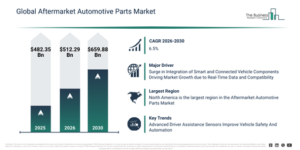
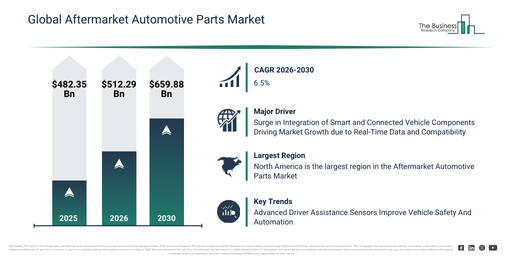
The aftermarket automotive parts market has seen significant expansion in recent years. It is anticipated to expand from $482.35 billion in 2025 to $512.29 billion in 2026, progressing at a compound annual growth rate (CAGR) of 6.2%. This historical growth can be attributed to several factors including the increase in global vehicle parc, escalating vehicle aging trends, the proliferation of independent repair shops, the widespread availability of varied aftermarket suppliers, and a growing demand for cost-effective maintenance solutions.
The aftermarket automotive parts market is projected to experience robust expansion over the coming years. This market is set to reach $659.88 billion by 2030, exhibiting a compound annual growth rate (CAGR) of 6.5%. The anticipated growth during this period stems from factors such as the increasing uptake of electric vehicle aftermarket components, the growing digitalization within auto parts retail, the broadening of performance tuning culture, the rising demand for sustainable automotive parts, and the greater integration of smart vehicle components. Key trends identified for the forecast period encompass a rising demand for economical replacement parts, the increasing embrace of online aftermarket sales channels, a heightened focus on improving vehicle performance, the expansion of customization and styling products, and a stronger emphasis on vehicle longevity.
Get A Free Sample Report With In-Depth Market Insights:
Aftermarket Automotive Parts Market Expansion Drivers: What’s Shaping Future Growth?
The integration of smart and connected vehicle components is projected to significantly advance the aftermarket automotive parts sector in the future. These components include sensors, software, and connected systems that enable vehicles to communicate, assess performance, and enhance safety and efficiency. The surge in smart and connected vehicle components is primarily driven by real-time data communication, allowing vehicles to exchange information with other systems, which improves safety and driving efficiency. Aftermarket automotive parts assist in integrating smart and connected vehicle components by providing economical, compatible alternatives that maintain or improve vehicle connectivity and advanced system functionalities. For instance, in December 2024, the Baker Institute for Public Policy, a US-based nonpartisan think tank, indicated that Chinese electric vehicle production and connected vehicle software or hardware are anticipated to remain absent in Mexico by 2026, while Mexico’s automotive sector, accounting for 22% of USMCA trade and 17.4% of global vehicle production, exports approximately 88% of its 3.5 million annual vehicles to the United States, and on September 23, 2024. Therefore, the integration of smart and connected vehicle components is fueling the expansion of the aftermarket automotive parts market.
Aftermarket Automotive Parts Market Breakdown By Product Type And Application
The aftermarket automotive parts market covered in this report is segmented –
1) By Product Type: Engine Components, Electrical Parts, Suspension And Steering Parts, Brake Parts, Exhaust Parts, Other Product Types
2) By Vehicle Type: Passenger Cars, Commercial Vehicles, Two-Wheelers
3) By Application: Replacement And Wear-And-Tear, Performance, Customization And Aesthetic Enhancements, Collision Repair And Structural Replacement
4) By Distribution Channel: Online Retailers, Offline Retailers, Original Equipment Suppliers (OES)
Subsegments:
1) By Engine Components: Pistons, Piston Rings, Oil Pumps, Gaskets, Cylinder Heads, Timing Belts, Valves
2) By Electrical Parts: Alternators, Starters, Spark Plugs, Batteries, Ignition Coils, Wiring Harnesses, Sensors
3) By Suspension And Steering Parts: Shock Absorbers, Struts, Control Arms, Ball Joints, Tie Rod Ends, Steering Racks, Bushings
4) By Brake Parts: Brake Pads, Brake Shoes, Brake Rotors, Brake Calipers, Brake Drums, Master Cylinders, Brake Lines
5) By Exhaust Parts: Mufflers, Catalytic Converters, Exhaust Manifolds, Resonators, Exhaust Pipes, Oxygen Sensor
6) By Other Product Types: Filters, Lighting Systems, Wiper Blades, Clutch Assemblies, Fuel Pumps, Cooling Systems
Aftermarket Automotive Parts Market Strategic Trends: What Defines The Next Growth Phase?
Leading companies in the aftermarket automotive parts sector are concentrating on developing innovative solutions, such as advanced driver assistance system sensors, to improve vehicle safety and automate driving functions. Advanced driver assistance system sensors are electronic devices found in vehicles that detect and monitor the surrounding environment, assisting drivers with features like collision avoidance, lane keeping, and adaptive cruise control. For instance, in September 2024, Continental AG, a manufacturing company based in Germany, introduced a significant expansion of its aftermarket product line, ensuring original equipment quality. This particular expansion addresses the increasing technical demands from workshops, especially with the rise of electric vehicles and advanced driver assistance systems. The extended product range encompasses new categories such as sensors for driver assistance systems (including cameras and radar), chassis and steering components (like wheel bearings, wishbone bushings, and ball joints), high-pressure fuel pumps, and an expanded series of brake discs and pads under the ATE New Original brand, specifically tailored for electric vehicles and adherence to Euro 7 emission standards.
Aftermarket Automotive Parts Market Company Landscape And Competitive Strategy
Major companies operating in the aftermarket automotive parts market are Robert Bosch GmbH, DENSO Corporation, Continental AG, ZF Friedrichshafen AG, Valeo, BorgWarner Inc., Aisin Corporation, Hyundai Mobis Company Limited, Schaeffler AG, Marelli Holdings Co., Ltd., Bridgestone Corporation, Forvia SE, Cardone Industries, ABC Technologies, Dayco, Edelbrock LLC, Centric Parts, Wilwood Engineering, Sanden International, Shelby American, Inc., Specialty Vehicle Engineering, RENNtech, Overfinch
View The Full Aftermarket Automotive Parts Market Report:
Aftermarket Automotive Parts Market Largest Region: Which Geography Holds The Biggest Share?
North America was the largest region in the aftermarket automotive parts market in 2025. Asia-Pacific is expected to be the fastest-growing region in the forecast period. The regions covered in the aftermarket automotive parts market report are Asia-Pacific, South East Asia, Western Europe, Eastern Europe, North America, South America, Middle East, Africa
Reach Out To Our Team:
The Business Research Company: https://www.thebusinessresearchcompany.com/
Americas: +1 310-496-7795
Asia: +44 7882 955267 & +91 8897263534
Europe: +44 7882 955267
Email us at: marketing@tbrc.info
Follow us on:
LinkedIn: https://in.linkedin.com/company/the-business-research-company
YouTube: https://www.youtube.com/channel/UC24_fI0rV8cR5DxlCpgmyFQ
Global Market Model: https://www.thebusinessresearchcompany.com/global-market-model

Wasay has over a decade of experience in market research, data modelling, and analytics, with prior experience at GlobalData and Decision Tree Consulting Services. At The Business Research Company , he leads research operations across syndicated studies, customized consulting engagements, and the Global Market Model platform. His professional experience includes supporting organizations such as Boston Consulting Group, KPMG, and Ernst & Young. Wasay holds a degree in Electronics and Communications Engineering, postgraduate management qualifications from International Management Institute Belgium and Indian School of Business and Entrepreneurship, and completed the Integrated Program in Business Analytics from Indian Institute of Management Indore.