Built to provide research that’s more actionable and strategically valuable, The Business Research Company’s 2026 market reports include market attractiveness analysis, total addressable market sizing, company benchmarking matrices, interactive Excel dashboards, broader supply chain intelligence, emerging startup tracking, and in-depth product insights.
Airflow And Zone Control Equipment Market Forecast: What Value Will The Market Reach By 2030?
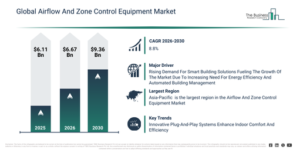
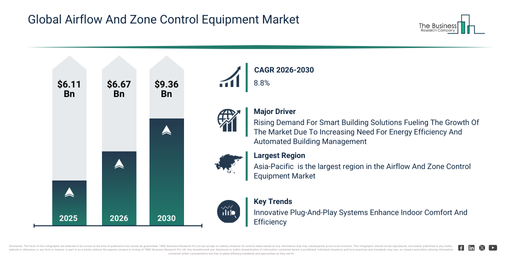
The airflow and zone control equipment market size has shown substantial growth over recent years. It is projected to increase from $6.11 billion in 2025 to $6.67 billion in 2026, exhibiting a compound annual growth rate (CAGR) of 9.2%. The historical expansion of this market can be attributed to factors such as commercial building expansion, HVAC modernization, energy efficiency regulations, the growth of urban housing, and the adoption of centralized air systems.
The market size for airflow and zone control equipment is projected to experience robust expansion over the coming years. This market is anticipated to reach $9.36 billion by 2030, demonstrating a compound annual growth rate (CAGR) of 8.8%. Factors contributing to this growth during the forecast period include investments in smart buildings, objectives for net zero energy, the need for occupant comfort management, the expansion of green buildings, and the uptake of digital HVAC monitoring. Key trends expected within the forecast timeframe involve the implementation of smart zoning systems, solutions for energy-efficient air distribution, increased focus on indoor air quality control, seamless integration with building automation systems, and the retrofitting of HVAC infrastructure.
Get A Free Sample Report With In-Depth Market Insights:
Airflow And Zone Control Equipment Market Demand Drivers Opening New Revenue Streams
The increasing need for smart building solutions is anticipated to boost the expansion of the airflow and zone control equipment market in the future. These smart solutions are defined as technology-enabled systems that incorporate sensors, automation, and data analytics to streamline building functionalities, including energy consumption, airflow, lighting, and security. The heightened interest in smart building solutions primarily stems from the escalating requirement for energy efficiency, given their capacity to decrease energy usage, cut expenses, and facilitate sustainable operations. Airflow and zone control equipment improves smart building solutions through precise temperature and ventilation regulation, making them highly suitable for various residential and commercial settings with multiple zones. This equipment optimizes energy consumption by automatically adapting airflow based on occupancy and ambient conditions, thereby enhancing comfort and lowering operational expenditures. For instance, in July 2023, data from the Central Statistics Office, an Ireland-based government agency, indicated that 30% of internet users had adopted smart solutions in their homes in 2024, an increase from 17% in 2022. Consequently, the escalating demand for smart building solutions is propelling the growth of the airflow and zone control equipment market.
Airflow And Zone Control Equipment Market Segment Trends And Revenue Contributors
The airflow and zone control equipment market covered in this report is segmented –
1) By Products: Variable Air Volume (VAV) Systems, Constant Air Volume (CAV) Systems, Dampers, Actuators, Controllers, Thermostats, Valves, Other Products
2) By Operation: Manual, Automatic
3) By Distribution Channel: Online, Retail Stores, Wholesale Stores, Other Distribution Channels
4) By Application: Commercial, Residential, Industrial
5) By End Users: Heating, Ventilation, And Air Conditioning (HVAC) Contractors, Building Owners, Facility Managers, System Integrators
Subsegments:
1) By Variable Air Volume Systems: Single Duct, Dual Duct, Fan Powered, Pressure Independent, Pressure Dependent
2) By Constant Air Volume Systems: Single Duct, Dual Duct, Fan Powered, Zoned
3) By Dampers, Volume Control: Fire, Smoke, Combination, Backdraft, Pressure Relief
4) By Actuators: Electric, Pneumatic, Hydraulic, Electro Pneumatic
5) By Controllers: Programmable Logic, Digital, Analog, Remote
6) By Thermostats: Programmable, Non Programmable, Smart, Wireless
7) By Valves: Globe, Ball, Butterfly, Pressure Independent, Control
8) By Other Products: Sensors, Switches, Humidifiers, Dehumidifiers, Air Cleaners
Airflow And Zone Control Equipment Market Trends Powering Strategic Industry Growth
Major companies operating in the airflow and zone control equipment market are prioritizing the development of innovative solutions, such as plug-and-play zoning systems, to simplify installation and improve energy efficiency, comfort, and easy heating, ventilation, and air conditioning (HVAC) integration. These plug-and-play zoning systems represent pre-assembled HVAC solutions that enable quick setup for precise temperature control across multiple zones, leading to enhanced energy efficiency and reduced operational costs. For example, in February 2023, Airzone, a Spain-based provider of HVAC control systems, introduced the Easyzone, a customizable plug-and-play zoning solution designed to optimize airflow control and boost indoor air quality across various HVAC systems in residential and commercial buildings. This advanced airflow and zone control equipment features precision zoning capability and customizable control interfaces, allowing it to fine-tune environmental conditions, improve energy efficiency, and foster enhanced comfort and air quality. The Easyzone exhibits high versatility, seamlessly integrating with diverse HVAC systems to provide precise zoning control and optimized airflow management, ultimately elevating indoor comfort, energy efficiency, and air quality throughout residential and commercial settings.
Airflow And Zone Control Equipment Market Competitive Landscape: Which Companies Lead The Industry?
Major companies operating in the airflow and zone control equipment market are Siemens AG, Hitachi Ltd., Panasonic Holdings Corporation, Mitsubishi Electric Corporation, Daikin Industries Ltd., Carrier Global Corporation, Trane Technologies plc, Danfoss A/S, Greenheck Fan Corporation, Blue Star Limited, Zehnder Group International AG, Broan-NuTone LLC, CAREL Industries S.p.A, Aldes Groupe, KMC Controls Inc., EBTRON Inc., Zonefirst, Zonex Systems, Arzel Zoning Technology Inc., ACD Machine Control Company Private Limited
View The Full Airflow And Zone Control Equipment Market Report:
Airflow And Zone Control Equipment Market Geographic Analysis: Where Is Demand Rising Fastest?
Asia-Pacific was the largest region in the airflow and zone control equipment market in 2025. North America is expected to be the fastest-growing region in the forecast period. The regions covered in the airflow and zone control equipment market report are Asia-Pacific, South East Asia, Western Europe, Eastern Europe, North America, South America, Middle East, Africa
Reach Out To Our Team:
The Business Research Company: https://www.thebusinessresearchcompany.com/
Americas: +1 310-496-7795
Asia: +44 7882 955267 & +91 8897263534
Europe: +44 7882 955267
Email us at: marketing@tbrc.info
Follow us on:
LinkedIn: https://in.linkedin.com/company/the-business-research-company
YouTube: https://www.youtube.com/channel/UC24_fI0rV8cR5DxlCpgmyFQ
Global Market Model: https://www.thebusinessresearchcompany.com/global-market-model

Wasay has over a decade of experience in market research, data modelling, and analytics, with prior experience at GlobalData and Decision Tree Consulting Services. At The Business Research Company , he leads research operations across syndicated studies, customized consulting engagements, and the Global Market Model platform. His professional experience includes supporting organizations such as Boston Consulting Group, KPMG, and Ernst & Young. Wasay holds a degree in Electronics and Communications Engineering, postgraduate management qualifications from International Management Institute Belgium and Indian School of Business and Entrepreneurship, and completed the Integrated Program in Business Analytics from Indian Institute of Management Indore.