Featuring market attractiveness scoring, total addressable market sizing, company benchmarking matrices, interactive Excel dashboards, deeper supply chain intelligence, emerging startup tracking, and granular product-level insights, The Business Research Company’s 2026 market reports are built to deliver research that is both more actionable and more strategically valuable.
Cargo Handling Equipment Market Growth From $30.37 Billion In 2026 To $37.47 Billion By 2030 At A CAGR Of 5.4%
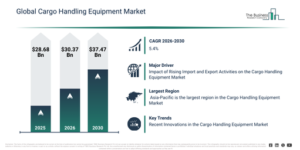
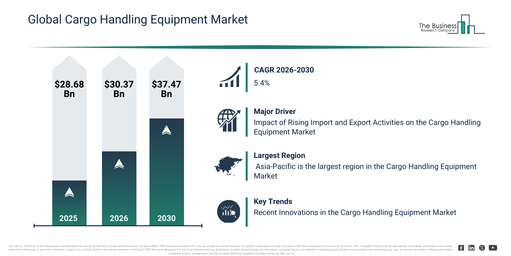
The cargo handling equipment market has demonstrated robust growth in recent years. It is anticipated to expand from $28.68 billion in 2025 to $30.37 billion in 2026, registering a compound annual growth rate (CAGR) of 5.9%. The historical growth of this market can be attributed to several factors, including the expansion of global trade volumes, the development of port and airport infrastructure, increasing warehouse automation adoption, the rising demand for faster cargo turnaround, and the availability of heavy-duty material handling equipment.
The cargo handling equipment market is projected to experience robust expansion over the coming years, reaching a valuation of $37.47 billion by 2030, exhibiting a compound annual growth rate (CAGR) of 5.4%. This anticipated growth stems from several factors, including escalating investments in intelligent logistics infrastructure, a surge in the need for autonomous cargo handling solutions, the proliferation of e-commerce-driven warehousing facilities, an increased emphasis on environmentally friendly material handling equipment, and the growing adoption of digital fleet management systems. Key developments expected during this period encompass the wider implementation of automated material handling systems, an escalating preference for electric and hybrid cargo equipment, the expanded utilization of AGVs (Automated Guided Vehicles) in storage facilities and maritime ports, the development of more extensive high-capacity container handling solutions, and a heightened commitment to operational safety and load stability.
Get A Free Sample Report With In-Depth Market Insights:
Cargo Handling Equipment Market Growth Factors Behind Sustained Expansion
Increased import and export activities are projected to propel the expansion of the cargo handling equipment market in the future. These activities entail the movement of goods across international boundaries, thereby facilitating global trade and supply chain operations. The volume of import and export operations is growing due to globalization, the expansion of supply chains, and an increasing need for cross-border trade. Cargo handling equipment plays a vital role in these processes by allowing for the efficient loading, unloading, storage, and transportation of products at ports, freight terminals, airports, and logistics hubs. For instance, in October 2024, the UN Trade and Development, an intergovernmental organization located in Switzerland, stated that global maritime trade expanded by 2.4% in 2023, recovering from the decline observed in 2022. Hence, the escalating import and export activities are a key driver for the growth of the cargo handling equipment market moving forward.
Cargo Handling Equipment Market Segment Landscape: Which Areas Lead Development?
The cargo handling equipment market covered in this report is segmented –
1) By Equipment Type: Aviation Dollies, Stacker, Pallet Jacks, Loaders, Conveyor System, Automated Guided Vehicle, Forklift Trucks, Cranes, Rubber Tired Gantry Cranes, Other Equipment Types
2) By Technology: Manual, Semi-Automated, Fully Automated
3) By Propulsion Type: Diesel, Electric, Other Propulsion Types
4) By Application: Air Cargo, Marine Cargo, Land Cargo
5) By End User: Automotive, Consumer And Retail, Energy Resources, Manufacturing, Transportation, Other End-Users
Subsegments:
1) By Aviation Dollies: Aircraft Towing Dollies, Pushback Dollies, Cargo Dollies
2) By Stacker: Manual Stackers, Electric Stackers, Semi-Electric Stackers
3) By Pallet Jacks: Manual Pallet Jacks, Electric Pallet Jacks, High-Lift Pallet Jacks
4) By Loaders: Front-End Loaders, Telescopic Loaders, Articulated Loaders
5) By Conveyor System: Roller Conveyors, Belt Conveyors, Chain Conveyors, Pneumatic Conveyors
6) By Automated Guided Vehicle (AGV): Laser-Guided AGVs, Vision-Guided AGVs, Magnetic Tape AGVs
7) By Forklift Trucks: Electric Forklifts, Internal Combustion Forklifts, Reach Trucks, Pallet Forklifts
8) By Cranes: Overhead Cranes, Gantry Cranes, Jib Cranes, Tower Cranes
9) By Rubber Tired Gantry Cranes (RTG): Standard RTG Cranes, Electric RTG Cranes, Hybrid RTG Cranes
10) By Other Equipment Types: Dock Levelers, Container Handling Equipment, Lifting Tables, Palletizers
Cargo Handling Equipment Market Industry Trends Fueling Future Revenue Growth
Key players in the cargo handling equipment market are rolling out sophisticated forklift models, aiming to boost operational efficiency, integrate cutting-edge automation capabilities, and address environmental concerns through electric and hybrid power sources. Specifically, a forklift is defined as a compact industrial vehicle equipped with a powered, pronged platform capable of vertical movement to slip beneath and then lift or transport objects. As an illustration, in May 2023, Toyota Material Handling, a machinery manufacturing firm based in the US, unveiled three new electric forklift models. These three electric forklift models encompass the Side-Entry End Rider, designed for streamlined operations across warehouses; the adaptable Center Rider Stacker, which integrates three functionalities into a single unit; and the robust Industrial Tow Tractor, engineered for effortlessly and efficiently moving substantial loads. Each of these three models is equipped with AC drive motors to ensure quiet and fluid performance, alongside adjustable controls for improved operator comfort, and offers optional functionalities such as cold storage conditioning and PIN code access for greater tailoring and protection.
Cargo Handling Equipment Market Industry Leaders And Competitive Landscape
Major companies operating in the cargo handling equipment market are Siemens AG, ABB Ltd., Komatsu Ltd., Toyota Industries Corporation, HD Hyundai Heavy Industries Co. Ltd., Liebherr-International Deutschland GmbH, KION Group AG, Sany Heavy Industry Co. Ltd., Doosan Industrial Vehicle BG, Jungheinrich AG, Mitsubishi Logisnext Co. Ltd., Shanghai Zhenhua Heavy Industries Company Limited, Terex Corporation, Crown Equipment Corporation, Cargotec Oyj, Hyster-Yale Materials Handling Inc., Konecranes Oyj, Anhui Heli Co. Ltd., Hangcha Group Co, Manitowoc Company Inc., John Bean Technologies Corporation, Kalmar Corporation, The Taylor Group Inc, CVS ferrari S.P.A.
View The Full Cargo Handling Equipment Market Report:
Cargo Handling Equipment Market Global Footprint: Which Region Leads The Market?
Asia-Pacific was the largest region in the cargo handling equipment market in 2025. The regions covered in the cargo handling equipment market report are Asia-Pacific, South East Asia, Western Europe, Eastern Europe, North America, South America, Middle East, Africa
Reach Out To Our Team:
The Business Research Company: https://www.thebusinessresearchcompany.com/
Americas: +1 310-496-7795
Asia: +44 7882 955267 & +91 8897263534
Europe: +44 7882 955267
Email us at: marketing@tbrc.info
Follow us on:
LinkedIn: https://in.linkedin.com/company/the-business-research-company
YouTube: https://www.youtube.com/channel/UC24_fI0rV8cR5DxlCpgmyFQ
Global Market Model: https://www.thebusinessresearchcompany.com/global-market-model

Wasay has over a decade of experience in market research, data modelling, and analytics, with prior experience at GlobalData and Decision Tree Consulting Services. At The Business Research Company , he leads research operations across syndicated studies, customized consulting engagements, and the Global Market Model platform. His professional experience includes supporting organizations such as Boston Consulting Group, KPMG, and Ernst & Young. Wasay holds a degree in Electronics and Communications Engineering, postgraduate management qualifications from International Management Institute Belgium and Indian School of Business and Entrepreneurship, and completed the Integrated Program in Business Analytics from Indian Institute of Management Indore.