
Backed by market attractiveness analysis, total addressable market sizing, company benchmarking matrices, interactive Excel dashboards, wider supply chain intelligence, emerging startup coverage, and detailed product-level insights, The Business Research Company’s 2026 market reports are designed to offer research that is more actionable and strategically valuable than ever.
Geostationary Satellites Market Size, Value And Growth Trajectory Through 2030
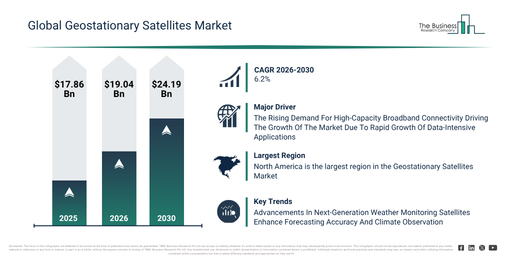
The market for geostationary satellites has seen significant expansion in recent years. Its valuation is set to increase from $17.87 billion in 2025 to $19.04 billion in 2026, demonstrating a compound annual growth rate (CAGR) of 6.6%. Throughout the historical period, this expansion was driven by several factors, including an early dependence on geostationary satellites for television broadcasting, an increasing need for weather forecasting and monitoring systems, the proliferation of global telecommunication infrastructure, governmental expenditures in space and defense communication technologies, and a rise in the utilization of satellite-based navigation services.
The geostationary satellites market is anticipated to experience substantial expansion in the coming years. This market is projected to reach $24.2 billion by 2030, exhibiting a compound annual growth rate (CAGR) of 6.2%. Key drivers for this growth during the forecast period include the broader integration of global broadband satellite constellations, an increasing need for real-time climate and disaster monitoring, the growing commercialization of services based in space, an expansion in defense surveillance and secure communication systems, and advancements in high-capacity satellite communication technologies. Significant trends expected throughout the forecast period encompass AI-powered satellite image analytics offering real-time Earth observation insights, IoT-enabled satellite communication networks ensuring uninterrupted connectivity, cloud-based platforms for geospatial data processing and distribution, autonomous systems for satellite station keeping and orbit optimization, and sustainable low-fuel propulsion systems designed for extended satellite lifecycles.
Get A Free Sample Report With In-Depth Market Insights:
Geostationary Satellites Market Growth Drivers: What’s Behind The Acceleration?
The geostationary satellites market is anticipated to expand due to the escalating need for high-capacity broadband connectivity. This type of connectivity involves swift communication networks designed for dependable and efficient transmission of substantial data volumes, thereby facilitating uninterrupted internet access, streaming, and data-intensive applications across extensive regions. The surge in demand for high-capacity broadband stems from the swift proliferation of data-intensive applications like video streaming, cloud computing, online gaming, and remote work, all of which necessitate quicker and more dependable internet bandwidth. Geostationary satellites contribute to high-capacity broadband by offering consistent, broad coverage, ensuring reliable high-speed data delivery to regions that are underserved or remote. As an illustration, in November 2024, data from the International Telecommunication Union, a specialized agency based in Switzerland, indicated that in 2023, global mobile broadband traffic for end-user internet consumption exceeded 1 zettabyte for the first time, and this is forecast to rise to approximately 1.3 zettabytes by 2024. In contrast, fixed broadband traffic is anticipated to climb from 5.1 zettabytes in 2023 to roughly 6 zettabytes in 2024. Consequently, the increasing need for high-capacity broadband connectivity is fueling the expansion of the geostationary satellites market.
Geostationary Satellites Market Segments: Where Is Growth Concentrated?
The geostationary satellites market covered in this report is segmented –
1) By Type Of Satellite: Communications Satellites, Earth Observation Satellites, Weather Satellites, Scientific Satellites, Military Satellites
2) By Orbit Parameters: Orbital Altitude, Inclination Angle
3) By Frequency Band: C Band, Ku Band, Ka Band, X Band, L Band, S Band
4) By Application: Telecommunication Services, Broadcasting Services, Data Collection And Analysis, Navigation And Timing Services, Environmental Monitoring
5) By End User: Government Institutions, Commercial Companies, Research Organizations, Non Governmental Organizations
Subsegments:
1) By Communications Satellites: Fixed Satellite Service Satellites, Broadcasting Satellite Service Satellites, Mobile Satellite Service Satellites, Broadband Communication Satellites.
2) By Earth Observation Satellites: Optical Imaging Satellites, Synthetic Aperture Radar Satellites, Environmental Monitoring Satellites, Resource Mapping Satellites
3) By Weather Satellites: Meteorological Monitoring Satellites, Climate Observation Satellites, Atmospheric Sounding Satellites, Storm Tracking Satellites
4) By Scientific Satellites: Astronomy Satellites, Space Science Satellites, Solar Observation Satellites, Astrophysics Research Satellites
5) By Military Satellites: Reconnaissance Satellites, Surveillance Satellites, Military Communication Satellites, Early Warning Satellites
Geostationary Satellites Market Trends: What’s Defining The Industry’s Next Phase?
Major companies in the geostationary satellites market are prioritizing the development of innovative solutions, such as next-generation weather monitoring satellites, to enhance real-time atmospheric observation, improve forecasting accuracy, and support climate monitoring applications. These advanced satellites are equipped with high-resolution sensors and atmospheric sounding instruments, supplying more precise, real-time data for weather forecasting, climate monitoring, and detecting severe weather. For example, in July 2025, Space Exploration Technologies Corp., a US-based aerospace and space transportation company, launched the MTG-S1 (Meteosat Third Generation Sounder-1) satellite for European meteorological operations using a Falcon 9 rocket. The satellite entered a geostationary transfer orbit to back next-generation weather forecasting and environmental monitoring services across Europe and its surrounding regions. MTG-S1 is specifically designed to provide high-frequency atmospheric sounding data, empowering meteorologists to monitor temperature, humidity, and atmospheric instability with greater precision. This satellite boosts the early detection of severe weather events, including storms and extreme climate conditions, thereby enhancing forecasting accuracy and public safety measures.
Geostationary Satellites Market Key Participants And Competitive Landscape
Major companies operating in the geostationary satellites market report are The Boeing Company, Airbus SE, Lockheed Martin Corporation, China Aerospace Science and Technology Corporation, Mitsubishi Electric Corporation, EchoStar Corporation, Israel Aerospace Industries Ltd., Viasat Inc., Thales Alenia Space, SES S.A., Sierra Space Corporation, York Space Systems LLC, Astranis Space Technologies Corp., Apex Space LLC, SKY Perfect JSAT Corporation, MEASAT Satellite Systems Sdn. Bhd., Kacific Broadband Satellites Group, K2 Space Corporation, AscendArc Inc., JSC Information Satellite Systems Reshetnev, Maxar Technologies, Northrop Grumman Corporation, Hughes Network Systems, OHB SE, Eutelsat S.A.
View The Full Geostationary Satellites Market Report:
Geostationary Satellites Market Top Region By Revenue And Market Share
North America was the largest region in the geostationary satellites market in 2025. Asia-Pacific is expected to be the fastest-growing region in the forecast period. The regions covered in the geostationary satellites market report are Asia-Pacific, South East Asia, Western Europe, Eastern Europe, North America, South America, Middle East, Africa.
Reach Out To Our Team:
The Business Research Company: https://www.thebusinessresearchcompany.com/
Americas: +1 310-496-7795
Asia: +44 7882 955267 & +91 8897263534
Europe: +44 7882 955267
Email us at: marketing@tbrc.info
Follow us on:
LinkedIn: https://in.linkedin.com/company/the-business-research-company
YouTube: https://www.youtube.com/channel/UC24_fI0rV8cR5DxlCpgmyFQ
Global Market Model: https://www.thebusinessresearchcompany.com/global-market-model

Wasay has over a decade of experience in market research, data modelling, and analytics, with prior experience at GlobalData and Decision Tree Consulting Services. At The Business Research Company , he leads research operations across syndicated studies, customized consulting engagements, and the Global Market Model platform. His professional experience includes supporting organizations such as Boston Consulting Group, KPMG, and Ernst & Young. Wasay holds a degree in Electronics and Communications Engineering, postgraduate management qualifications from International Management Institute Belgium and Indian School of Business and Entrepreneurship, and completed the Integrated Program in Business Analytics from Indian Institute of Management Indore.