Backed by market attractiveness analysis, total addressable market sizing, company benchmarking matrices, interactive Excel dashboards, wider supply chain intelligence, emerging startup coverage, and detailed product-level insights, The Business Research Company’s 2026 market reports are designed to offer research that is more actionable and strategically valuable than ever.
Micro-Factory Market Poised To Hit $17.18 Billion By 2030 With A 21% CAGR
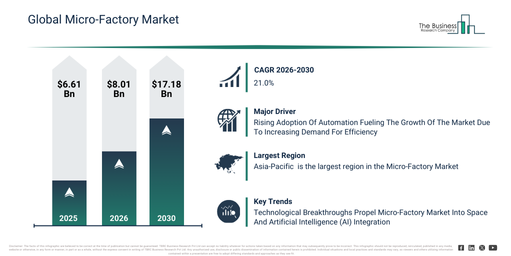
The micro-factory market size has experienced rapid growth in recent years. It is projected to expand from $6.61 billion in 2025 to $8.01 billion in 2026, achieving a compound annual growth rate (CAGR) of 21.2%. Historically, this growth has been fueled by factors such as the growth in automation technologies, rising manufacturing space costs, the demand for flexible production, the adoption of robotics in factories, and the need for faster product development.
The micro-factory market is anticipated to experience substantial growth in the upcoming years, projected to reach $17.18 billion by 2030 with a compound annual growth rate (CAGR) of 21.0%. This expansion during the forecast period is primarily driven by the reshoring of manufacturing operations, the increasing demand for customized products, advancements in AI-driven production, the expansion of smart factories, and a sharpened focus on cost-optimized manufacturing. Significant trends for this period include the proliferation of compact automated manufacturing units, a growing adoption of modular production setups, an increased need for rapid prototyping facilities, the enhanced use of robotics in small batch manufacturing, and a discernible shift toward localized manufacturing models.
Get A Free Sample Report With In-Depth Market Insights:
Micro-Factory Market Growth Drivers: What’s Behind The Acceleration?
The expanding integration of automation is set to drive the growth of the micro-factory market moving forward. Automation refers to the method of utilizing machines or technology to execute tasks automatically, thereby decreasing the necessity for human involvement. The demand for automation is escalating due to the pursuit of greater efficiency, enabling businesses to complete operations more quickly and precisely while minimizing human errors and operational costs. Automation empowers microfactories to achieve efficient, high-quality production, allowing them to manufacture goods rapidly and consistently, even in a restricted area. For instance, in November 2024, according to the International Federation of Robotics, a Germany-based non-profit organization, the worldwide average robot density escalated to 162 units per 10,000 workers in 2023, which is more than double the 74 units reported seven years prior. Consequently, the increasing adoption of automation is fueling the expansion of the micro-factory market.
Micro-Factory Market Segment Trends And Revenue Contributors
The micro-factory market covered in this report is segmented –
1) By Type: Fixed Type, Removable Type
2) By Scale: Small-Scale, Medium-Scale, Large-Scale
3) By End-User Industry: Manufacturing Industry, Healthcare Industry, Automotive Industry, Consumer Goods Industry, Aerospace Industry, Other End-User Industries
Subsegments:
1) By Fixed Type: Assembly Line Micro Factories, Additive Manufacturing Micro Factories, Hybrid Manufacturing Micro Factories, Continuous Flow Micro Factories
2) By Removable Type: Modular Micro Factories, Portable Micro Factories, Containerized Micro Factories, Mobile Micro Factories
Micro-Factory Market Trends Redefining Industry Growth
Leading companies in the micro-factory market are concentrating on developing advanced methods, such as vacuum-condition manufacturing, to create compact, highly automated production facilities. These facilities are designed to enable advanced manufacturing, enhance efficiency, and support flexible production across both terrestrial and space environments. Vacuum-condition manufacturing is a technique that employs a vacuum’s low-pressure environment to conduct advanced production, offering improved precision, reduced contamination, and better material properties. For instance, in March 2025, a Welsh startup, a pioneering US-based in-space manufacturing company, deployed a zero-gravity micro-factory into space. The company intends to leverage the distinctive conditions of space, including microgravity, vacuum, and sub-zero temperatures, to produce sophisticated materials and alloys that are challenging to create on Earth. This micro-factory will operate autonomously in orbit, fabricating high-quality metals and semiconductors, and will return to Earth after several months to deliver its manufactured items. This initiative signifies a notable progression toward utilizing space environments for innovative manufacturing processes.
Micro-Factory Market Competitive Landscape: Which Companies Lead The Industry?
Major companies operating in the micro-factory market are Siemens AG, Bright Machines Inc., Divergent Technologies Inc., Local Motors Inc., Plant Prefab Inc., BLOX, Project Frog Inc., Rapid Robotics, Modular Arts, Giant Containers, FullStack Modular, Boxman Studios, Kuka AG, Festo AG & Co. KG, FANUC Corporation, Universal Robots A/S, Additive Industries B.V., Xometry Inc., Vention Inc., Tulip Interfaces Inc., Formlabs
View The Full Micro-Factory Market Report:
Micro-Factory Market Regional Analysis: Which Geography Leads On Revenue?
Asia-Pacific was the largest region in the micro-factory market in 2025. North America is expected to be the fastest-growing region in the forecast period. The regions covered in the micro-factory market report are Asia-Pacific, South East Asia, Western Europe, Eastern Europe, North America, South America, Middle East, Africa
Reach Out To Our Team:
The Business Research Company: https://www.thebusinessresearchcompany.com/
Americas: +1 310-496-7795
Asia: +44 7882 955267 & +91 8897263534
Europe: +44 7882 955267
Email us at: marketing@tbrc.info
Follow us on:
LinkedIn: https://in.linkedin.com/company/the-business-research-company
YouTube: https://www.youtube.com/channel/UC24_fI0rV8cR5DxlCpgmyFQ
Global Market Model: https://www.thebusinessresearchcompany.com/global-market-model

Wasay has over a decade of experience in market research, data modelling, and analytics, with prior experience at GlobalData and Decision Tree Consulting Services. At The Business Research Company , he leads research operations across syndicated studies, customized consulting engagements, and the Global Market Model platform. His professional experience includes supporting organizations such as Boston Consulting Group, KPMG, and Ernst & Young. Wasay holds a degree in Electronics and Communications Engineering, postgraduate management qualifications from International Management Institute Belgium and Indian School of Business and Entrepreneurship, and completed the Integrated Program in Business Analytics from Indian Institute of Management Indore.