
Backed by market attractiveness analysis, total addressable market sizing, company benchmarking matrices, interactive Excel dashboards, wider supply chain intelligence, emerging startup coverage, and detailed product-level insights, The Business Research Company’s 2026 market reports are designed to offer research that is more actionable and strategically valuable than ever.
Recovered Carbon Black Market Size Outlook: How Quickly Will Revenue Expand Through 2030?
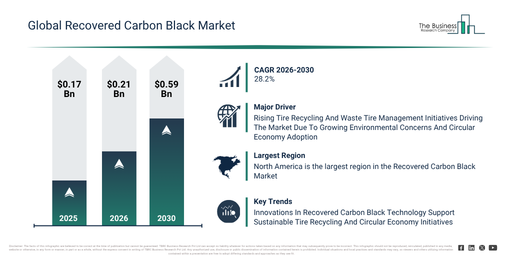
The recovered carbon black market has experienced significant expansion in recent years. It is forecast to grow from $0.17 billion in 2025 to $0.22 billion in 2026, achieving a compound annual growth rate (CAGR) of 28.0%. This past growth can be ascribed to several factors, such as the increasing production of tire and rubber waste, more stringent environmental regulations regarding landfill and incineration waste, the rising implementation of basic tire pyrolysis systems, the requirement for cost-effective carbon black alternatives, and the expanding automotive tire replacement market.
The recovered carbon black market is projected to experience substantial expansion over the coming years. Its valuation is anticipated to reach $0.59 billion by 2030, exhibiting a robust compound annual growth rate (CAGR) of 28.2%. This projected expansion is primarily fueled by an escalating demand for sustainable and circular economy materials, the increasing use in electric vehicle tires and lightweight rubber applications, wider implementation of sophisticated recycling techniques, a surge in conductive materials for battery and electronic uses, and more stringent regulations for carbon emission reduction. Key developments expected during this period involve optimized advanced pyrolysis for enhanced recovered carbon black output, the creation of low-ash and high-purity recovered carbon black varieties for specialized uses, the incorporation of circular rubber recycling frameworks within tire manufacturing, broader application of conductive recovered carbon black in batteries and electronics, and process intensification methods that boost thermal decomposition efficiency and manage emissions.
Get A Free Sample Report With In-Depth Market Insights:
Recovered Carbon Black Market Growth Drivers: What’s Behind The Acceleration?
The expansion of tire recycling and waste tire management efforts is projected to fuel the growth of the recovered carbon black market in the future. These initiatives encompass methods and procedures for gathering, treating, and reusing discarded tires to lessen environmental contamination and encourage the reclamation of resources. Their growth primarily stems from increasing ecological worries, given that unmanaged tire waste contributes to pollution, fire hazards, and excessive landfill accumulation, necessitating sustainable disposal and material retrieval. Recovered carbon black (rCB) plays a crucial role in tire recycling and waste tire management by transforming end-of-life tires into a valuable raw material, which can substitute virgin carbon black. This process consequently minimizes landfill waste, decreases environmental pollution, and facilitates a circular economy for tire components. For example, the U.S. Tire Manufacturers Association (USTMA), a US-based tire industry association, reported in October 2024 that in 2023, around 28% of end-of-life tires underwent processing into ground rubber via recycling. Consequently, the increasing number of tire recycling and waste tire management programs are stimulating the growth of the recovered carbon black market.
Recovered Carbon Black Market Segmentation And Category Overview
The recovered carbon black market covered in this report is segmented –
1) By Type: Commodity Grade Recovered Carbon Black, Specialty Grade Recovered Carbon Black, Conductive Grade Recovered Carbon Black, Other Types
2) By Process Technology: Pyrolysis Based Recovery, Thermal Decomposition Recovery, Advanced Upgraded Recovery Processes
3) By Distribution Channel: Direct Sales, Distributors And Suppliers
4) By Application: Tires, Non Tire Rubber, Plastics, Inks, Adhesives And Sealants, Other Applications
5) By End Use Industry: Automotive, Tire Manufacturing, Industrial Manufacturing, Construction, Packaging, Printing And Coatings, Other End Use Industries
Subsegments:
1) By Commodity Grade Recovered Carbon Black: General Rubber Reinforcement Grade, Tire Manufacturing Grade, Industrial Rubber Products Grade, Basic Plastic Compounding Grade, Standard Pigment Grade
2) By Specialty Grade Recovered Carbon Black: High Purity Recovered Carbon Black, Low Ash Content Recovered Carbon Black, Fine Particle Recovered Carbon Black, High Reinforcement Recovered Carbon Black, Premium Pigment Recovered Carbon Black
3) By Conductive Grade Recovered Carbon Black: Conductive Plastic Grade, Conductive Rubber Grade, Antistatic Compound Grade, Battery Material Grade, Electronic Components Grade
4) By Other Types: Thermal Recovered Carbon Black, Activated Recovered Carbon Black, Surface Modified Recovered Carbon Black, Blended Recovered Carbon Black, Custom Formulation Recovered Carbon Black
Recovered Carbon Black Market Trends: What’s Defining The Industry’s Next Phase?
Major companies operating in the recovered carbon black market are focusing on advancing tire recycling technologies, such as the development of high-performing and environmentally friendly recovered carbon black. This strategic emphasis aims to strengthen circular economy initiatives, diminish reliance on virgin carbon black, and promote sustainable manufacturing practices. High-performing and environmentally friendly recovered carbon black is a sustainable material sourced from recycled end-of-life tires; it delivers performance comparable to conventional carbon black while simultaneously reducing waste, carbon emissions, and dependence on virgin fossil-based resources. For example, in January 2025, Epsilon Carbon Pvt. Ltd., an India-based company specializing in carbon products and sustainable materials, launched Terrablack. This new sustainable carbon black product line is produced using recovered carbon black (rCB) and tire-derived oil (TDO), targeting both tire and non-tire rubber applications. The various grades of Terrablack are specifically designed for these tire and non-tire rubber applications, with the goal of partially replacing conventional virgin carbon black while maintaining high performance across critical properties like wear resistance, resilience, and durability.
Recovered Carbon Black Market Competitive Analysis Of Leading Industry Participants
Major companies operating in the recovered carbon black market report are Alpha Carbone SAS, Bolder Industries Inc., Contec S.A., DVA Renewable Energy JSC, Ecolomondo Corporation, Enrestec Inc., Gravita Recycling Private Limited, Hi-Green Carbon Ltd., Klean Industries Inc., Pyrum Innovations AG, Reoil Sp. z o.o., Scandinavian Enviro Systems AB, Wastefront AS
View The Full Recovered Carbon Black Market Report:
Recovered Carbon Black Market Regional Analysis And Top Geography
North America was the largest region in the recovered carbon black market in 2025. Asia-Pacific is expected to be the fastest-growing region in the forecast period. The regions covered in the recovered carbon black market report are Asia-Pacific, South East Asia, Western Europe, Eastern Europe, North America, South America, Middle East, Africa.
Reach Out To Our Team:
The Business Research Company: https://www.thebusinessresearchcompany.com/
Americas: +1 310-496-7795
Asia: +44 7882 955267 & +91 8897263534
Europe: +44 7882 955267
Email us at: marketing@tbrc.info
Follow us on:
LinkedIn: https://in.linkedin.com/company/the-business-research-company
YouTube: https://www.youtube.com/channel/UC24_fI0rV8cR5DxlCpgmyFQ
Global Market Model: https://www.thebusinessresearchcompany.com/global-market-model

Wasay has over a decade of experience in market research, data modelling, and analytics, with prior experience at GlobalData and Decision Tree Consulting Services. At The Business Research Company , he leads research operations across syndicated studies, customized consulting engagements, and the Global Market Model platform. His professional experience includes supporting organizations such as Boston Consulting Group, KPMG, and Ernst & Young. Wasay holds a degree in Electronics and Communications Engineering, postgraduate management qualifications from International Management Institute Belgium and Indian School of Business and Entrepreneurship, and completed the Integrated Program in Business Analytics from Indian Institute of Management Indore.