
Backed by market attractiveness analysis, total addressable market sizing, company benchmarking matrices, interactive Excel dashboards, wider supply chain intelligence, emerging startup coverage, and detailed product-level insights, The Business Research Company’s 2026 market reports are designed to offer research that is more actionable and strategically valuable than ever.
Silicone Baking Mat Market Size, Value And Growth Trajectory Through 2030
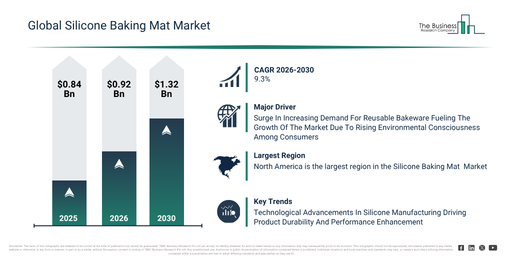
The silicone baking mat market has seen significant growth in recent years. It is projected to expand from $0.84 billion in 2025 to $0.93 billion in 2026, registering a compound annual growth rate (CAGR) of 9.7%. This historic growth can be attributed to several factors including the rising trend of home baking culture and domestic cooking habits, increased adoption of non-stick cookware in homes, growing understanding of food safety and hygiene standards, the proliferation of modern retail kitchenware, and a shift from single-use baking paper to reusable alternatives.
The silicone baking mat market is projected to experience substantial expansion in the coming years, reaching a valuation of $1.32 billion by 2030, exhibiting a compound annual growth rate (CAGR) of 9.3%. This anticipated growth is primarily fueled by factors such as the increasing consumer demand for sustainable kitchen items, the flourishing premium home baking and artisanal bakery culture, the growing integration of professional-grade cookware within households, the broadening reach of e-commerce channels for kitchenware sales, and ongoing advancements in food-grade silicone materials. Concurrently, key trends expected during this period involve a heightened demand for reusable and environmentally friendly kitchen baking accessories, spurred by greater sustainability awareness. There’s also an increasing embrace of non-stick and chemical-free baking surfaces in home kitchens, a developing preference for durable and heat-resistant silicone cookware in commercial bakeries, an expanding market for premium baking tools influenced by home baking trends and social media, and a rising adoption of easy-to-clean and low-maintenance baking solutions among urban consumers.
Get A Free Sample Report With In-Depth Market Insights:
Silicone Baking Mat Market Growth Drivers: What’s Behind The Acceleration?
The market for silicone baking mats is anticipated to expand due to the growing need for reusable bakeware. Reusable bakeware consists of kitchen tools and surfaces for baking that are made for repeated use over many baking sessions, thereby removing the necessity for single-use options like disposable parchment paper or aluminum foil. The heightened demand for reusable bakeware stems from consumers’ growing emphasis on environmental sustainability, as they actively seek items that help reduce kitchen waste and lessen their environmental impact. Silicone baking mats enhance reusable bakeware by offering a robust, washable, and enduring non-stick surface that completely substitutes disposable baking liners, presenting an effective solution for consumers concerned about the environment. For instance, in May 2025, the International Housewares Association (IHA), a US-based not-for-profit, full-service trade association, representing the global home and housewares industry, reported that 42% of U.S. consumers considered bakeware a category they were very likely or somewhat likely to purchase in 2025, with replacements and sustainability-driven upgrades being the primary reasons for purchase across the bakeware segment. Consequently, the rising demand for reusable bakeware is fueling the growth of the silicone baking mat market.
Silicone Baking Mat Market Segment Trends And Revenue Contributors
The silicone baking mat market covered in this report is segmented –
1) By Product Type: Fiberglass Silicone Baking Mats, Pure Silicone Baking Mats, Perforated Silicone Baking Mats, Other Product Types
2) By Material Grade: Industrial Grade Silicone, Food Grade Silicone, Platinum Cured Silicone, Peroxide Cured Silicone
3) By Distribution Channel: Online Retail, Supermarkets Or Hypermarkets, Specialty Stores, Other Distribution Channels
4) By End User: Households, Bakeries, Restaurants, Food Processing Industry, Other End Users
Subsegments:
1) By Fiberglass Silicone Baking Mats: Reinforced Fiberglass Mesh Silicone Baking Mats, Double Layer Fiberglass Silicone Baking Mats, Non Stick Fiberglass Silicone Baking Mats, Heat Resistant Fiberglass Silicone Baking Mats
2) By Pure Silicone Baking Mats: Food Grade Pure Silicone Baking Mats, Non Stick Pure Silicone Baking Mats, Thick Pure Silicone Baking Mats, Flexible Pure Silicone Baking Mats
3) By Perforated Silicone Baking Mats: Micro Perforated Silicone Baking Mats, Air Flow Silicone Baking Mats, Fiberglass Reinforced Perforated Silicone Baking Mats, Non Stick Perforated Silicone Baking Mats, Commercial Bakery Perforated Silicone Baking Mats
4) By Other Product Types: Macaron Silicone Baking Mats, Silicone Pastry Rolling Mats, Custom Printed Silicone Baking Mats, Silicone Oven Liner Mats
Silicone Baking Mat Market Trends: What’s Defining The Industry’s Next Phase?
Major companies active in the silicone baking mat market are concentrating on technological improvements in silicone manufacturing, specifically techniques like platinum catalyzed crosslinking. This effort aims to improve product durability, enhance heat resistance and safety, ensure consistent non-stick performance, and eliminate harmful residues for food-grade applications. Platinum catalyzed crosslinking is a curing method that forms highly stable silicone structures, leading to better thermal resistance, increased durability, and reduced chemical residue, which facilitates safer and longer-lasting baking uses. For example, in October 2023, Silpat, a bakeware firm based in France, introduced a new assortment of silicone molds and custom baking mats, along with an upgraded e-commerce platform. This launch included food-grade fiberglass mesh coated with silicone, seasonal custom mat patterns, and specialty baking molds designed for repeated high-temperature use and uniform baking results. These technological advancements support product premiumization and sustainability objectives, although sophisticated manufacturing processes do increase production costs.
Silicone Baking Mat Market Competitive Landscape: Which Companies Lead The Industry?
Major companies operating in the silicone baking mat market report are Helen of Troy Limited, Wilton Brands LLC, Nordic Ware, Bundy Baking Solutions, Conair Corporation, Norpro Inc., Fox Run Brands LLC, Joseph Joseph Ltd., Trudeau Corporation, Matfer Bourgeat SAS, Silikomart S.r.l., Mastrad S.A., Pavoni Italia S.p.A., Sasa Demarle S.A.S., de Buyer Industries, Lékué S.L., Fat Daddio’s Inc., TESCOMA s.r.o., Tovolo, Harold Import Company, Groupe SEB
View The Full Silicone Baking Mat Market Report:
Silicone Baking Mat Market Top Region: Where Does Most Revenue Come From?
North America was the largest region in the silicone baking mat market in 2025. Asia-Pacific is expected to be the fastest-growing region in the forecast period. The regions covered in the silicone baking mat market report are Asia-Pacific, South East Asia, Western Europe, Eastern Europe, North America, South America, Middle East, Africa.
Reach Out To Our Team:
The Business Research Company: https://www.thebusinessresearchcompany.com/
Americas: +1 310-496-7795
Asia: +44 7882 955267 & +91 8897263534
Europe: +44 7882 955267
Email us at: marketing@tbrc.info
Follow us on:
LinkedIn: https://in.linkedin.com/company/the-business-research-company
YouTube: https://www.youtube.com/channel/UC24_fI0rV8cR5DxlCpgmyFQ
Global Market Model: https://www.thebusinessresearchcompany.com/global-market-model

Wasay has over a decade of experience in market research, data modelling, and analytics, with prior experience at GlobalData and Decision Tree Consulting Services. At The Business Research Company , he leads research operations across syndicated studies, customized consulting engagements, and the Global Market Model platform. His professional experience includes supporting organizations such as Boston Consulting Group, KPMG, and Ernst & Young. Wasay holds a degree in Electronics and Communications Engineering, postgraduate management qualifications from International Management Institute Belgium and Indian School of Business and Entrepreneurship, and completed the Integrated Program in Business Analytics from Indian Institute of Management Indore.