
Through market attractiveness analysis, total addressable market evaluation, company benchmarking matrices, interactive Excel dashboards, expanded supply chain intelligence, emerging startup coverage, and detailed product insights, The Business Research Company’s 2026 market reports provide more actionable and strategically valuable research.
Deployable Inflatable Lunar Habitat Market Growth From $1.35 Billion In 2026 To $2.65 Billion By 2030 At A CAGR Of 18.33%
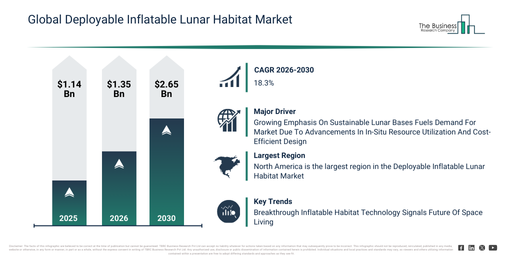
The market size for deployable inflatable lunar habitats has experienced swift expansion in recent years. This market is projected to expand from $1.14 billion in 2025 to reach $1.35 billion by 2026, demonstrating a compound annual growth rate (CAGR) of 18.5%. Historically, this growth can be attributed to several factors: the testing of inflatable habitat modules in terrestrial analog environments, the initial integration of life-support systems, progress in lightweight and flexible structural materials, a rising interest in lunar exploration initiatives, and the creation of rapid deployment mechanisms.
The deployable inflatable lunar habitat market is projected for substantial expansion in the coming years, with its size expected to reach $2.65 billion by 2030, reflecting a compound annual growth rate (CAGR) of 18.3%. This significant growth during the forecast period is attributable to several factors, including the expansion of commercial lunar missions, the continuous development of radiation-shielded inflatable habitats, the successful integration with autonomous deployment systems, an increased preference for modular and scalable designs, and the adoption of advanced thermal insulation and monitoring systems. Major trends anticipated during this period encompass the escalating development of multilayer radiation and micrometeoroid shielding specifically for inflatable habitats, breakthroughs in high-strength, lightweight inflatable structural materials engineered for lunar environments, the rising deployment of modular, expandable habitat systems intended for scalable lunar bases, the progression of integrated life-support and environmental control systems optimized for inflatable habitats, and the broad expansion of rapid-deployment mechanisms enabling swift operational readiness on the lunar surface.
Download A Free Sample Report For Comprehensive Market Insights:
#Deployable Inflatable Lunar Habitat Market Growth Drivers And Industry Catalysts
The increasing global focus on developing sustainable lunar bases is expected to propel the deployable inflatable lunar habitat market. A sustainable lunar base is conceptualized for long-term human habitation, aiming to minimize reliance on Earth by employing advanced recycling systems and in-situ resource utilization (ISRU) for air, water, and fuel, all while supporting scientific and exploration endeavors. Inflatable lunar habitats are highly compatible with this vision due to their lightweight and compact design, leading to lower launch costs, offering scalable living space, integrating life support systems, and providing effective radiation protection, thereby facilitating extended stays on the Moon. For instance, in July 2023, as reported by Situation Publishing, a UK-based B2B technology publisher, NASA allocated $150 million in 2023 to 11 companies, with each contributing 10–25% of the costs, to advance technologies crucial for sustainable lunar exploration, including habitats, power, transportation, and essential infrastructure. Thus, the intensifying emphasis on sustainable lunar bases is a primary driver for the expansion of the deployable inflatable lunar habitat market.
Deployable Inflatable Lunar Habitat Market Categorization By Product Type And Application
The deployable inflatable lunar habitat market covered in this report is segmented –
1) By Product Type: Single-Module, Multi-Module
2) By Material: Polymer Films, Composite Materials, Other Materials
3) By Deployment Mechanism: Automated, Manual
4) By Application: Scientific Research, Commercial, Defense, Other Applications
5) By End-User: Space Agencies, Private Space Companies, Research Institutes, Other End-Users
Subsegments:
1) By Single-Module: Rigid Frame, Fabric Shell, Hybrid
2) By Multi-Module: Connected Modules, Expandable Modules, Stackable Modules
Deployable Inflatable Lunar Habitat Market Innovation Trends Driving Future Development
Major companies operating in the deployable inflatable lunar habitat market are concentrating on developing advanced products, such as expandable inflatable habitats, to accelerate the creation of high-volume, lightweight habitation systems capable of sustaining human life in space or on planetary surfaces. An expandable inflatable habitat is a lightweight, fabric-based construction designed for compact stowage during launch and subsequent inflation to provide a spacious, pressurized environment for human habitation or research in space or on planetary surfaces. For instance, in January 2024, Sierra Space, a US-based commercial space technology company, unveiled the Large Integrated Flexible Environment (LIFE) habitat. The LIFE habitat is a full-scale, expandable structure manufactured from high-strength fabric materials that significantly surpassed the National Aeronautics and Space Administration’s recommended safety factor during pressure testing, showcasing robust performance under extreme conditions. It features a compact launch configuration that inflates to create a living and working space multiple times larger than its transport volume, positioning it as a scalable solution for future orbital and planetary habitation requirements.
Deployable Inflatable Lunar Habitat Market Industry Leaders And Market Competition
Major companies operating in the deployable inflatable lunar habitat market are Airbus SE, Collins Aerospace (RTX Corporation), Lockheed Martin Corporation, Northrop Grumman Corporation, National Aeronautics and Space Administration (NASA), Thales Alenia Space S.p.A., Sierra Nevada Corporation, European Space Agency, Sierra Space Corporation, ILC Dover LP, Redwire Corporation, Spartan Space, Axiom Space Inc., Bigelow Aerospace, GITAI Inc., Astrobotic Technology Inc., SpaceFund Inc., Max Space, Astroport Space Technologies Inc., Lunexus Space Inc.
Access The Complete Deployable Inflatable Lunar Habitat Market Report:
Deployable Inflatable Lunar Habitat Market Regional Analysis And Leading Geography
North America was the largest region in the deployable inflatable lunar habitat market in 2025. Asia-Pacific is expected to be the fastest-growing region in the forecast period. The regions covered in the deployable inflatable lunar habitat market report are Asia-Pacific, South East Asia, Western Europe, Eastern Europe, North America, South America, Middle East, Africa.
Access a Customized Deployable Inflatable Lunar Habitat Market Report for Deeper Competitive Insights
https://www.thebusinessresearchcompany.com/customise?id=28598&type=smp
The Business Research Company: https://www.thebusinessresearchcompany.com/
Americas: +1 310-496-7795
Asia: +44 7882 955267 & +91 8897263534
Europe: +44 7882 955267
Email us at: marketing@tbrc.info
Follow us on:
LinkedIn: https://in.linkedin.com/company/the-business-research-company
YouTube: https://www.youtube.com/channel/UC24_fI0rV8cR5DxlCpgmyFQ
Global Market Model: https://www.thebusinessresearchcompany.com/global-market-model

Wasay has over a decade of experience in market research, data modelling, and analytics, with prior experience at GlobalData and Decision Tree Consulting Services. At The Business Research Company , he leads research operations across syndicated studies, customized consulting engagements, and the Global Market Model platform. His professional experience includes supporting organizations such as Boston Consulting Group, KPMG, and Ernst & Young. Wasay holds a degree in Electronics and Communications Engineering, postgraduate management qualifications from International Management Institute Belgium and Indian School of Business and Entrepreneurship, and completed the Integrated Program in Business Analytics from Indian Institute of Management Indore.