Backed by market attractiveness analysis, total addressable market sizing, company benchmarking matrices, interactive Excel dashboards, wider supply chain intelligence, emerging startup coverage, and detailed product-level insights, The Business Research Company’s 2026 market reports are designed to offer research that is more actionable and strategically valuable than ever.
Exhaust Heat Recovery System Market Size Forecast: How Big Could The Market Get By 2030?
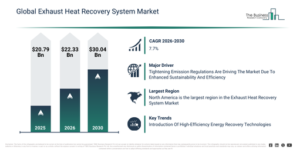
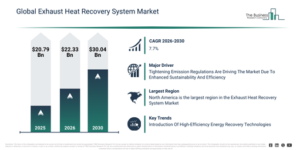
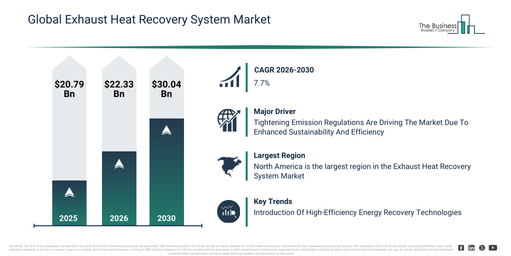
The exhaust heat recovery system market has seen strong growth in recent years. It is projected to expand from $20.79 billion in 2025 to $22.33 billion in 2026, achieving a compound annual growth rate (CAGR) of 7.4%. Historically, this growth has been driven by increasing fuel efficiency requirements, a rise in heavy-duty vehicle production, the expansion of industrial power generation, a growing focus on emission reduction technologies, and the availability of advanced heat exchangers.
The market for exhaust heat recovery systems is projected to experience robust expansion over the coming years. This market is anticipated to reach $30.04 billion by 2030, demonstrating a compound annual growth rate (CAGR) of 7.7%. Several factors are expected to drive this growth during the forecast period, including the increased electrification of powertrains, a rise in the uptake of hybrid systems, the broadening of industrial energy recovery solutions, heightened regulatory scrutiny on emissions, and greater investments in energy efficiency technologies. Key trends anticipated during this period encompass the incorporation of waste heat recovery technologies, an increase in the deployment of thermoelectric generators, the extension of exhaust heat recovery applications to commercial vehicles, a rising implementation in industrial engines, and improved system efficiency designs.
Get A Free Sample Report With In-Depth Market Insights:
Exhaust Heat Recovery System Market Growth Backed By Core Demand Fundamentals
Stricter emission rules are anticipated to boost the expansion of the exhaust heat recovery system market in the future. These regulations are official criteria and directives implemented by government bodies and regulatory agencies to manage and restrict the discharge of damaging pollutants and greenhouse gases from various sources like industrial operations and transport, aiming to safeguard public health and the ecosystem. The main impetus behind more stringent emission controls is the growing focus on environmental sustainability, as a greater understanding of pollution’s extended ecological and social consequences motivates regulators to introduce measures that promote cleaner technologies. Exhaust heat recovery systems assist in complying with these rigorous demands by capturing and repurposing waste heat from exhaust flows, consequently enhancing energy efficiency, decreasing fuel use, and diminishing detrimental emissions. For example, in March 2024, the U.S. Environmental Protection Agency (EPA), a federal agency located in the US, completed national standards for pollution related to passenger cars, light-duty trucks, and medium-duty vehicles for model years ranging from 2027 through 2032 and subsequent years. These new benchmarks are anticipated to avert more than 7 billion tons of carbon emissions and produce almost $100 billion in yearly net societal advantages. These benefits encompass $13 billion from better public health resulting from cleaner air and $62 billion from decreased fuel, maintenance, and repair expenses for motorists. Consequently, the imposition of more stringent emission regulations is fueling the expansion of the exhaust heat recovery system market.
Exhaust Heat Recovery System Market Segment Breakdown: Which Categories Lead On Revenue?
The exhaust heat recovery system market covered in this report is segmented –
1) By Type: Heat Recovery Steam Generators, Heat Exchangers, Steam Turbines, Condensing Units
2) By Component: Turbine, Thermoelectric Generator (TEG) Module, Evaporator, Condenser, Other Components
3) By Vehicle Type: Passenger Car, Light Commercial Vehicle (LCV), Heavy Commercial Vehicle (HCV)
4) By Application: Industrial, Power Generation, Automotive
5) By End-User: Manufacturing, Oil And Gas, Food And Beverage, Utility, Transportation
Subsegments:
1) By Heat Recovery Steam Generators: Waste Heat Boilers, Once-Through Steam Generators, Firetube Steam Generators, Watertube Steam Generators
2) By Heat Exchangers: Shell And Tube Heat Exchangers, Plate Heat Exchangers, Air Cooled Heat Exchangers, Finned Tube Heat Exchangers
3) By Steam Turbines: Back Pressure Steam Turbines, Condensing Steam Turbines, Extraction Steam Turbines, Reheat Steam Turbines
4) By Condensing Units: Air Cooled Condensers, Water Cooled Condensers, Evaporative Condensers, Hybrid Condensers
Exhaust Heat Recovery System Market Growth Trends Reshaping The Competitive Landscape
Leading companies within the exhaust heat recovery system market are concentrating on leveraging government initiatives, such as the electric program investment charge (EPIC), to enhance sustainable energy adoption and infrastructure development. The electric program investment charge (EPIC) represents a government-funded program that backs the research, development, and demonstration of innovative clean energy technologies, aiming to accelerate sustainable energy solutions and drive low-carbon advancements. For instance, in January 2025, the California Energy Commission (CEC), a US-based state government agency, implemented a low-temperature waste heat recovery system at Searles Valley Minerals in Trona, California. This system was designed to capture vented low-pressure steam for drying V-BOR, thereby reducing natural gas use. The project additionally conserved water by recycling cold condensate through a storage tank, addressing critical water-resource needs. This system ultimately achieved a 15% reduction in natural gas consumption.
Exhaust Heat Recovery System Market Leading Players And Competitive Positioning
Major companies operating in the exhaust heat recovery system market are MAHLE GmbH, Denso Corporation, Forvia Faurecia SE, Continental AG, Robert Bosch GmbH, Mitsubishi Heavy Industries,Ltd., Valeo SE, Tenneco Inc., Eberspächer Gruppe GmbH & Co. KG, Schaeffler AG, Marelli Holdings Co.,Ltd., Siemens AG, Bosal International N.V., Dana Incorporated, GE Vernova, IHI Corporation, Schneider Electric SE, Viessmann Group, Babcock & Wilcox, Senior Flexonics, EnviroKinetics,Inc., Exergy International SRL, GEA Group, Anguil Environmental Systems, Ormat Technologies,Inc
View The Full Exhaust Heat Recovery System Market Report:
Exhaust Heat Recovery System Market Geographic Analysis: Where Is Demand Rising Fastest?
North America was the largest region in the exhaust heat recovery system market in 2025. Asia-Pacific is expected to be the fastest-growing region in the forecast period. The regions covered in the exhaust heat recovery system market report are Asia-Pacific, South East Asia, Western Europe, Eastern Europe, North America, South America, Middle East, Africa
Reach Out To Our Team:
The Business Research Company: https://www.thebusinessresearchcompany.com/
Americas: +1 310-496-7795
Asia: +44 7882 955267 & +91 8897263534
Europe: +44 7882 955267
Email us at: marketing@tbrc.info
Follow us on:
LinkedIn: https://in.linkedin.com/company/the-business-research-company
YouTube: https://www.youtube.com/channel/UC24_fI0rV8cR5DxlCpgmyFQ
Global Market Model: https://www.thebusinessresearchcompany.com/global-market-model

Wasay has over a decade of experience in market research, data modelling, and analytics, with prior experience at GlobalData and Decision Tree Consulting Services. At The Business Research Company , he leads research operations across syndicated studies, customized consulting engagements, and the Global Market Model platform. His professional experience includes supporting organizations such as Boston Consulting Group, KPMG, and Ernst & Young. Wasay holds a degree in Electronics and Communications Engineering, postgraduate management qualifications from International Management Institute Belgium and Indian School of Business and Entrepreneurship, and completed the Integrated Program in Business Analytics from Indian Institute of Management Indore.