
Delivering more actionable and strategically valuable research, The Business Research Company’s 2026 market reports feature market attractiveness analysis, total addressable market evaluation, company benchmarking matrices, interactive Excel dashboards, expanded supply chain intelligence, emerging startup coverage, and detailed product insights.
Direct Broadcast Satellite Service Market Forecast Highlighting Growth From $40.58 Billion To $57.1 Billion
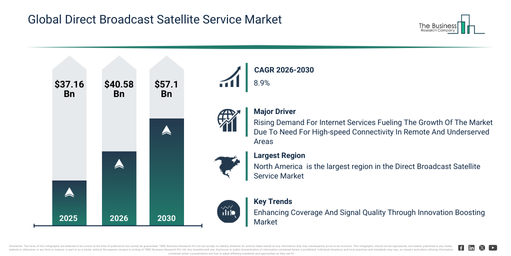
The direct broadcast satellite service market has observed robust growth in recent years. This market is anticipated to expand from $37.16 billion in 2025 to $40.58 billion in 2026, at a compound annual growth rate (CAGR) of 9.2%. The historical expansion can be attributed to several factors including the rapid adoption of direct-to-home television services, the extension of satellite coverage to rural and remote areas, advancements in high-power transponder technology, the increasing availability of affordable satellite dishes and receivers, and a rising consumer demand for diverse television and radio content.
The direct broadcast satellite service market is anticipated to experience substantial growth in the coming years. It is projected to reach $57.1 billion by 2030, demonstrating a compound annual growth rate (CAGR) of 8.9%. This expansion during the forecast period is driven by several factors, including the increasing availability of subscription-based and on-demand content services, the deployment of high-throughput satellites to improve signal quality, the integration of internet and interactive services with satellite broadcasting, a rise in partnerships between content providers and satellite operators, and the adoption of hybrid broadcast-broadband services to enhance user experience. Key trends during this period encompass a growing move towards bundled broadcast and streaming hybrid packages, an increasing demand for uhd and multi-channel broadcasting, the wider implementation of advanced encryption for the protection of premium content, the expansion of multi-regional satellite broadcasting networks, and the rising adoption of compact, low-cost consumer satellite receiver equipment.
Download A Free Sample Report For Comprehensive Market Insights:
Direct Broadcast Satellite Service Market Demand Drivers: What Is Fueling Industry Growth?
The increasing need for internet services is projected to stimulate the expansion of the direct broadcast satellite service market in the future. Internet services refer to diverse online resources and functions that enable users to access, share, and exchange information, communication, and digital content over the internet. The demand for internet services is escalating due to the rising adoption of smartphones and connected devices that require constant online access. Direct broadcast satellite (DBS) service supports this demand by providing high-speed connectivity in remote and underserved areas where traditional broadband infrastructure is limited. For instance, in July 2024, according to the Office of Communications, a UK-based government-approved regulatory and competition authority, the average monthly data usage per mobile user grew by 21%, reaching 9.9 GB in 2023. Therefore, the increasing demand for internet services is a key driver for the growth of the direct broadcast satellite service market.
Direct Broadcast Satellite Service Market Segmentation: How Is The Market Structured Across Key Categories?
The direct broadcast satellite service market covered in this report is segmented –
1) By Satellite Type: Low Earth Orbit (LEO), Medium Earth Orbit (MEO), Geostationary Orbit (GEO)
2) By Service Type: Standard Definition (SD) Services, High Definition (HD) Services, Ultra High Definition (UHD) Services, Interactive Services, Pay-Per-View Services
3) By Technology: Satellite Communication Technology, IP-Based Technology, Hybrid Services, Cloud-Based Solutions, Advanced Modulation Techniques
4) By Distribution Channel: Direct Sales, Retail Partnerships, Online Sales Platforms, Value-Added Resellers (VARs), Franchise Networks
5) By End-User: Residential Customers, Commercial Customers, Govement And Defense Institutions, Educational Institutions, Healthcare Facilities
Subsegments:
1) By Low Earth Orbit (LEO): Communication Satellites, Earth Observation Satellites, Navigation Satellites, Scientific Satellites, Technology Demonstration Satellites
2) By Medium Earth Orbit (MEO): Navigation Satellites, Communication Satellites, Earth Observation Satellites, Military Satellites
3) By Geostationary Orbit (GEO): Communication Satellites, Weather Satellites, Earth Observation Satellites, Broadcast Satellites, Surveillance Satellites
Direct Broadcast Satellite Service Market Trends: What Is Shaping Future Industry Growth?
Leading companies in the direct broadcast satellite (DBS) service market are focused on developing innovative next-generation broadcast satellites. This initiative aims to expand coverage, improve signal quality, and provide advanced broadcasting services. These advanced satellites incorporate high-power payloads and enhanced transmission capabilities, resulting in improved efficiency, broader coverage, and the capacity to support Ultra HD broadcasting. As an illustration, in June 2024, SES S.A., a satellite telecommunications firm based in Luxembourg, launched its ASTRA 1P (SES-24) satellite. This satellite delivers more robust and reliable broadcast signals across Europe, addressing the rising demand for high definition (HD) and ultra high definition (UHD) television channels. It also boosts SES’s direct-to-home (DTH) television services by increasing capacity, thereby ensuring sustained broadcast continuity and expanded media distribution for its clientele.
Direct Broadcast Satellite Service Market Competitive Landscape: Who Are The Leading Companies?
Major companies operating in the direct broadcast satellite service market are EchoStar Corporation, CANAL+ S.A., SES SA, Eutelsat Communications S.A., Astro Malaysia Holdings Berhad, Telesat Corporation, Sun Direct TV Private Limited, Azam Media Limited, Claro TV, StarTimes Group, NXE Australia Pty. Ltd., ZAP TV, Beximco Communications Limited, DIRECTV Ecuador, Tata Play Limited, Bell Canada Enterprises Inc., Dialog Axiata PLC, True Visions Group Co. Ltd., SKY Perfect JSAT Holdings Inc., Bharti Telemedia Limited
Access The Complete Direct Broadcast Satellite Service Market Report:
Direct Broadcast Satellite Service Market Geographic Landscape: Which Region Dominates Industry Growth?
North America was the largest region in the direct broadcast satellite service market in 2025. Asia-Pacific is expected to be the fastest-growing region in the forecast period. The regions covered in the direct broadcast satellite service market report are Asia-Pacific, South East Asia, Western Europe, Eastern Europe, North America, South America, Middle East, Africa.
Access a Customized Direct Broadcast Satellite Service Market Report for Deeper Competitive Insights
https://www.thebusinessresearchcompany.com/customise?id=27677&type=smp
The Business Research Company: https://www.thebusinessresearchcompany.com/
Americas: +1 310-496-7795
Asia: +44 7882 955267 & +91 8897263534
Europe: +44 7882 955267
Email us at: marketing@tbrc.info
Follow us on:
LinkedIn: https://in.linkedin.com/company/the-business-research-company
YouTube: https://www.youtube.com/channel/UC24_fI0rV8cR5DxlCpgmyFQ
Global Market Model: https://www.thebusinessresearchcompany.com/global-market-model

Wasay has over a decade of experience in market research, data modelling, and analytics, with prior experience at GlobalData and Decision Tree Consulting Services. At The Business Research Company , he leads research operations across syndicated studies, customized consulting engagements, and the Global Market Model platform. His professional experience includes supporting organizations such as Boston Consulting Group, KPMG, and Ernst & Young. Wasay holds a degree in Electronics and Communications Engineering, postgraduate management qualifications from International Management Institute Belgium and Indian School of Business and Entrepreneurship, and completed the Integrated Program in Business Analytics from Indian Institute of Management Indore.