
Featuring market attractiveness scoring, total addressable market sizing, company benchmarking matrices, interactive Excel dashboards, deeper supply chain intelligence, emerging startup tracking, and granular product-level insights, The Business Research Company’s 2026 market reports are built to deliver research that is both more actionable and more strategically valuable.
Heating Equipment (Except Warm Air Furnaces) Market Value Growth And Long-Term Outlook
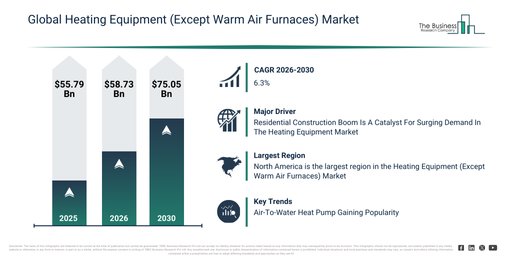
The market size for heating equipment (excluding warm air furnaces) has shown significant growth in recent years. This sector is anticipated to increase from $55.79 billion in 2025 to $58.73 billion in 2026, achieving a compound annual growth rate (CAGR) of 5.3%. The expansion observed in the past can be attributed to factors such as the growth of industrial processing facilities, the need for precise temperature control, an increase in laboratory testing activities, the adoption of boiler-based heating, and various industrial safety requirements.
The heating equipment (except warm air furnaces) market is anticipated to experience substantial growth over the next few years. It is forecast to reach $75.05 billion in 2030, demonstrating a compound annual growth rate (CAGR) of 6.3%. This expansion during the forecast period is driven by industrial decarbonization initiatives, the replacement of legacy heating systems, the adoption of high-efficiency boilers, growth within chemical and pharmaceutical processing, and the automation of industrial heating. Key developments expected over the forecast period include an increasing demand for process heating equipment, the expansion of laboratory heating applications, the implementation of energy-efficient boiler systems, rising utilization in industrial fluid heating, and the modernization of heating infrastructure.
Get A Free Sample Report With In-Depth Market Insights:
Heating Equipment (Except Warm Air Furnaces) Market Expansion Drivers: What’s Shaping Future Growth?
The growth of the heating equipment (except warm air furnaces) market is anticipated to be propelled by the rising number of residential construction projects. Residential projects encompass the building of houses, apartments, and high-rise structures. Heating equipment is utilized to regulate temperature and humidity in these residential settings, with the aim of ensuring thermal comfort and acceptable indoor air quality. Therefore, an increase in both residential and commercial construction projects leads to a higher demand for heating equipment (except warm air furnaces). For example, in January 2023, according to the U.S. Census Bureau and the U.S. Department of Housing and Urban Development, 1.4 million residential houses were constructed, representing a 12.8% increase compared to January 2022. This demonstrates that the expanding volume of residential construction projects is a key driver for the heating equipment (except warm air furnaces) market.
Heating Equipment (Except Warm Air Furnaces) Market Segment Analysis: What Are The Core Market Categories?
The heating equipment (except warm air furnaces) market covered in this report is segmented –
1) By Equipment Type: Boilers and Hydronic Heating Equipment, Steam Heating Equipment, Electric Process Heating Equipment, Thermal Fluid (Hot Oil) Heating Systems, Laboratory and Analytical Heating Equipment, Supplemental and Temporary Heating Equipment
2) By Energy Source: Electric, Natural Gas, Oil, Biomass, Other Energy Sources
3) By Application: Industrial Process Heating, Laboratory and Analytical Heating, Commercial Building Heating, District and Institutional Heating, Other Applications
4) By End-Use Industry: Chemicals and Petrochemicals, Pharmaceuticals and Biotechnology, Food and Beverage Processing, Oil and Gas, Power Generation, Research and Academic Laboratories, Commercial and Institutional Facilities, Other End-Use Industries
Subsegments:
1) By Boilers and Hydronic Heating Equipment: Hot Water Boilers, Condensing Boilers, Combi Boilers, Commercial and Industrial Hydronic Systems
2) By Steam Heating Equipment: Low-Pressure Steam Boilers, Steam Radiators and Heat Exchangers, Steam Distribution and Control Equipment
3) By Electric Process Heating Equipment: Immersion Heaters, Circulation Heaters, Cartridge and Band Heaters
4) By Thermal Fluid (Hot Oil) Heating Systems: Thermal Fluid Heaters, Heat Transfer Oil Systems, Indirect Fired Heating Systems
5) By Laboratory and Analytical Heating Equipment: Heating Mantles, Hot Plates and Stirrers, Heating Baths (Oil, Water, Sand), Rotary Evaporator Heating Units
6) By Supplemental and Temporary Heating Equipment: Electric Space and Infrared Heaters, Portable Industrial Heaters, Temporary Construction and Event Heaters
Heating Equipment (Except Warm Air Furnaces) Market Strategic Trends: What Defines The Next Growth Phase?
Leading companies in the heating equipment (except warm air furnaces) market are concentrating on air-to-water heat pumps to boost their revenues. An air-to-water heat pump is a system that uses ambient air to either release or absorb heat for heating or cooling, depending on its operational mode. For instance, in May 2023, Daikin Industries Ltd., a Japan-based company specializing in air conditioning, heating, ventilation, and refrigeration systems, introduced an air-to-water heat pump. This unit features a reversing function, allowing the chiller to switch between heating and cooling modes according to the specific temperature needs of a process or space. The device exhibits a coefficient of performance (COP) of 3.12 in heating mode and a seasonal coefficient of performance (SCOP) of 3.31, providing a heating capacity of 91.2 kW and a cooling capacity of 23.58 tons. The heat pump is equipped with a brazed plate evaporator ensuring low refrigerant pressure drops, low discharge pressure, continuous fan speed modulation, a large condenser coil surface area for optimal heat transfer, and high-efficiency scroll compressors.
Heating Equipment (Except Warm Air Furnaces) Market Top Companies Driving Competitive Growth
Major companies operating in the heating equipment (except warm air furnaces) market are Thermal Solutions Products LLC, New Yorker Boiler Company Inc., Bard HVAC, Fulton Thermal Corporation, John Zink Company LLC, Toyotomi Co. Ltd., ECR International Inc., Daikin Industries Ltd., Robert Bosch GmbH, A.O. Smith Corporation, Bosch Thermotechnology Corp., Bradford White Corporation, Burnham Holdings Inc., Carrier Corporation, Danfoss A/S, Emerson Electric Co., Honeywell International Inc., HTP Comfort Solutions LLC, Johnson Controls International plc, Laars Heating Systems Company, Lochinvar LLC, Mitsubishi Electric Corporation
View The Full Heating Equipment (Except Warm Air Furnaces) Market Report:
Heating Equipment (Except Warm Air Furnaces) Market Regional Analysis: Which Geography Leads On Revenue?
North America was the largest region in the heating equipment (except warm air furnaces) market in 2025. The regions covered in the heating equipment (except warm air furnaces) market report are Asia-Pacific, South East Asia, Western Europe, Eastern Europe, North America, South America, Middle East, Africa
Reach Out To Our Team:
The Business Research Company: https://www.thebusinessresearchcompany.com/
Americas: +1 310-496-7795
Asia: +44 7882 955267 & +91 8897263534
Europe: +44 7882 955267
Email us at: marketing@tbrc.info
Follow us on:
LinkedIn: https://in.linkedin.com/company/the-business-research-company
YouTube: https://www.youtube.com/channel/UC24_fI0rV8cR5DxlCpgmyFQ
Global Market Model: https://www.thebusinessresearchcompany.com/global-market-model

Wasay has over a decade of experience in market research, data modelling, and analytics, with prior experience at GlobalData and Decision Tree Consulting Services. At The Business Research Company , he leads research operations across syndicated studies, customized consulting engagements, and the Global Market Model platform. His professional experience includes supporting organizations such as Boston Consulting Group, KPMG, and Ernst & Young. Wasay holds a degree in Electronics and Communications Engineering, postgraduate management qualifications from International Management Institute Belgium and Indian School of Business and Entrepreneurship, and completed the Integrated Program in Business Analytics from Indian Institute of Management Indore.
