Built to provide research that’s more actionable and strategically valuable, The Business Research Company’s 2026 market reports include market attractiveness analysis, total addressable market sizing, company benchmarking matrices, interactive Excel dashboards, broader supply chain intelligence, emerging startup tracking, and in-depth product insights.
Prismatic Cell Assembly Automation Market Forecast: Value Set To Climb From $2.63 Billion To $4.25 Billion
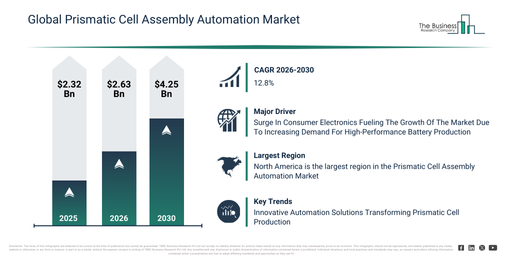
The prismatic cell assembly automation market size has experienced rapid growth in recent years. It is projected to expand from $2.32 billion in 2025 to $2.63 billion in 2026, achieving a compound annual growth rate (CAGR) of 13.0%. The historical period’s growth can be attributed to several factors, including the expansion of lithium-ion battery manufacturing capacity, increased adoption of prismatic cells, rising automation in battery production, the availability of advanced robotic systems, and a growing demand for consistent cell quality.
The prismatic cell assembly automation market size is poised for substantial expansion in the coming years. This market is projected to reach $4.25 billion by 2030, exhibiting a compound annual growth rate (CAGR) of 12.8%. Factors contributing to this growth over the forecast period encompass the intensification of electric vehicle manufacturing, greater financial commitments in battery gigafactories, an escalating need for uniform battery configurations, increased implementation of digital twins in production, and the incorporation of AI-powered quality surveillance. Key developments anticipated within this timeframe involve the wider uptake of entirely automated prismatic cell lines, the increased incorporation of vision-guided assembly technologies, an expanding reliance on robotics for precise stacking and welding operations, the proliferation of high-throughput battery assembly facilities, and improvements in quality control via software analytics.
Get A Free Sample Report With In-Depth Market Insights:
Prismatic Cell Assembly Automation Market Opportunity Drivers: What’s Unlocking New Revenue Potential?
The increasing need for consumer electronics is projected to advance the expansion of the prismatic cell assembly automation market in the future. Consumer electronics encompass electronic gadgets intended for daily personal use, such as smartphones, laptops, tablets, and wearables. This growing demand for consumer electronics stems from the creation of quicker and more potent processors, which improve device functionality and introduce novel features, prompting consumers to update their devices more often. The increasing consumption of these electronics reinforces the necessity for prismatic cell assembly automation, since such devices demand high-capacity, efficient batteries, which can only be manufactured at scale via automated production methods. For example, data from the Japan Electronics and Information Technology Industries Association, a Japan-based trade body, showed that in February 2024, consumer electronic equipment production hit $201.91 million (¥31,685 million), an increase from $149.27 million (¥23,425 million) in January 2023. Consequently, the heightened demand for consumer electronics is a key factor propelling the expansion of the prismatic cell assembly automation market.
Prismatic Cell Assembly Automation Market Breakdown By Product Type And Application
The prismatic cell assembly automation market covered in this report is segmented –
1) By Component: Robots, Conveyors, Vision Systems, Control Systems, Software, Other Components
2) By Automation Level: Fully Automated, Semi-Automated
3) By Application: Electric Vehicles, Consumer Electronics, Energy Storage Systems, Industrial Equipment, Other Applications
4) By End-User: Automotive, Electronics, Energy And Power, Industrial, Other End-Users
Subsegments:
1) By Robots: Articulated Robots, Selective Compliance Assembly Robot Arm (SCARA) Robots, Delta Robots, Collaborative Robots (Cobots)
2) By Conveyors: Belt Conveyors, Roller Conveyors, Chain Conveyors, Modular Conveyors
3) By Vision Systems: Two-Dimensional (2D) Vision Systems, Three-Dimensional (3D) Vision Systems, Laser Vision Systems, Multi-Camera Vision Systems
4) By Control Systems: Programmable Logic Controllers (PLC), Human-Machine Interfaces (HMI), Distributed Control Systems (DCS), Motion Controllers
5) By Software: Assembly Automation Software, Process Monitoring Software, Quality Control Software, Analytics And Reporting Software
6) By Other Components: End Effectors, Grippers, Sensors, Safety Systems
Prismatic Cell Assembly Automation Market Innovation Trends: What Developments Are Reshaping The Industry?
Leading companies in the prismatic cell assembly automation market are concentrating on developing innovative solutions, such as fully automated assembly lines, to boost production efficiency, ensure quality, and address the growing demand for advanced energy storage. These fully automated assembly lines are manufacturing systems where machines and robotics execute all tasks with minimal human involvement, which helps increase efficiency, reduce errors, lower labor costs, and ensure consistent, high-quality battery production. For instance, in January 2025, The Lithium Battery Company, a US-based manufacturing firm, unveiled a cutting-edge 60,000 sq ft automated manufacturing facility in Tampa, Florida. This plant features fully automated assembly lines for large prismatic and cylindrical batteries, alongside semi-automated pack assembly lines, designed to support defense contracts, AI data center energy storage, and OEM partnerships. The facility enables the company to scale production, enhance quality control, and accelerate the deployment of advanced energy storage solutions. Equipped with clean room environments, advanced testing and validation laboratories, climate-controlled storage, and comprehensive quality control systems, the plant guarantees high reliability and safety standards for all its battery products.
Prismatic Cell Assembly Automation Market Company Landscape And Competitive Strategy
Major companies operating in the prismatic cell assembly automation market are Siemens AG, Mitsubishi Electric Corporation, Schneider Electric SE, Rockwell Automation Inc., FANUC Corporation, Yaskawa Electric Corporation, Comau S.p.A., Manz AG, Dürr AG, Wuxi Lead Intelligent Equipment Co. Ltd., Shenzhen Yinghe Technology Co. Ltd., Guangdong Lyric Robot Automation Co. Ltd., CKD Corporation, Schuler Group GmbH, Hitachi Ltd., Thyssenkrupp AG, Honeywell International Inc., KUKA AG, ABB Ltd., Bosch Rexroth AG, SFA Engineering S.p.A., Koerber AG
View The Full Prismatic Cell Assembly Automation Market Report:
Prismatic Cell Assembly Automation Market Geographic Analysis: Where Is Demand Rising Fastest?
North America was the largest region in the prismatic cell assembly automation market in 2025. The regions covered in the prismatic cell assembly automation market report are Asia-Pacific, South East Asia, Western Europe, Eastern Europe, North America, South America, Middle East, Africa
Reach Out To Our Team:
The Business Research Company: https://www.thebusinessresearchcompany.com/
Americas: +1 310-496-7795
Asia: +44 7882 955267 & +91 8897263534
Europe: +44 7882 955267
Email us at: marketing@tbrc.info
Follow us on:
LinkedIn: https://in.linkedin.com/company/the-business-research-company
YouTube: https://www.youtube.com/channel/UC24_fI0rV8cR5DxlCpgmyFQ
Global Market Model: https://www.thebusinessresearchcompany.com/global-market-model

Wasay has over a decade of experience in market research, data modelling, and analytics, with prior experience at GlobalData and Decision Tree Consulting Services. At The Business Research Company , he leads research operations across syndicated studies, customized consulting engagements, and the Global Market Model platform. His professional experience includes supporting organizations such as Boston Consulting Group, KPMG, and Ernst & Young. Wasay holds a degree in Electronics and Communications Engineering, postgraduate management qualifications from International Management Institute Belgium and Indian School of Business and Entrepreneurship, and completed the Integrated Program in Business Analytics from Indian Institute of Management Indore.