
Featuring market attractiveness scoring, total addressable market sizing, company benchmarking matrices, interactive Excel dashboards, deeper supply chain intelligence, emerging startup tracking, and granular product-level insights, The Business Research Company’s 2026 market reports are built to deliver research that is both more actionable and more strategically valuable.
Automotive Ultrasonic Sensors Market Revenue Growth On Track For A 9.68% CAGR Through 2030
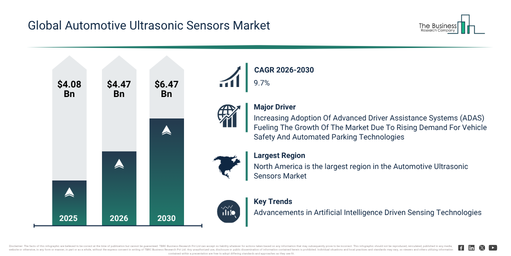
The automotive ultrasonic sensors market has demonstrated robust growth in recent years. It is anticipated to expand from $4.08 billion in 2025 to $4.47 billion in 2026, achieving a compound annual growth rate (CAGR) of 9.4%. This historical expansion can be attributed to the growing demand for vehicle safety features, increasing adoption of park assist systems, stringent automotive safety regulations, rising production of passenger vehicles, and a growing consumer preference for collision avoidance technologies.
The automotive ultrasonic sensors market is anticipated to experience substantial expansion in the coming years. This market is projected to reach $6.47 billion by 2030, demonstrating a compound annual growth rate (CAGR) of 9.7%.
This growth during the projection period is primarily driven by the increasing implementation of autonomous driving systems, the growing integration of advanced sensing technologies, the escalating demand for intelligent parking assistance, the expanding uptake of electric and hybrid vehicles, and heightened investment in next-generation vehicle perception systems.
Key trends anticipated during this period encompass the increasing embrace of high accuracy ultrasonic distance measurement, a growing demand for multi-sensor object detection systems, the rising integration of compact ultrasonic sensor modules, the expansion of enhanced short-range environmental sensing capabilities, and the intensified development of highly reliable ultrasonic sensing solutions.
Get A Free Sample Report With In-Depth Market Insights:
Automotive Ultrasonic Sensors Market Growth Factors: What’s Supporting Expansion?
The rising uptake of advanced driver assistance systems (ADAS) is anticipated to drive the expansion of the automotive ultrasonic sensors market in the future. ADAS comprises electronic safety and driver-support technologies that leverage sensors, cameras, radar, ultrasonic sensors, lidar, and software to help drivers operate vehicles more safely and effectively. The growth of ADAS is spurred by strict vehicle safety mandates, as governments globally enforce advanced safety functionalities such as automatic emergency braking and lane departure warning, thereby leading to widespread integration of ADAS technologies across new vehicle models. Automotive ultrasonic sensors assist ADAS by enabling precise short-range object detection for functions like parking assistance, obstacle detection, and avoiding collisions at low speeds. For instance, in October 2024, the MITRE Corporation, a US-based not-for-profit organization, stated that by the 2023 model year, 10 of the 14 advanced driver-assistance systems (ADAS) features achieved over 50% market penetration, with five features surpassing 90%. In contrast, none of the ADAS features had reached 75% penetration. Consequently, the increasing adoption of advanced driver assistance systems (ADAS) is propelling the growth of the automotive ultrasonic sensors market.
Automotive Ultrasonic Sensors Market Segment Breakdown: Which Categories Lead On Revenue?
The automotive ultrasonic sensors market covered in this report is segmented –
1) By Sensor Type: Open Type Ultrasonic Sensors, Closed Type Ultrasonic Sensors
2) By Propulsion Type: Internal Combustion Engine Vehicles, Electric Vehicles, Hybrid Electric Vehicles
3) By Vehicle Type: Passenger Cars, Light Commercial Vehicles, Heavy Commercial Vehicles
4) By Sales Channel: Original Equipment Manufacturers, Aftermarket
5) By Application: Park Assist Systems, Blind Spot Detection, Object Detection, Collision Avoidance Systems, Autonomous Emergency Braking Support, Self Parking Systems, Proximity Sensing, Other Applications
Subsegments:
1) By Open Type Ultrasonic Sensors: Single Element Open Type Ultrasonic Sensors, Dual Element Open Type Ultrasonic Sensors, Short Range Open Type Ultrasonic Sensors, Medium Range Open Type Ultrasonic Sensors, Long Range Open Type Ultrasonic Sensors
2) By Closed Type Ultrasonic Sensors: Flush Mount Closed Type Ultrasonic Sensors, Surface Mount Closed Type Ultrasonic Sensors, Short Range Closed Type Ultrasonic Sensors, Medium Range Closed Type Ultrasonic Sensors, Long Range Closed Type Ultrasonic Sensors
Automotive Ultrasonic Sensors Market Industry Trends: What’s Reshaping Demand?
Major companies operating in the automotive ultrasonic sensors market are concentrating on developing technological advancements in automotive sensors, specifically automotive ultrasonic transceiver ICs. This endeavor aims to enhance AI-based parking assistance, refine object detection accuracy, bolster environmental perception, and facilitate sophisticated automated driving functions. Automotive ultrasonic transceiver ICs are specialized integrated circuits responsible for transmitting, receiving, and processing ultrasonic signals exchanged between ultrasonic sensors and a vehicle’s electronic control unit (ECU). As an illustration, Robert Bosch GmbH, a Germany-based engineering and technology company, launched its TB193 and TB293 ultrasonic chipsets in April 2026. These chipsets were introduced to improve AI-based parking assistance and close-range object detection by acquiring raw ultrasonic sensor data, thereby enabling more precise perception, better obstacle detection, and advanced automated driving features. The TB193 and TB293 ultrasonic chipsets provide direct access to raw ultrasonic sensor signals, which in turn permits AI algorithms to process a greater volume of environmental data, leading to significantly higher-precision object detection.
Automotive Ultrasonic Sensors Market Leading Players And Competitive Positioning
Major companies operating in the automotive ultrasonic sensors market are Aptiv PLC, Continental AG, DENSO Corporation, Elmos Semiconductor SE, FORVIA, Hitachi Astemo Ltd., Hyundai Mobis Co. Ltd., Infineon Technologies AG, Magna International Inc., Murata Manufacturing Co. Ltd., NXP Semiconductors N.V., Panasonic Holdings Corporation, Robert Bosch GmbH, Sensata Technologies Holding plc, STMicroelectronics N.V., TDK Corporation, TE Connectivity Ltd., Texas Instruments Incorporated, Valeo SA, ZF Friedrichshafen AG
View The Full Automotive Ultrasonic Sensors Market Report:
Automotive Ultrasonic Sensors Market Geographic Landscape: Which Region Leads Industry Growth?
North America was the largest region in the automotive ultrasonic sensors market in 2025. Asia-Pacific is expected to be the fastest-growing region in the forecast period. The regions covered in the automotive ultrasonic sensors market report are Asia-Pacific, South East Asia, Western Europe, Eastern Europe, North America, South America, Middle East, Africa.
Reach Out To Our Team:
The Business Research Company: https://www.thebusinessresearchcompany.com/
Americas: +1 310-496-7795
Asia: +44 7882 955267 & +91 8897263534
Europe: +44 7882 955267
Email us at: marketing@tbrc.info
Follow us on:
LinkedIn: https://in.linkedin.com/company/the-business-research-company
YouTube: https://www.youtube.com/channel/UC24_fI0rV8cR5DxlCpgmyFQ
Global Market Model: https://www.thebusinessresearchcompany.com/global-market-model

Wasay has over a decade of experience in market research, data modelling, and analytics, with prior experience at GlobalData and Decision Tree Consulting Services. At The Business Research Company , he leads research operations across syndicated studies, customized consulting engagements, and the Global Market Model platform. His professional experience includes supporting organizations such as Boston Consulting Group, KPMG, and Ernst & Young. Wasay holds a degree in Electronics and Communications Engineering, postgraduate management qualifications from International Management Institute Belgium and Indian School of Business and Entrepreneurship, and completed the Integrated Program in Business Analytics from Indian Institute of Management Indore.