Backed by market attractiveness analysis, total addressable market sizing, company benchmarking matrices, interactive Excel dashboards, wider supply chain intelligence, emerging startup coverage, and detailed product-level insights, The Business Research Company’s 2026 market reports are designed to offer research that is more actionable and strategically valuable than ever.
Robotic Cutting, Deburring, And Finishing Market Size Outlook: How Quickly Will Revenue Expand Through 2030?
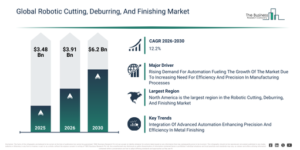
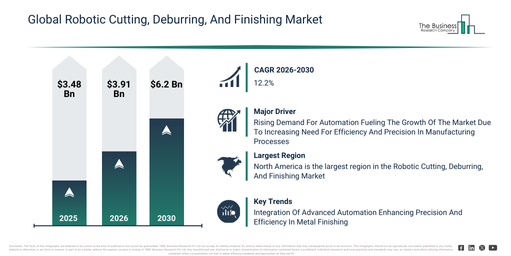
The market size for robotic cutting, deburring, and finishing has observed rapid expansion in recent years. This sector is projected to increase from $3.48 billion in 2025 to $3.91 billion in 2026, achieving a compound annual growth rate (CAGR) of 12.5%. The historical growth can be linked to the expansion of metal fabrication activities, growth in aerospace and automotive production, increasing demand for consistent surface finishes, availability of advanced robotic tools, and rising labor cost pressures.
The robotic cutting, deburring, and finishing market size is projected to experience substantial expansion in the coming years. This market is anticipated to reach a valuation of $6.2 billion by 2030, demonstrating a compound annual growth rate (CAGR) of 12.2%. This projected expansion during the forecast timeframe is attributable to several factors, including the increasing incorporation of AI-driven robotic control, the broadening scope of high-mix low-volume manufacturing, a surging need for defect-free components, heightened automation within finishing operations, and an emphasis on adaptable robotic cells. Significant trends identified for the upcoming period encompass a greater uptake of automated finishing cells, an escalating requirement for precision surface quality, the proliferation of multi-axis robotic systems, wider implementation of vision-guided finishing, and a heightened emphasis on ensuring worker safety.
Get A Free Sample Report With In-Depth Market Insights:
Robotic Cutting, Deburring, And Finishing Market Growth Backed By Core Demand Fundamentals
The burgeoning need for automation is projected to fuel the expansion of the robotic cutting, deburring, and finishing market in the coming period. Automation refers to employing technology, machinery, or integrated systems to execute operations requiring minimal human involvement, thereby enhancing efficiency and precision. Businesses are increasingly seeking automation to enhance productivity, reduce human-related mistakes, and decrease running costs, all while ensuring superior product quality. Within automation, robotic cutting, deburring, and finishing applications serve to optimize material processing jobs, offering significant precision, rapid execution, and uniform results, with reduced human input. As an illustration, in September 2024, the International Federation of Robotics (IFR), a non-profit organization based in Germany, announced a 51% surge in industrial robot installations in the UK, reaching 3,830 units. Concurrently, the Americas saw more than 50,000 units installed for the third consecutive year, amounting to 55,389 units in 2023. Consequently, the escalating need for automation is a primary impetus behind the expansion of the robotic cutting, deburring, and finishing market.
Robotic Cutting, Deburring, And Finishing Market Segment Analysis And Revenue Potential
The robotic cutting, deburring, and finishing market covered in this report is segmented –
1) By Type: 6-Axis And 7-Axis, 3-Axis To 5-Axis
2) By Robot Type: Articulated Robots, Selective Compliance Articulated Robot Arm (SCARA) Robots, Delta Robots, Collaborative Robots (Cobots)
3) By Functionality: Automated Systems, Semi-Automated Systems
4) By Application: Cutting, Deburring, Finishing
5) By End-User Industry: Aerospace, Automotive, Metal Fabrication, Electronics, Consumer Goods, Shipbuilding
Subsegments:
1) By 6-Axis and 7-Axis: Articulated 6-Axis Wrist Robots, Redundant 7-Axis Articulated Robots, 6-Axis High-Payload Robots, 6-Axis High-Precision Robots, 6-Axis Long-Reach Robots, 6-Axis Compact Or Mini Robots, 6-Axis Collaborative Robots (Cobots), 6-Axis CNC-Integrated Machining Robots, 6-Axis Vision-Guided Or Robot-Vision Systems, 7-Axis Linear-Track Or Rail-Mounted Systems
2) By 3-Axis to 5-Axis: 3-Axis Gantry Robots, 3-Axis Tabletop Or Bench Robots, 3-Axis Articulated Or Basic Machining Robots, 4-Axis Indexing Or Rotary-Table Systems, 4-Axis Tilting-Head Systems, 5-Axis Simultaneous Trunnion-Table Systems, 5-Axis Tilting-Table Or Tilt-Rotary Head Systems, 5-Axis Gantry Or Multi-Axis Gantry Systems, 3–5-Axis CNC-Integrated Robotic Cells, 3–5-Axis Portable Or Fixture-Mounted Units
#Robotic Cutting, Deburring, And Finishing Market Growth Trends: What’s Shaping The Future Outlook?
Within the robotic cutting, deburring, and finishing market, leading companies are concentrating their efforts on creating machines that are compact, energy-efficient, and user-friendly, like the 4DD processing system, to boost precision, productivity, and operational safety. This 4DD processing system employs four discs, two positioned at the front and two at the back, enabling it to manage both initial deburring and final polishing concurrently, thereby enhancing speed, accuracy, and overall processing efficiency. As an illustration, in November 2024, Murata Machinery Ltd. (Muratec), an industrial machinery manufacturer based in Japan, introduced the DB1000H deburring machine, engineered for achieving high-quality and efficient metal finishing. Incorporating a 4DD processing system with dual front and back discs, it carries out deburring, polishing, and chamfering in a single operation. The machine is characterized by its compact footprint, occupying only 2.65 ? of floor space, offers enhanced energy efficiency with merely 4.7 kVA of power consumption, and ensures straightforward operation through automatic thickness detection and NC data updates. Further features include barcode-based tool management, conveniently placed rear operation buttons, and a full open-door design for simple maintenance, positioning the DB1000H as an intelligent, space-efficient solution for contemporary manufacturing automation.
Robotic Cutting, Deburring, And Finishing Market Key Players Shaping Industry Direction
Major companies operating in the robotic cutting, deburring, and finishing market are ABB Ltd., FANUC Corporation, Yaskawa Electric Corporation (MOTOMAN), Kawasaki Heavy Industries, Ltd., DAIHEN Corporation, Stäubli International AG, Comau S.p.A., Dürr AG, DENSO Corporation, Seiko Epson Corporation, Mitsubishi Electric Corporation, Omron Corporation, Hyundai Robotics Co., Ltd., KC Robotics Inc., AV&R S.A.S., Wolf Robotics, Fastems Oy Ab, Robot System Products AB, AVR-Global, Applied Robotics, Romheld Automation Pty Ltd, Geometrix Automation and Robotics Pvt. Ltd., Hammond Roto-Finish, Cyan-TEC, KC Engineering
View The Full Robotic Cutting, Deburring, And Finishing Market Report:
Robotic Cutting, Deburring, And Finishing Market Largest Region: Which Geography Holds The Biggest Share?
North America was the largest region in the robotic cutting, deburring, and finishing market in 2025. Asia-Pacific is expected to be the fastest-growing region in the forecast period. The regions covered in the robotic cutting, deburring, and finishing market report are Asia-Pacific, South East Asia, Western Europe, Eastern Europe, North America, South America, Middle East, Africa
Reach Out To Our Team:
The Business Research Company: https://www.thebusinessresearchcompany.com/
Americas: +1 310-496-7795
Asia: +44 7882 955267 & +91 8897263534
Europe: +44 7882 955267
Email us at: marketing@tbrc.info
Follow us on:
LinkedIn: https://in.linkedin.com/company/the-business-research-company
YouTube: https://www.youtube.com/channel/UC24_fI0rV8cR5DxlCpgmyFQ
Global Market Model: https://www.thebusinessresearchcompany.com/global-market-model

Wasay has over a decade of experience in market research, data modelling, and analytics, with prior experience at GlobalData and Decision Tree Consulting Services. At The Business Research Company , he leads research operations across syndicated studies, customized consulting engagements, and the Global Market Model platform. His professional experience includes supporting organizations such as Boston Consulting Group, KPMG, and Ernst & Young. Wasay holds a degree in Electronics and Communications Engineering, postgraduate management qualifications from International Management Institute Belgium and Indian School of Business and Entrepreneurship, and completed the Integrated Program in Business Analytics from Indian Institute of Management Indore.