Featuring market attractiveness scoring, total addressable market sizing, company benchmarking matrices, interactive Excel dashboards, deeper supply chain intelligence, emerging startup tracking, and granular product-level insights, The Business Research Company’s 2026 market reports are built to deliver research that is both more actionable and more strategically valuable.
Robotic Welding For Automotive Manufacturing Market Growth From $4 Billion In 2026 To $5.9 Billion By 2030 At A CAGR Of 10.2%
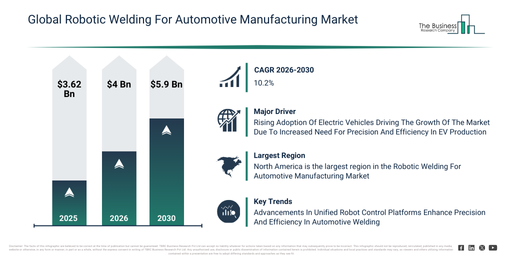
The market size for robotic welding for automotive manufacturing has seen swift expansion in recent years. It is projected to grow from $3.62 billion in 2025 to $4 billion in 2026, exhibiting a compound annual growth rate (CAGR) of 10.5%. The growth observed in the historic period stems from the expansion of automotive mass production, rising labor cost pressures, an increasing demand for consistent weld quality, the adoption of automated body-in-white lines, and the availability of industrial robotic welding systems.
The robotic welding for automotive manufacturing market size is anticipated to expand significantly in the coming years, reaching $5.9 billion by 2030 with a compound annual growth rate (CAGR) of 10.2%. This growth over the forecast period is driven by the shift towards electric vehicle manufacturing, the increasing intricacy of vehicle architectures, greater investments in smart automotive factories, the rising adoption of flexible manufacturing lines, and the integration of AI-driven welding analytics. Prominent trends expected in this period encompass the increased deployment of multi-robot welding cells, a surge in the use of laser welding in body-in-white operations, the growing integration of vision-guided robotic welding, the expansion of robotic welding for battery pack assembly, and an enhanced focus on maintaining consistent weld quality.
Get A Free Sample Report With In-Depth Market Insights:
Robotic Welding For Automotive Manufacturing Market Expansion Drivers: What’s Shaping Future Growth?
The increasing uptake of electric vehicles (EVs) is anticipated to fuel expansion in the robotic welding for automotive manufacturing market moving ahead. This surge in EV adoption is largely fueled by stronger policy backing and various purchase incentives, which successfully reduce initial expenses for buyers and boost the overall affordability of EVs. Robotic welding for automotive manufacturing facilitates increased EV production volumes through precise, consistent, and efficient joining techniques for lightweight vehicle bodies, battery casings, and intricate multi-material components. An illustration of this trend is seen in 2024, where data from the International Energy Agency (IEA), a France-based intergovernmental organization, revealed that almost 14 million new electric cars were registered globally in 2023, marking a 35% rise compared to 2022. Consequently, the expanding adoption of electric vehicles (EVs) is serving as a key driver for the growth of the robotic welding for automotive manufacturing market.
Robotic Welding For Automotive Manufacturing Market Segment Analysis: What Are The Core Market Categories?
The robotic welding for automotive manufacturing market covered in this report is segmented –
1) By Product: Resistance Spot Welding, Resistance Seam Welding, Laser Beam Welding
2) By Vehicle Type: Passenger Vehicles, Commercial Vehicles
3) By Welding Process: Arc Welding, Spot Welding, Laser Welding
4) By Application: Body-in-White, Powertrain, Chassis, Exhaust Systems, Battery Packs
Subsegments:
1) By Resistance Spot Welding: Servo-controlled Spot Welding Robots, Pneumatic Spot Welding Robots, Fixed Spot Welding Robots, Multi-gun Spot Welding Robots
2) By Resistance Seam Welding: Longitudinal Seam Welding Robots, Circumferential Seam Welding Robots, Roller-type Seam Welding Robots, Wheel Electrode Seam Welding Robots, Continuous Seam Welding Robots
3) By Laser Beam Welding: Fiber Laser Welding Robots, Hybrid Laser-Arc Welding Robots
Robotic Welding For Automotive Manufacturing Market Industry Trends Fueling Future Revenue Growth
Key players in the robotic welding for automotive manufacturing market are prioritizing innovations in robotics and automation technology, specifically unified robot control platforms that integrate hardware and software to boost precision, speed, and autonomy. These platforms are defined as integrated control architectures designed to operate multiple robot types from a single controller, unify motion and process coordination, and enable advanced functionalities such as higher cycle speeds, deterministic synchronization, and built-in autonomy. As an illustration, in June 2024, ABB, a Switzerland-based robotics company, unveiled OmniCore, its next-generation robotics control platform, which features a unified, modular architecture engineered to significantly enhance the speed, precision, and sustainability of industrial automation. Representing a $170 million strategic investment, OmniCore succeeds ABB’s legacy IRC5 controller and integrates advanced mechatronics, AI, sensor technology, and cloud-edge connectivity to deliver next-level performance.
Robotic Welding For Automotive Manufacturing Market Top Companies Driving Competitive Growth
Major companies operating in the robotic welding for automotive manufacturing market are ABB Limited, FANUC Corporation, Yaskawa Electric Corporation, KUKA AG, Kawasaki Heavy Industries Limited, Panasonic Holdings Corporation, Comau S.p.A., Nachi-Fujikoshi Corporation, DAIHEN Corporation, Hyundai Robotics Corporation, Fronius International GmbH, The Lincoln Electric Company, ESAB Corporation, Cloos Robotic Welding GmbH, OTC Daihen Incorporated, Ador Welding Limited, Servo-Robot Incorporated, ACRO Automation Systems Incorporated, Scott Technology Limited, Melton Machine and Control Company, Tiesse Robot S.p.A., Reis Robotics GmbH
View The Full Robotic Welding For Automotive Manufacturing Market Report:
Robotic Welding For Automotive Manufacturing Market Top Region By Revenue And Market Share
North America was the largest region in the robotic welding for automotive manufacturing market in 2025. Asia-Pacific is expected to be the fastest-growing region in the forecast period. The regions covered in the robotic welding for automotive manufacturing market report are Asia-Pacific, South East Asia, Western Europe, Eastern Europe, North America, South America, Middle East, Africa
Reach Out To Our Team:
The Business Research Company: https://www.thebusinessresearchcompany.com/
Americas: +1 310-496-7795
Asia: +44 7882 955267 & +91 8897263534
Europe: +44 7882 955267
Email us at: marketing@tbrc.info
Follow us on:
LinkedIn: https://in.linkedin.com/company/the-business-research-company
YouTube: https://www.youtube.com/channel/UC24_fI0rV8cR5DxlCpgmyFQ
Global Market Model: https://www.thebusinessresearchcompany.com/global-market-model

Wasay has over a decade of experience in market research, data modelling, and analytics, with prior experience at GlobalData and Decision Tree Consulting Services. At The Business Research Company , he leads research operations across syndicated studies, customized consulting engagements, and the Global Market Model platform. His professional experience includes supporting organizations such as Boston Consulting Group, KPMG, and Ernst & Young. Wasay holds a degree in Electronics and Communications Engineering, postgraduate management qualifications from International Management Institute Belgium and Indian School of Business and Entrepreneurship, and completed the Integrated Program in Business Analytics from Indian Institute of Management Indore.