Backed by market attractiveness analysis, total addressable market sizing, company benchmarking matrices, interactive Excel dashboards, wider supply chain intelligence, emerging startup coverage, and detailed product-level insights, The Business Research Company’s 2026 market reports are designed to offer research that is more actionable and strategically valuable than ever.
Rotate Vector (RV) Reducer Market CAGR Outlook And Future Development
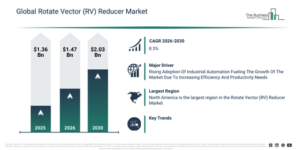
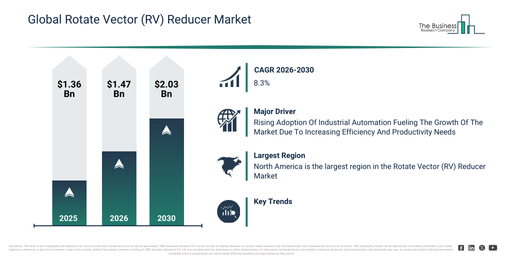
The rotate vector (rv) reducer market has experienced robust growth in recent years. This market is projected to expand from $1.36 billion in 2025 to reach $1.47 billion in 2026, demonstrating an 8.6% compound annual growth rate (CAGR). Historically, this growth has been influenced by the broadening of industrial automation systems, an increase in robotics deployment, the growing demand for precision motion control, escalating investments in manufacturing modernization, and the availability of advanced gearbox technologies.
The rotate vector (rv) reducer market is projected to experience substantial expansion over the upcoming years, with its size reaching $2.03 billion by 2030, exhibiting a compound annual growth rate (CAGR) of 8.3%. This anticipated growth during the forecast period is driven by several factors, including the increasing integration of collaborative robots, a surge in demand for energy-efficient drive systems, the ongoing expansion of electric vehicle production, the broadening application of automation in healthcare equipment, and an intensifying focus on compact high-performance gear solutions. Key trends influencing the market in this period encompass the growing uptake of high-precision cycloidal rv reducers, the heightened incorporation of rv reducers into industrial robotics, a rising need for compact high-torque gear systems, the extended deployment of rv reducers in electric vehicles, and a strengthened emphasis on backlash-free motion control.
Get A Free Sample Report With In-Depth Market Insights:
Rotate Vector (RV) Reducer Market Growth Drivers: What’s Behind The Acceleration?
The increasing integration of industrial automation is projected to boost the growth of the rotate vector (RV) reducer market in the future. Industrial automation involves utilizing control systems, robotics, and information technologies to manage and supervise industrial processes with minimal human input, thereby enhancing efficiency, productivity, and safety. This growth in industrial automation stems from a demand for greater operational efficiency as businesses strive to lower costs, minimize errors, and improve output. Rotate vector (RV) reducers support industrial automation through their high-precision motion control and compact design, making them perfectly suited for robotic applications and automated machinery. They contribute to improved operational efficiency by ensuring smooth, accurate, and dependable torque transmission, which in turn reduces downtime and maintenance needs. For example, data from September 2024 by the International Federation of Robotics, a Germany-based non-profit organization, indicated that 4,281,585 robotic units were operational in factories worldwide in 2023, representing a 10% rise from 3,904,000 units in 2022. Consequently, the expanding adoption of industrial automation is a key factor propelling the rotate vector (RV) reducer market forward. The growing adoption of electric vehicles is anticipated to drive the expansion of the rotate vector (RV) reducer market moving forward. Electric vehicles (EVs) are automobiles powered by electric motors that draw energy from rechargeable batteries, offering transportation solutions that are cleaner, quieter, and more efficient compared to traditional fossil fuel vehicles. The escalating demand for electric vehicles is largely attributable to rising fuel costs, positioning EVs as a more economical alternative to conventional gasoline cars. Rotate Vector (RV) reducers play a crucial role in advancing electric vehicle adoption by providing precise and efficient torque transmission, making them ideal for electric drivetrains and robotics-assisted manufacturing processes. They enhance vehicle performance and energy efficiency by facilitating smooth and reliable motion control, thereby minimizing mechanical losses and maintenance requirements. As an illustration, the International Energy Agency, a France-based intergovernmental organization, reported in May 2025 that electric car sales surpassed 17 million units in 2024, signifying a growth of over 25% and an increase of approximately 3.5 million vehicles compared to 2023. Thus, the increasing uptake of electric vehicles is stimulating growth in the rotate vector (RV) reducer market.
Rotate Vector (RV) Reducer Market Segment Landscape And Growth Outlook
The rotate vector (rv) reducer market covered in this report is segmented –
1) By Type: Helical Rotate Vector (RV) Reducers, Worm Rotate Vector (RV) Reducers, Planetary Rotate Vector (RV) Reducers, Cycloidal Rotate Vector (RV) Reducers
2) By Distribution Channel: Direct Sales, Indirect Sales
3) By Application: Industrial Automation, Robotics, Aerospace, Marine, Automotive
4) By End-Use: Manufacturing, Healthcare, Construction, Energy, Transportation
Subsegments:
1) By Helical Rotate Vector (RV) Reducers: Single Stage Helical, Double Stage Helical, Coaxial Helical, Parallel Shaft Helical
2) By Worm Rotate Vector (RV) Reducers: Single Enveloping Worm, Double Enveloping Worm, Non-Enveloping Worm, Precision Worm
3) By Planetary Rotate Vector (RV) Reducers: Inline Planetary, Right Angle Planetary, High Torque Planetary, Compact Planetary
4) By Cycloidal Rotate Vector (RV) Reducers: Single Stage Cycloidal, Double Stage Cycloidal, High Precision Cycloidal, Compact Cycloidal
Rotate Vector (RV) Reducer Market Competitive Landscape: Who Leads The Industry?
Major companies operating in the rotate vector (rv) reducer market are Parker Hannifin Corporation, Nidec Corporation, Sumitomo Heavy Industries Ltd., FANUC Corporation, Nabtesco Corporation, Zhejiang Shuanghuan Driveline Co. Ltd., Qinchuan Machine Tool & Tool Group Co. Ltd., Rossi S.p.A., Ningbo Zhongda Leader Intelligent Transmission Co. Ltd., Greatoo Intelligent Equipment Inc., Shenzhen Homwing Technology Co. Ltd., Zhejiang Hengfengtai Reducer Co. Ltd., Wuhan Jinghua Precision Machinery Co. Ltd., Jiangsu Guomao Reducer Co. Ltd., DieQua Corporation, Chietom Precision Transmission Technology Co. Ltd., Genius Robotics, Shanghai Like Precision Machinery Co. Ltd., TallMan Robotics Limited, TechMan Automation Limited
View The Full Rotate Vector (RV) Reducer Market Report:
Rotate Vector (RV) Reducer Market Regional Split: Which Areas Are Fueling Growth?
North America was the largest region in the rotate vector (RV) reducer market in 2025. Asia-Pacific is expected to be the fastest-growing region in the forecast period. The regions covered in the rotate vector (rv) reducer market report are Asia-Pacific, South East Asia, Western Europe, Eastern Europe, North America, South America, Middle East, Africa
Reach Out To Our Team:
The Business Research Company: https://www.thebusinessresearchcompany.com/
Americas: +1 310-496-7795
Asia: +44 7882 955267 & +91 8897263534
Europe: +44 7882 955267
Email us at: marketing@tbrc.info
Follow us on:
LinkedIn: https://in.linkedin.com/company/the-business-research-company
YouTube: https://www.youtube.com/channel/UC24_fI0rV8cR5DxlCpgmyFQ
Global Market Model: https://www.thebusinessresearchcompany.com/global-market-model

Wasay has over a decade of experience in market research, data modelling, and analytics, with prior experience at GlobalData and Decision Tree Consulting Services. At The Business Research Company , he leads research operations across syndicated studies, customized consulting engagements, and the Global Market Model platform. His professional experience includes supporting organizations such as Boston Consulting Group, KPMG, and Ernst & Young. Wasay holds a degree in Electronics and Communications Engineering, postgraduate management qualifications from International Management Institute Belgium and Indian School of Business and Entrepreneurship, and completed the Integrated Program in Business Analytics from Indian Institute of Management Indore.