
Featuring market attractiveness scoring, total addressable market sizing, company benchmarking matrices, interactive Excel dashboards, deeper supply chain intelligence, emerging startup tracking, and granular product-level insights, The Business Research Company’s 2026 market reports are built to deliver research that is both more actionable and more strategically valuable.
Carbon Black In Printing Ink Market Expansion Outlook: What Revenue Opportunities Are Ahead?
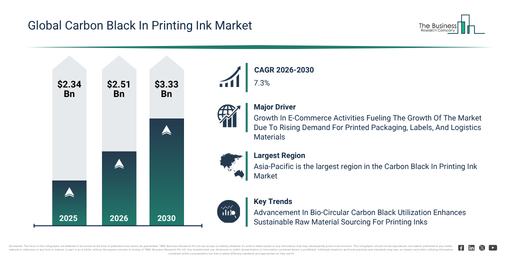
The carbon black in printing ink market has demonstrated considerable growth recently. This market is set to expand from $2.34 billion in 2025 to $2.51 billion in 2026, achieving a compound annual growth rate (CAGR) of 7.1%. The historical expansion can be attributed to a combination of factors including the increasing demand for packaging and commercial printing, the development of publishing and advertising industries, a rising adoption of high-quality printing inks, the expansion of flexible packaging production, and the increasing consumption of carbon black pigments for color enhancement.
The carbon black in printing ink market size is anticipated to undergo significant expansion in the coming years. It is projected to climb to $3.33 billion by 2030, achieving a compound annual growth rate (CAGR) of 7.3%. This growth during the forecast period can be attributed to several factors including an increasing demand for sustainable printing solutions, the rising adoption of digital and advanced printing technologies, a growing need for specialty carbon blacks with superior performance characteristics, the expansion of packaging and labeling applications, and an enhanced focus on high-quality and durable printing outputs. Major trends foreseen in this period include a heightened demand for high-performance carbon black grades in sophisticated printing applications, the increasing integration of sustainable carbon black production methods, a rising call for low particle size carbon blacks to improve print quality, the growing utilization of specialty carbon blacks for high-contrast and long-lasting inks, and the widening applications of carbon black pigments in digital and industrial printing.
Get A Free Sample Report With In-Depth Market Insights:
Carbon Black In Printing Ink Market Growth Factors: What’s Supporting Expansion?
The increasing volume of e-commerce transactions is anticipated to boost the demand for carbon black within the printing ink market. E-commerce encompasses the digital exchange of goods and services, including their purchase, sale, promotion, and distribution via online platforms like websites, mobile apps, and digital marketplaces. This rise is attributed to the wider availability of smartphones and internet access, offering consumers convenient shopping options regardless of location or time. Carbon black in printing ink plays a crucial role in e-commerce by providing durable, high-quality prints essential for packaging labels, barcodes, shipping details, and product branding. For example, the United States Census Bureau, a federal statistical agency based in the U.S., reported U.S. retail e-commerce sales for the first quarter of 2026 reached $326.7 billion in May 2026, marking a 2.7 percent (±0.5 percent) rise from the fourth quarter of 2025, after seasonal adjustments but without price adjustments. Consequently, the expansion of e-commerce activities is a significant catalyst for the growth of carbon black in the printing ink market.
Carbon Black In Printing Ink Market Segmentation: How Does The Market Break Down By Category?
The carbon black in printing ink market covered in this report is segmented –
1) By Type: Furnace Black, Thermal Black, Channel Black, Lamp Black, High Performance Carbon Blacks
2) By Printing Process: Flexographic Printing, Gravure Printing, Offset Printing, Screen Printing, Digital Printing, Inkjet Printing
3) By Ink Type: Solvent Based Inks, Water Based Inks, Ultraviolet Curable Inks, Oil Based Inks, Digital Printing Inks
4) By Application: Packaging Printing, Label Printing, Publication Printing, Commercial Printing, Industrial Printing, Security Printing
Subsegments:
1) By Furnace Black: Standard Furnace Black, Semi Reinforcing Furnace Black, Fast Extrusion Furnace Black, High Abrasion Furnace Black, Intermediate Super Abrasion Furnace Black
2) By Thermal Black: Fine Particle Thermal Black, Medium Particle Thermal Black, Coarse Particle Thermal Black, High Purity Thermal Black, Specialty Thermal Black
3) By Channel Black: Gas Channel Black, Fine Channel Black, Medium Channel Black, Conductive Channel Black, Specialty Channel Black
4) By Lamp Black: Conventional Lamp Black, High Tint Lamp Black, Low Structure Lamp Black, High Structure Lamp Black, Specialty Lamp Black
5) By High Performance Carbon Blacks: Conductive Carbon Black, High Jetness Carbon Black, High Color Carbon Black, Ultraviolet Protection Carbon Black, Low Particle Size Carbon Black
Carbon Black In Printing Ink Market Industry Trends: What’s Reshaping Demand?
Companies active in the carbon black in printing ink market are increasingly concentrating on innovations in the use of recovered carbon black (rCB), including sustainable carbon black for printing inks. This focus aims to bolster sustainability, lessen carbon footprints, elevate the biogenic content of ink formulations, and support customers in reaching their environmental goals. Sustainable carbon black for printing inks is a pigment made from renewable, bio-circular, recycled, or recovered feedstocks, diverging from traditional fossil-based raw materials. As an illustration, in October 2024, Orion S.A., a US-based specialty chemicals company, unveiled PRINTEX Nature 35, a carbon black formulated entirely from bio-circular feedstocks. This particular product enhances sustainability in printing inks by decreasing reliance on fossil-based constituents and assisting customers with their carbon-reduction targets, all while providing performance equivalent to conventional carbon black. It is suitable for applications like food packaging and commercial printing and is manufactured in an ISCC PLUS-certified facility to ensure the traceability of sustainable raw materials.
Carbon Black In Printing Ink Market Competitive Overview And Top Companies
Major companies operating in the carbon black in printing ink market are Cabot Corporation, Birla Carbon, Orion S.A., Mitsubishi Chemical Corporation, Tokai Carbon Co. Ltd., PCBL Chemical Ltd., Himadri Speciality Chemical Ltd., Omsk Carbon Group, Longxing Chemical Stock Co. Ltd., Jiangxi Black Cat Carbon Black Co. Ltd., Continental Carbon Company, Hebei Daguangming Industrial Group, Asahi Carbon Co. Ltd., Denka Company Limited.
View The Full Carbon Black In Printing Ink Market Report:
Carbon Black In Printing Ink Market Regional Breakdown: Where Is Demand Concentrated?
Asia-Pacific was the largest region in the carbon black in printing ink market in 2025. North America is expected to be the fastest-growing region in the forecast period. The regions covered in the carbon black in printing ink market report are Asia-Pacific, South East Asia, Western Europe, Eastern Europe, North America, South America, Middle East, Africa.
Reach Out To Our Team:
The Business Research Company: https://www.thebusinessresearchcompany.com/
Americas: +1 310-496-7795
Asia: +44 7882 955267 & +91 8897263534
Europe: +44 7882 955267
Email us at: marketing@tbrc.info
Follow us on:
LinkedIn: https://in.linkedin.com/company/the-business-research-company
YouTube: https://www.youtube.com/channel/UC24_fI0rV8cR5DxlCpgmyFQ
Global Market Model: https://www.thebusinessresearchcompany.com/global-market-model

Wasay has over a decade of experience in market research, data modelling, and analytics, with prior experience at GlobalData and Decision Tree Consulting Services. At The Business Research Company , he leads research operations across syndicated studies, customized consulting engagements, and the Global Market Model platform. His professional experience includes supporting organizations such as Boston Consulting Group, KPMG, and Ernst & Young. Wasay holds a degree in Electronics and Communications Engineering, postgraduate management qualifications from International Management Institute Belgium and Indian School of Business and Entrepreneurship, and completed the Integrated Program in Business Analytics from Indian Institute of Management Indore.