
Backed by market attractiveness analysis, total addressable market sizing, company benchmarking matrices, interactive Excel dashboards, wider supply chain intelligence, emerging startup coverage, and detailed product-level insights, The Business Research Company’s 2026 market reports are designed to offer research that is more actionable and strategically valuable than ever.
Convenience Store Retailing Market Size And Revenue Outlook Through 2030
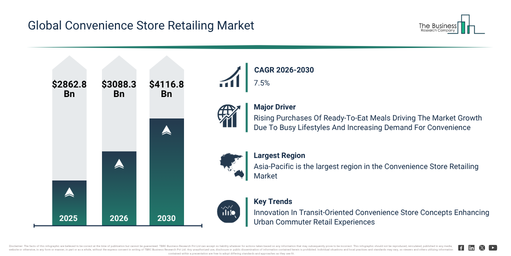
The convenience store retailing market size has demonstrated robust growth recently. It is projected to increase from $2862.83 billion in 2025 to $3088.31 billion in 2026, at a compound annual growth rate (CAGR) of 7.9%. Historically, this expansion has been influenced by factors such as increasing urbanization and population growth, a rising demand for quick and accessible shopping options, consumers’ growing preference for immediate purchase convenience, the expanding network of retail outlets, and the increasing integration of convenience stores in transportation and high traffic areas.
The convenience store retailing market is anticipated to experience substantial expansion over the coming years. This market is projected to reach $4116.89 billion by 2030, exhibiting a compound annual growth rate (CAGR) of 7.5%. Several factors are driving this anticipated growth, including a rising demand for retail experiences that support digital payments, the increasing proliferation of convenience stores within emerging markets, a growing consumer preference for fresh food and ready-to-eat items, greater investment in modernizing store formats, and a heightened need for effective inventory management techniques. Key trends expected during this forecast period involve the expanding integration of self-checkout and automated solutions in convenience stores, a wider availability of ready-to-eat food and beverage options, an increasing call for extended-hour and 24-hour retail services, a sharpened emphasis on delivering personalized shopping experiences for customers, and the continued growth of convenience store networks operating on a franchise model.
Get A Free Sample Report With In-Depth Market Insights:
Convenience Store Retailing Market Growth Backed By Core Demand Fundamentals
The increasing acquisition of ready-to-eat meals is anticipated to fuel expansion within the convenience store retailing market in the future. Ready-to-eat meals are food items that are either pre-cooked or pre-prepared, demanding minimal or no further preparation prior to being eaten. A surge in demand for ready-to-eat meals stems from demanding lifestyles, as individuals juggling busy work schedules and scarce time for cooking look for rapid, effortless, and time-efficient food choices requiring minimal exertion. Convenience store retailing addresses this rising need for ready-to-eat meals by providing a diverse selection of freshly made, pre-packaged, and grab-and-go food items. These are available in strategically situated stores operating for longer hours, allowing consumers with packed schedules to obtain fast and time-saving meal solutions, which in turn boosts store footfall and revenue. For example, data from March 2024, sourced from a report by the Food Manufacturers – a UK-based online resource exclusively for professionals in the UK food and drink manufacturing industry – indicated that sales of on-the-go snacks hit 39% in 2023 when benchmarked against 2022. Present sales figures for 2024 revealed a 4% rise compared to the preceding year. Consequently, the expanding volume of ready-to-eat meal purchases is propelling the expansion of the convenience store retailing market.
Convenience Store Retailing Market Segmentation And Category Overview
The convenience store retailing market covered in this report is segmented –
1) By Store Type: Traditional Convenience Stores, Gas Station Convenience Stores, Hyper Convenience Stores
2) By Product Offering: Food And Beverages, Tobacco Products, Personal Care Products, Household Goods, Other Product Offerings
3) By Ownership: Franchise, Independent, Chain
4) By Application: Residential, Office Buildings, Schools, Transportation Hubs, Other Applications
Subsegments:
1) By Traditional Convenience Stores: Neighborhood Convenience Stores, Independent Convenience Stores, Franchise Convenience Stores, Urban Convenience Stores, Rural Convenience Stores
2) By Gas Station Convenience Stores: Fuel Integrated Convenience Stores, Highway Convenience Stores, Truck Stop Convenience Stores, Branded Oil Company Stores, Express Fuel Mart Stores
3) By Hyper Convenience Stores: Large Format Convenience Stores, Foodservice Focused Convenience Stores, Twenty Four Hour Hyper Convenience Stores, Multi Service Convenience Stores, Premium Convenience Stores
Convenience Store Retailing Market Strategic Trends: What Defines The Next Growth Phase?
Leading companies in the convenience store retailing market are prioritizing the development of advanced solutions, such as transit-oriented convenience store concepts, to improve commuter convenience, expand urban retail access, and boost customer engagement in busy transportation hubs. These transit-oriented convenience store concepts are compact retail formats situated within transportation hubs that offer commuters quick access to essential products and services, thereby enhancing convenience, increasing customer involvement, and driving retail sales in high-traffic transit locations. For example, in March 2025, Carrefour, a France-based retail company, collaborated with Altarea SCA, a France-based real estate development and investment company, and RATP Group, a France-based public transportation operator, to launch a new convenience store concept across 45 metro stations within the Grand Paris Express network. These stores, designed to serve an anticipated 300 million annual passengers, range from 50 to 250 square meters and incorporate multifunctional retail formats offering groceries, fresh produce, electronic accessories, chargers, earphones, parcel collection points, luggage lockers, and concierge services. This initiative is part of a broader development plan that could extend to as many as 136 commercial spaces throughout the network, establishing a comprehensive retail ecosystem within transit hubs. Additionally, Carrefour is testing complementary concepts, such as fresh produce-focused stores and autonomous self-service formats, to meet evolving consumer preferences for speed, convenience, and seamless shopping experiences.
Convenience Store Retailing Market Competitive Analysis Of Leading Industry Participants
Major companies operating in the convenience store retailing market are 7-Eleven Inc., Alimentation Couche-Tard Inc, ARKO Corp., Buc-ee’s Ltd., Casey’s General Stores, EG America LLC, FamilyMart Co. Ltd., Global Partners LP, GS25, Lawson Inc., Love’s Travel Stops & Country Stores, Maverik, Ministop Co. Ltd., Murphy USA Inc., Nouria Energy Corporation, OXXO SA DE CV, QuikTrip Corporation, RaceTrac Inc., Reitan AS, Seicomart Co. Ltd., Sheetz Inc., Wawa Inc., Yesway Inc.
View The Full Convenience Store Retailing Market Report:
Convenience Store Retailing Market Regional Analysis: Which Geography Leads On Revenue?
Asia-Pacific was the largest region in the convenience store retailing market in 2025. Asia-Pacific is expected to be the fastest-growing region in the forecast period. The regions covered in the convenience store retailing market report are Asia-Pacific, South East Asia, Western Europe, Eastern Europe, North America, South America, Middle East, Africa.
Reach Out To Our Team:
The Business Research Company: https://www.thebusinessresearchcompany.com/
Americas: +1 310-496-7795
Asia: +44 7882 955267 & +91 8897263534
Europe: +44 7882 955267
Email us at: marketing@tbrc.info
Follow us on:
LinkedIn: https://in.linkedin.com/company/the-business-research-company
YouTube: https://www.youtube.com/channel/UC24_fI0rV8cR5DxlCpgmyFQ
Global Market Model: https://www.thebusinessresearchcompany.com/global-market-model

Wasay has over a decade of experience in market research, data modelling, and analytics, with prior experience at GlobalData and Decision Tree Consulting Services. At The Business Research Company , he leads research operations across syndicated studies, customized consulting engagements, and the Global Market Model platform. His professional experience includes supporting organizations such as Boston Consulting Group, KPMG, and Ernst & Young. Wasay holds a degree in Electronics and Communications Engineering, postgraduate management qualifications from International Management Institute Belgium and Indian School of Business and Entrepreneurship, and completed the Integrated Program in Business Analytics from Indian Institute of Management Indore.