
Built to provide research that’s more actionable and strategically valuable, The Business Research Company’s 2026 market reports include market attractiveness analysis, total addressable market sizing, company benchmarking matrices, interactive Excel dashboards, broader supply chain intelligence, emerging startup tracking, and in-depth product insights.
Gasoline Port Fuel Injection Market Size Forecast: How Big Could The Market Get By 2030?
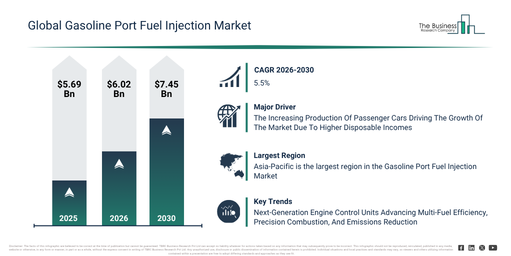
The size of the gasoline port fuel injection market has experienced robust expansion over recent years. Projections indicate it will expand from $5.69 billion in 2025 to $6.02 billion in 2026, demonstrating a compound annual growth rate (CAGR) of 5.9%. Factors contributing to this growth during historical periods include the rising output of gasoline-fueled vehicles, a surging need for better engine fuel efficiency, the increasing integration of electronic fuel injection systems, a heightened emphasis within the automotive sector on reducing emissions, and a developing demand for replacing fuel injection parts.
The gasoline port fuel injection market is poised for significant expansion in the coming years. It is projected to reach $7.45 billion by 2030, exhibiting a compound annual growth rate (CAGR) of 5.5%. This growth throughout the forecast period stems from the increasing integration of sophisticated engine management systems, a rising demand for optimized gasoline combustion technologies, the growing adoption of hybrid vehicle powertrains that utilize gasoline engines, the ongoing development of efficient fuel injection components, and an intensified focus on reducing both fuel consumption and exhaust emissions. Key trends anticipated during this period include the optimization of advanced fuel injection systems for enhanced combustion efficiency, the creation of high-precision fuel delivery components, a broader embrace of low-emission gasoline engine technologies, the expansion of compact and lightweight fuel injection systems, and a heightened demand for improved fuel atomization and overall engine performance.
Get A Free Sample Report With In-Depth Market Insights:
Gasoline Port Fuel Injection Market Opportunity Drivers: What’s Unlocking New Revenue Potential?
The gasoline port fuel injection market is anticipated to expand, driven by the rising manufacturing of passenger cars. These vehicles are defined as motor vehicles primarily intended for passenger transport, usually seating up to nine people including the driver, and utilized for personal or private travel instead of commercial goods hauling. The surge in passenger car production stems from increased disposable incomes, allowing more consumers to purchase personal vehicles and thereby stimulating greater demand within the automotive sector. Gasoline port fuel injection enhances the performance of passenger cars by precisely injecting fuel into the intake port, which leads to improved fuel efficiency, lower emissions, and a smoother-running engine. As an illustration, data from April 2024, provided by the Serbian Association of Vehicle and Parts Importers, a professional automotive body based in Serbia, revealed that global vehicle production (encompassing cars and light commercial vehicles) reached 93,546,599 in 2023, which included 67,133,570 passenger vehicles. This figure represents an increase from the 84,830,376 vehicles produced in 2022. Consequently, the escalating production of passenger cars is a significant factor propelling the expansion of the gasoline port fuel injection market.
Gasoline Port Fuel Injection Market Segmentation: How Does The Market Break Down By Category?
The gasoline port fuel injection market covered in this report is segmented –
1) By Component: Fuel Injectors, Pressure Regulators, Fuel Rail, Electronic Control Unit, Sensors, Other Components
2) By Vehicle Type: Passenger Cars, Light Commercial Vehicles, Heavy Commercial Vehicles, Other Vehicle Types
3) By Fuel Type: Gasoline, Alternative Fuels
4) By Application: Original Equipment Manufacturer, Aftermarket
Subsegments:
1) By Fuel Injectors: Single Point Fuel Injectors, Multi Point Fuel Injectors, Top Feed Fuel Injectors, Side Feed Fuel Injectors, High Flow Fuel Injectors, Low Flow Fuel Injectors
2) By Pressure Regulators: Mechanical Pressure Regulators, Vacuum Controlled Pressure Regulators, Adjustable Pressure Regulators, Return Style Pressure Regulators, Returnless Pressure Regulators, Electronic Pressure Regulators
3) By Fuel Rail: Aluminum Fuel Rail, Stainless Steel Fuel Rail, High Capacity Fuel Rail, Single Feed Fuel Rail, Dual Feed Fuel Rail, Integrated Fuel Rail
4) By Electronic Control Unit: Engine Management Control Unit, Powertrain Control Unit, Fuel Injection Control Unit, Programmable Control Unit, Integrated Vehicle Control Unit, Advanced Engine Control Unit
5) By Sensors: Oxygen Sensors, Manifold Pressure Sensors, Throttle Position Sensors, Temperature Sensors, Air Flow Sensors, Crankshaft Position Sensors
6) By Other Components: Fuel Pumps, Throttle Bodies, Fuel Filters, Intake Manifolds, Wiring Harnesses, Fuel Delivery Modules
Gasoline Port Fuel Injection Market Innovation Trends Shaping Future Development
Key players in the gasoline port fuel injection market are focused on creating advanced engine management solutions, such as next-generation engine control units (ECUs), to boost fuel efficiency, enhance combustion precision, lower emissions, and support multi-fuel compatibility across evolving vehicle powertrains. Engine control units for port fuel injection (PFI ECUs) are electronic systems that oversee and optimize the timing and quantity of fuel injected into an internal combustion engine’s intake port, ensuring effective air–fuel mixing and combustion. For example, in March 2026, Marelli Holdings Co. Ltd. Europe S.p.A., an Italy-based automotive mobility technology company, unveiled a new generation of port fuel injection engine control units intended for gasoline, flex fuels (ethanol, methanol, and synthetic fuels), and compressed natural gas applications across Brazil, India, and the EMEA region. These ECUs are engineered to optimize engine performance by precisely managing fuel injection timing, air–fuel ratios, and combustion efficiency, thereby facilitating improved power output and lower tailpipe emissions in modern vehicle architectures. The platform supports regional customization, with variants adapted to specific regulatory and operating conditions, helping automakers achieve faster deployment and cost optimization through localized design, validation, and manufacturing.
Gasoline Port Fuel Injection Market Competitive Overview And Top Companies
Major companies operating in the gasoline port fuel injection market are Robert Bosch GmbH, DENSO Corporation, Hitachi Astemo Ltd., Continental AG, BorgWarner Inc., PHINIA Inc., TI Fluid Systems plc, MAHLE GmbH, Aisin Corporation, Mitsubishi Electric Corporation, Marelli Holdings Co. Ltd. Holdings Co. Ltd., Aisan Industry Co. Ltd., Woodward Inc., Hyundai KEFICO Corporation, Standard Motor Products Inc., UCAL Fuel Systems Limited, Walker Products Inc., Dumarey Group, Stanadyne LLC, Ricardo plc
View The Full Gasoline Port Fuel Injection Market Report:
Gasoline Port Fuel Injection Market Geographic Landscape: Which Region Leads Industry Growth?
Asia-Pacific was the largest region in the gasoline port fuel injection market in 2025. Asia-Pacific is expected to be the fastest-growing region in the forecast period. The regions covered in the gasoline port fuel injection market report are Asia-Pacific, South East Asia, Western Europe, Eastern Europe, North America, South America, Middle East, Africa.
Reach Out To Our Team:
The Business Research Company: https://www.thebusinessresearchcompany.com/
Americas: +1 310-496-7795
Asia: +44 7882 955267 & +91 8897263534
Europe: +44 7882 955267
Email us at: marketing@tbrc.info
Follow us on:
LinkedIn: https://in.linkedin.com/company/the-business-research-company
YouTube: https://www.youtube.com/channel/UC24_fI0rV8cR5DxlCpgmyFQ
Global Market Model: https://www.thebusinessresearchcompany.com/global-market-model

Wasay has over a decade of experience in market research, data modelling, and analytics, with prior experience at GlobalData and Decision Tree Consulting Services. At The Business Research Company , he leads research operations across syndicated studies, customized consulting engagements, and the Global Market Model platform. His professional experience includes supporting organizations such as Boston Consulting Group, KPMG, and Ernst & Young. Wasay holds a degree in Electronics and Communications Engineering, postgraduate management qualifications from International Management Institute Belgium and Indian School of Business and Entrepreneurship, and completed the Integrated Program in Business Analytics from Indian Institute of Management Indore.