
Built to provide research that’s more actionable and strategically valuable, The Business Research Company’s 2026 market reports include market attractiveness analysis, total addressable market sizing, company benchmarking matrices, interactive Excel dashboards, broader supply chain intelligence, emerging startup tracking, and in-depth product insights.
Inflight Internet Connectivity Market Value Growth And Long-Term Outlook
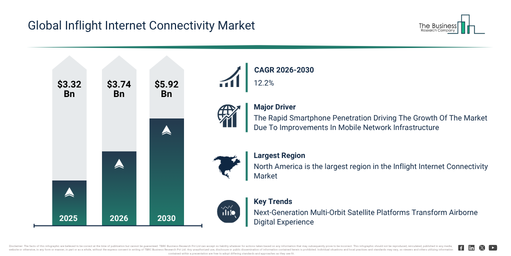
The inflight internet connectivity market has experienced swift growth in recent years. It is projected to expand from $3.32 billion in 2025 to $3.74 billion in 2026, exhibiting a compound annual growth rate (CAGR) of 12.6%. This historical expansion can be primarily attributed to increasing passenger demand for onboard internet access, the growing adoption of connected aircraft solutions, airlines’ rising focus on enhancing passenger experience, the expanded deployment of satellite communication systems, and increasing investment in aviation connectivity infrastructure.
The inflight internet connectivity market is projected for swift expansion in the upcoming years. This market is set to reach $5.92 billion by 2030, demonstrating a compound annual growth rate (CAGR) of 12.2%. Factors driving this growth during the forecast period include the greater uptake of low earth orbit satellite networks, an escalating call for high-speed inflight streaming, the increasing incorporation of connected aircraft technologies, the expanding reach of global aviation communication networks, and the growing necessity for smooth digital experiences for passengers. Key trends anticipated for the forecast timeframe encompass the broadening of high-speed satellite connectivity to improve inflight internet, the emergence of low-latency aviation communication networks, a rise in the use of multi-orbit connectivity solutions, the extension of personalized digital services for passengers on flights, and an increasing requirement for dependable high-bandwidth aircraft connectivity.
Get A Free Sample Report With In-Depth Market Insights:
Inflight Internet Connectivity Market Opportunity Drivers: What’s Unlocking New Revenue Potential?
The escalating adoption of smartphones is projected to stimulate expansion within the inflight internet connectivity market moving forward. Smartphone penetration denotes the increasing population of individuals who own and operate smartphones. This growth is attributed to enhancements in mobile network infrastructure, making smartphones more readily available to a broader segment of the population, thereby enabling superior connectivity, access to digital services, and possibilities for economic, educational, and social interaction across various communities. Inflight internet connectivity allows smartphones to maintain constant connection during flights by establishing links between mobile devices and onboard satellite or air-to-ground networks, enabling passengers to browse, stream, send messages, and use applications much like they would on land. For example, in June 2025, according to the Mobility Report from Telefonaktiebolaget LM Ericsson, a Sweden-based telecommunications company, global smartphone subscriptions totaled 6.93 billion in 2023 and increased to 7.13 billion in 2024. Therefore, the rapid advancement in smartphone penetration is driving the expansion of the inflight internet connectivity market.
Inflight Internet Connectivity Market Segment Analysis Spotlighting Growth Areas
The inflight internet connectivity market covered in this report is segmented –
1) By Technology: Satellite Connectivity, Air To Ground Connectivity, Hybrid Connectivity
2) By Service Type: Network Service Provider, Airline Managed Service, Third Party Service
3) By Aircraft Type: Narrow Body Aircraft, Wide Body Aircraft, Regional Aircraft, Business Jets
4) By End User: Commercial Airlines, Private Airlines, Charter Services
Subsegments:
1) By Satellite Connectivity: Geostationary Satellite Connectivity, Medium Earth Orbit Satellite Connectivity, Low Earth Orbit Satellite Connectivity, High Throughput Satellite Connectivity, Multi Orbit Satellite Connectivity
2) By Air To Ground Connectivity: Cellular Air To Ground Connectivity, Broadband Air To Ground Connectivity, Terrestrial Network Connectivity, Dedicated Aviation Ground Network Connectivity, Wireless Air To Ground Connectivity
3) By Hybrid Connectivity: Satellite And Air To Ground Hybrid Connectivity, Multi Network Hybrid Connectivity, Dynamic Network Switching Connectivity, Integrated Aviation Connectivity, Intelligent Hybrid Connectivity System
Inflight Internet Connectivity Market Transformation Trends: What Innovations Are Driving Change?
Major companies within the inflight internet connectivity market are concentrating on creating advanced platforms, such as next-generation multi-orbit satellite connectivity platforms. Their objective is to elevate passenger experience, bolster network dependability, and empower airlines to provide customized, high-speed internet offerings during flights. These next-generation multi-orbit satellite connectivity platforms represent sophisticated aviation communication systems that integrate geostationary (GEO), medium Earth orbit (MEO), and low Earth orbit (LEO) satellite networks, coupled with intelligent routing and cloud-based network management. This combination delivers uninterrupted, rapid, and low-latency internet access on aircraft, marking a substantial advancement compared to conventional single-orbit satellite or air-to-ground connectivity systems, which frequently encounter bandwidth constraints and uneven coverage. For instance, in April 2025, Viasat Inc., a US-based communications company, introduced Viasat Amara, a next-generation inflight connectivity solution specifically developed to provide a highly personalized and adaptable onboard internet experience for commercial aviation. The platform incorporates innovations across satellite network architecture, intelligent bandwidth management, and digital service layers, enabling it to support multi-orbit connectivity with enhanced quality of service and greater flexibility for airlines. Furthermore, Viasat Amara facilitates real-time application-level data linking and dynamic network optimization, which empowers airlines to boost passenger engagement, strengthen brand loyalty, and uncover new revenue streams by offering distinct connectivity options.
Inflight Internet Connectivity Market Leading Companies: Who Holds The Strongest Market Presence?
Major companies operating in the inflight internet connectivity market are Viasat Inc., Panasonic Avionics Corporation, Eutelsat, Thales Group, RTX Corporation, Space Exploration Technologies Corp., Gogo Inc., Honeywell International Inc., Iridium Communications Inc., Anuvu Operations LLC, Hughes Network Systems LLC, Safran S.A., Gilat Satellite Networks Ltd., Astronics Corporation, Kymeta Corporation, ThinKom Solutions Inc., Burrana Pty Ltd., Kontron AIS GmbH, SatixFy Communications Ltd.
View The Full Inflight Internet Connectivity Market Report:
Inflight Internet Connectivity Market Top Region: Where Does Most Revenue Come From?
North America was the largest region in the inflight internet connectivity market in 2025. Asia-Pacific is expected to be the fastest-growing region in the forecast period. The regions covered in the inflight internet connectivity market report are Asia-Pacific, South East Asia, Western Europe, Eastern Europe, North America, South America, Middle East, Africa.
Reach Out To Our Team:
The Business Research Company: https://www.thebusinessresearchcompany.com/
Americas: +1 310-496-7795
Asia: +44 7882 955267 & +91 8897263534
Europe: +44 7882 955267
Email us at: marketing@tbrc.info
Follow us on:
LinkedIn: https://in.linkedin.com/company/the-business-research-company
YouTube: https://www.youtube.com/channel/UC24_fI0rV8cR5DxlCpgmyFQ
Global Market Model: https://www.thebusinessresearchcompany.com/global-market-model

Wasay has over a decade of experience in market research, data modelling, and analytics, with prior experience at GlobalData and Decision Tree Consulting Services. At The Business Research Company , he leads research operations across syndicated studies, customized consulting engagements, and the Global Market Model platform. His professional experience includes supporting organizations such as Boston Consulting Group, KPMG, and Ernst & Young. Wasay holds a degree in Electronics and Communications Engineering, postgraduate management qualifications from International Management Institute Belgium and Indian School of Business and Entrepreneurship, and completed the Integrated Program in Business Analytics from Indian Institute of Management Indore.