
Backed by market attractiveness analysis, total addressable market sizing, company benchmarking matrices, interactive Excel dashboards, wider supply chain intelligence, emerging startup coverage, and detailed product-level insights, The Business Research Company’s 2026 market reports are designed to offer research that is more actionable and strategically valuable than ever.
Military Aerial Refueling Tanker Market Growth Potential: How Will Market Size Shift Through 2030?
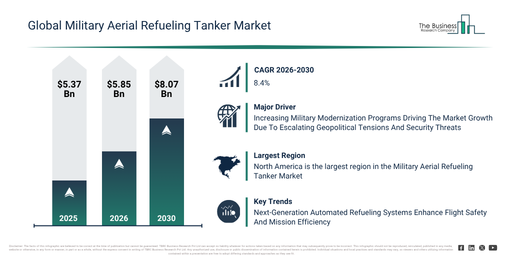
The market size for military aerial refueling tankers has experienced strong expansion over recent years. This market is projected to expand from $5.37 billion in 2025 to $5.85 billion by 2026, achieving a compound annual growth rate (CAGR) of 8.8%. The historical period’s growth is largely attributable to factors such as increasing military modernization programs, a growing demand for extended aircraft mission endurance, rising defense expenditures for air superiority capabilities, the expanding deployment of strategic air mobility operations, and the increasing requirement for aerial refueling support during military missions.
The military aerial refueling tanker market size is anticipated to experience substantial growth over the coming years. It is predicted to expand to $8.07 billion by 2030, demonstrating a compound annual growth rate (CAGR) of 8.4%. This growth during the forecast period is fueled by several factors, including the increasing adoption of unmanned aerial refueling technologies, rising investments in next-generation tanker aircraft platforms, a growing demand for long-range military operations, the increasing integration of advanced aircraft communication systems, and the expanding procurement of multi-role tanker transport aircraft. Noteworthy trends for the forecast period encompass an increasing demand for extended-range military aircraft operations, a growing embrace of advanced aerial refueling capabilities, the rising modernization of military tanker aircraft fleets, increased development of autonomous and unmanned refueling systems, and a growing emphasis on multi-mission airborne support platforms.
Get A Free Sample Report With In-Depth Market Insights:
Military Aerial Refueling Tanker Market Growth Drivers: What’s Behind The Acceleration?
The growth of the military aerial refueling tanker market is expected to be propelled by increasing military modernization programs. These programs are comprehensive initiatives undertaken by armed forces to upgrade and enhance their defense capabilities through advanced weapons systems and technologies. The rise in military modernization programs stems from escalating geopolitical tensions and security threats to national sovereignty and regional stability, as countries aim to strengthen their defense capabilities, deter potential adversaries, and safeguard their strategic interests. Expanding military modernization efforts drive a higher demand for advanced force projection capabilities, which in turn accelerates the adoption and expansion of military aerial refueling tanker fleets to extend operational range, enhance mission endurance, and support next-generation multi-domain combat operations. For instance, in March 2023, according to the European Security and Defence College, a Belgium-based autonomous institution, by 2030, the ongoing US Army modernization program is poised to field 35 new future force systems, forming the core of more than 500 development, acquisition, or upgrade initiatives currently underway. Therefore, the increasing military modernization programs are driving the growth of the military aerial refueling tanker market.
Military Aerial Refueling Tanker Market Segment Breakdown: Which Categories Lead On Revenue?
The military aerial refueling tanker market covered in this report is segmented –
1) By Type: Manned, Unmanned
2) By Refueling System: Flying Boom System, Probe And Drogue System, Dual Refueling System
3) By Mission Type: Combat Support Missions, Strategic Mobility Missions, Humanitarian And Disaster Relief Missions, Training And Exercise Missions
4) By End User: Air Force, Navy, Joint Defense Forces
Subsegments:
1) By Manned: Fixed Wing Tanker Aircraft, Multi Role Tanker Transport Aircraft, Strategic Air Refueling Tankers, Tactical Air Refueling Tankers, Converted Commercial Tanker Aircraft
2) By Unmanned: Unmanned Aerial Refueling Tankers, Autonomous Tanker Drone Systems, High Altitude Long Endurance Refueling Platforms, Loyal Wingman Refueling Systems, Swarm Based Aerial Refueling Systems
Military Aerial Refueling Tanker Market Trends: What’s Defining The Industry’s Next Phase?
Leading entities within the military aerial refueling tanker market are dedicating efforts to developing advanced solutions, such as automated air-to-air refueling systems, to elevate mission effectiveness, enhance flight safety, and alleviate pilot strain during intricate aerial maneuvers. These automated air-to-air refueling systems represent sophisticated aviation technologies integrated into tanker aircraft, facilitating precise, computer-aided fuel transfers to receiving aircraft with minimal manual input. This approach significantly boosts refueling accuracy, lessens operational hazards, and ensures consistent performance across various mission scenarios, in contrast to traditional methods like fully manual boom or probe-and-drogue refueling. As an illustration, in February 2026, Airbus SE, a Netherlands-based aeronautics and space company, in collaboration with the Republic of Singapore Air Force (RSAF), a Singapore-based aerial branch, and the Defense Science and Technology Agency (DSTA), a Singapore-based statutory board, secured a global pioneering certification for its Automatic Air-to-Air Refueling (A3R) capability on the Airbus A330 Multi Role Tanker Transport (MRTT). This certification, issued by the Spanish National Institute for Aerospace Technology, confirmed the system’s safety, maturity, and reliability across numerous mission profiles. Furthermore, the A3R system enables the Singapore Air Force’s A330 MRTT fleet to carry out entirely automated refueling operations, marking a significant progression in tanker aircraft technology and setting a new international benchmark for automated aerial refueling capabilities.
Military Aerial Refueling Tanker Market Leading Players And Competitive Positioning
Major companies operating in the military aerial refueling tanker market are The Boeing Company, Airbus Defence and Space S.A.U., Aviation Industry Corporation of China Ltd., Lockheed Martin Corporation, United Aircraft Corporation, Embraer S.A., Israel Aerospace Industries Ltd., Northrop Grumman Corporation, L3Harris Technologies Inc., BAE Systems plc, Eaton Corporation plc, Parker-Hannifin Corporation, Safran S.A., Leonardo S.p.A., Marshall Aerospace, Metrea Strategic Mobility LLC, Omega Air Refueling Services Inc., Anduril Industries, Sierra Nevada Corporation
View The Full Military Aerial Refueling Tanker Market Report:
Military Aerial Refueling Tanker Market Regional Analysis: Which Geography Leads On Revenue?
North America was the largest region in the military aerial refueling tanker market in 2025. Asia-Pacific is expected to be the fastest-growing region in the forecast period. The regions covered in the military aerial refueling tanker market report are Asia-Pacific, South East Asia, Western Europe, Eastern Europe, North America, South America, Middle East, Africa.
Reach Out To Our Team:
The Business Research Company: https://www.thebusinessresearchcompany.com/
Americas: +1 310-496-7795
Asia: +44 7882 955267 & +91 8897263534
Europe: +44 7882 955267
Email us at: marketing@tbrc.info
Follow us on:
LinkedIn: https://in.linkedin.com/company/the-business-research-company
YouTube: https://www.youtube.com/channel/UC24_fI0rV8cR5DxlCpgmyFQ
Global Market Model: https://www.thebusinessresearchcompany.com/global-market-model

Wasay has over a decade of experience in market research, data modelling, and analytics, with prior experience at GlobalData and Decision Tree Consulting Services. At The Business Research Company , he leads research operations across syndicated studies, customized consulting engagements, and the Global Market Model platform. His professional experience includes supporting organizations such as Boston Consulting Group, KPMG, and Ernst & Young. Wasay holds a degree in Electronics and Communications Engineering, postgraduate management qualifications from International Management Institute Belgium and Indian School of Business and Entrepreneurship, and completed the Integrated Program in Business Analytics from Indian Institute of Management Indore.