
Through market attractiveness analysis, total addressable market evaluation, company benchmarking matrices, interactive Excel dashboards, expanded supply chain intelligence, emerging startup coverage, and detailed product insights, The Business Research Company’s 2026 market reports provide more actionable and strategically valuable research.
Microgravity Research Flight Services Market Value Analysis: What Growth Is Expected Over The Forecast Period?
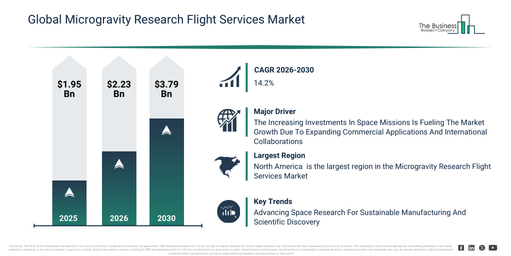
The market size for microgravity research flight services has seen rapid expansion in recent years. It is anticipated to increase from $1.95 billion in 2025 to $2.23 billion in 2026, achieving a compound annual growth rate (CAGR) of 14.4%. The observed growth during the historical period is primarily due to a rising number of space-based research programs, the development of specialized microgravity flight platforms, continuous advancements in payload integration technology, increasing interest from academic and pharmaceutical research communities, and government-backed microgravity experiments.
The microgravity research flight services market is projected for substantial expansion over the coming years. This market is anticipated to reach a valuation of $3.79 billion by 2030, exhibiting a compound annual growth rate (CAGR) of 14.2%. Key drivers for this growth include the emergence of commercial microgravity research missions, the proliferation of hosted orbital platforms, advancements in space-based quantum laboratories, enhanced cooperation between private and public research entities, and the uptake of high-altitude balloon and analog simulation solutions. Notable trends for the outlook period encompass the broadening of parabolic and suborbital research flight initiatives, the incorporation of space-based quantum laboratories, the expansion of high-altitude balloon microgravity systems, sophisticated payload integration and mission assistance, and a heightened need for analog microgravity simulation facilities.
Download A Free Sample Report For Comprehensive Market Insights:
Microgravity Research Flight Services Market Expansion Supported By Key Demand Factors
The growth of the microgravity research flight services market is anticipated to be fueled by increasing investments in space missions. Space missions encompass planned operations executed in outer space utilizing spacecraft or satellites, purposed for exploration, studying celestial bodies, or achieving scientific, commercial, or military objectives. The escalating investments in these missions are primarily driven by the pursuit of scientific discovery, aiming to expand human knowledge of the universe and its underlying phenomena. Such increased investments in space missions expand opportunities for microgravity research flight services by providing more platforms, funding, and advanced technologies to conduct critical experiments in unique orbital environments. For instance, in June 2024, according to the Ministry of Foreign Affairs and Trade, a New Zealand-based government department, the UK has pledged to invest about USD 12.5 billion (£10 billion) in space initiatives over the decade starting in 2023, with roughly USD 3.75 billion (£3 billion) allocated in the 2023 spending review. Consequently, the rising financial commitments to space missions are propelling the expansion of the microgravity research flight services market.
Microgravity Research Flight Services Market Segmentation And Category Breakdown
The microgravity research flight services market covered in this report is segmented –
1) By Service Type: Parabolic Flight Services, Suborbital Flight Services, Orbital Flight Services
2) By Platform: Manned, Unmanned
3) By Application: Scientific Research, Commercial Research, Educational, Aerospace And Defense, Pharmaceuticals, Other Applications
4) By End-User: Government Agencies, Research Institutes, Commercial Enterprises, Other End-User
Subsegments:
1) By Parabolic Flight Services: Single Parabolic Flights, Multiple Parabolic Flights, Extended Parabolic Campaigns
2) By Suborbital Flight Services: Suborbital Research Missions, Suborbital Tourism Flights, Suborbital Technology Demonstration Flight
3) By Orbital Flight Services: Short-Duration Orbital Missions, Long-Duration Orbital Missions, Commercial Cargo Orbital Flights, Commercial Crew Orbital Flights
#Microgravity Research Flight Services Market Trends Influencing Long-Term Demand
Companies in the microgravity research flight services market are increasingly leveraging innovative technologies like powder-based 3D printing to enable sustainable manufacturing in space. Powder-based three-dimensional (3D) printing technologies construct objects layer by layer by fusing or binding fine powders, facilitating rapid prototyping, intricate geometries, custom production, and reduced material waste. For example, in May 2023, the German Aerospace Center (DLR), a government agency based in Germany, successfully launched the MAPHEUS-13 rocket from the Esrange Space Center to conduct microgravity experiments, including the testing of a powder-based 3D printer in space. This experiment aimed to evaluate the feasibility of producing metal components under reduced gravity, a crucial step towards sustainable manufacturing for future lunar or Martian habitats. In addition to 3D printing, the mission carried other experiments investigating how microgravity impacts fundamental physical processes, such as the interaction of liquid metals and the behavior of brain cells at the cellular and genetic level. By combining applied and fundamental research, the MAPHEUS campaign enhances the understanding of physics and biology in space while offering valuable insights into the technologies required for long-term human presence beyond Earth.
Microgravity Research Flight Services Market Leading Companies: Who Holds Significant Market Presence?
Major companies operating in the microgravity research flight services market are Airbus Defence and Space GmbH, Space Exploration Technologies Corp., Blue Origin LLC, QinetiQ Group plc, Redwire Space Inc., Svenska Rymdaktiebolaget (SSC) AB, Axiom Space Inc., World View Enterprises Inc., Varda Space Industries Inc., Loft Federal LLC, Virgin Galactic Holdings Inc., Zero Gravity Corporation, yuri GmbH, Exos Aerospace Systems & Technologies Inc., China Academy of Space Technology, Tyvak Nano-Satellite Systems LLC, SpacePharma SA, Saber Astronautics LLC, Novespace SAS, Diamond Air Service Inc.
Access The Complete Microgravity Research Flight Services Market Report:
Microgravity Research Flight Services Market Regional Analysis And Leading Geography
North America was the largest region in the microgravity research flight services market in 2025. Asia-Pacific is expected to be the fastest-growing region in the forecast period. The regions covered in the microgravity research flight services market report are Asia-Pacific, South East Asia, Western Europe, Eastern Europe, North America, South America, Middle East, Africa.
Access a Customized Microgravity Research Flight Services Market Report for Deeper Competitive Insights
https://www.thebusinessresearchcompany.com/customise?id=27727&type=smp
The Business Research Company: https://www.thebusinessresearchcompany.com/
Americas: +1 310-496-7795
Asia: +44 7882 955267 & +91 8897263534
Europe: +44 7882 955267
Email us at: marketing@tbrc.info
Follow us on:
LinkedIn: https://in.linkedin.com/company/the-business-research-company
YouTube: https://www.youtube.com/channel/UC24_fI0rV8cR5DxlCpgmyFQ
Global Market Model: https://www.thebusinessresearchcompany.com/global-market-model

Wasay has over a decade of experience in market research, data modelling, and analytics, with prior experience at GlobalData and Decision Tree Consulting Services. At The Business Research Company , he leads research operations across syndicated studies, customized consulting engagements, and the Global Market Model platform. His professional experience includes supporting organizations such as Boston Consulting Group, KPMG, and Ernst & Young. Wasay holds a degree in Electronics and Communications Engineering, postgraduate management qualifications from International Management Institute Belgium and Indian School of Business and Entrepreneurship, and completed the Integrated Program in Business Analytics from Indian Institute of Management Indore.

