
Backed by market attractiveness analysis, total addressable market sizing, company benchmarking matrices, interactive Excel dashboards, wider supply chain intelligence, emerging startup coverage, and detailed product-level insights, The Business Research Company’s 2026 market reports are designed to offer research that is more actionable and strategically valuable than ever.
Radio Frequency (RF) Signal Amplifier Market Revenue Outlook: What CAGR Lies Ahead Through 2030?
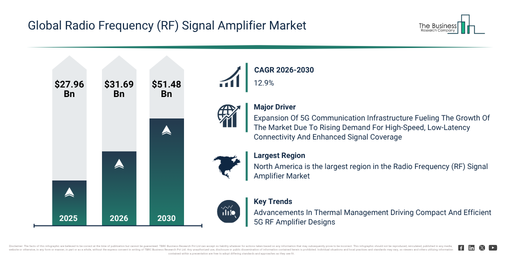
The radio frequency (RF) signal amplifier market size has experienced swift expansion in recent years. It is projected to grow from $27.96 billion in 2025 to $31.69 billion in 2026, demonstrating a compound annual growth rate (CAGR) of 13.3%. Historically, this growth can be ascribed to elements such as increasing demand for wireless communication systems, rising expansion of cellular network infrastructure, growing need for improved signal transmission quality, increasing adoption of radio communication technologies, and the expansion of defense and aerospace communication applications.
The radio frequency (RF) signal amplifier market is anticipated to experience substantial expansion over the next few years. Its valuation is projected to reach $51.48 billion by 2030, progressing at a compound annual growth rate (CAGR) of 12.9%. This projected growth throughout the forecast period stems from factors such as the burgeoning demand for 5G and advanced wireless networks, an escalating need for high-performance signal amplification, the increasing integration of satellite communication systems, the expanding deployment of connected industrial communication networks, and the heightened requirement for next-generation RF communication equipment. Noteworthy trends during this period encompass a greater adoption of high-efficiency RF signal amplification solutions, a rising demand for low-noise and high-gain RF amplifiers, ongoing advancements in compact and energy-efficient RF amplifier designs, an increasing incorporation of multi-frequency RF amplification capabilities, and an intensified focus on enhancing signal quality and mitigating communication interference.
Get A Free Sample Report With In-Depth Market Insights:
Radio Frequency (RF) Signal Amplifier Market Growth Drivers: What’s Behind The Acceleration?
The future expansion of 5G communication infrastructure is anticipated to drive the advancement of the radio frequency (RF) signal amplifier market. This infrastructure encompasses sophisticated base stations, antennas, fiber-optic connections, small cells, and core network systems, designed to facilitate ultra-fast, low-latency, and high-capacity wireless connectivity. The rise of 5G communication infrastructure is primarily due to the increasing demand for high-speed, low-latency connections crucial for data-intensive applications such as AI, IoT, and cloud computing. Within this 5G setup, RF signal amplifiers play a vital role by boosting weak radio signals to higher power levels, thus ensuring strong, efficient, and long-range transmission between base stations and user devices. For instance, data released in March 2024 by 5G Americas, a US-based telecommunications trade organization, reported that global 5G connections reached 1.76 billion by the end of 2023, with 700 million new connections added during that year, representing a 66% annual increase. In North America, 5G comprised 29% of all wireless connections, growing 64% year-on-year to achieve 197 million connections after integrating 77 million new users in 2023. Therefore, the ongoing expansion of 5G communication infrastructure is indeed fueling the growth of the radio frequency (RF) signal amplifier market.
Radio Frequency (RF) Signal Amplifier Market Segment Performance And Emerging Opportunities
The radio frequency (rf) signal amplifier market covered in this report is segmented –
1) By Product Type: Low Noise Amplifiers, Power Amplifiers, Wideband Amplifiers, Operational Amplifiers, Radio Frequency Integrated Circuits
2) By Frequency Range: Below 1 Gigahertz, 1 Gigahertz To 2 Gigahertz, 2 Gigahertz To 6 Gigahertz, 6 Gigahertz To 10 Gigahertz, Above 10 Gigahertz
3) By Technology: Solid State Amplifiers, Thermionic Emission Amplifiers, Other Technologies
4) By End Use Industry: Military And Defense, Commercial, Industrial, Healthcare, Agriculture
Subsegments:
1) By Low Noise Amplifiers: Broadband Low Noise Amplifiers, Narrowband Low Noise Amplifiers, Cryogenic Low Noise Amplifiers, Gallium Arsenide Low Noise Amplifiers
2) By Power Amplifiers: Linear Power Amplifiers, High Power Radio Frequency Amplifiers, Solid State Power Amplifiers, Gallium Nitride Power Amplifiers
3) By Wideband Amplifiers: Multi Band Wideband Amplifiers, Ultra Wideband Amplifiers, Broadband Driver Amplifiers, Distributed Wideband Amplifiers
4) By Operational Amplifiers: High Speed Operational Amplifiers, Precision Operational Amplifiers, Low Power Operational Amplifiers, Voltage Feedback Operational Amplifiers
5) By Radio Frequency Integrated Circuits: Radio Frequency Front End Integrated Circuits, Radio Frequency Transceiver Integrated Circuits, Radio Frequency Gain Block Integrated Circuits, Radio Frequency System On Chip Integrated Circuits
Radio Frequency (RF) Signal Amplifier Market Trends: What’s Defining The Industry’s Next Phase?
Leading companies in the radio frequency (RF) signal amplifier market are concentrating on developing advanced solutions, such as top-side cooling technologies. These innovations aim to enhance heat dissipation, boost amplifier efficiency, reduce system size, and support high-performance 5G network infrastructure deployments. Top-side cooling technology is a thermal design strategy where heat is expelled from the top of an RF amplifier device, rather than the bottom. As an illustration, in June 2023, NXP Semiconductors N.V., a semiconductor manufacturing company based in the Netherlands, launched its family of top-side-cooled RF amplifier modules, specifically targeting next-generation 5G infrastructure with an emphasis on creating smaller, lighter, and more energy-efficient base station designs. These new GaN-based multi-chip modules introduce an industry-first top-side cooling method that improves thermal management while simultaneously decreasing radio size and weight by over 20%. By separating thermal and RF design functionalities and eliminating the requirement for dedicated RF shielding, this solution simplifies manufacturing, reduces costs, and shortens design cycles. Designed for 32T32R, 200W radios operating within the 3.3–3.8 GHz range, the modules provide high gain and efficiency, facilitating denser and more sustainable 5G network deployments.
Radio Frequency (RF) Signal Amplifier Market Key Players: Which Companies Lead Industry Competition?
Major companies operating in the radio frequency (rf) signal amplifier market are Broadcom Inc., Qualcomm Incorporated, Mitsubishi Electric Corporation, Sumitomo Electric Industries Ltd., Toshiba Electronic Devices & Storage Corporation, Texas Instruments Incorporated, STMicroelectronics N.V., Infineon Technologies AG, NXP Semiconductors N.V., Analog Devices Inc., Murata Manufacturing Co. Ltd., Renesas Electronics Corporation, Microchip Technology Incorporated, Skyworks Solutions Inc., Qorvo Inc., Wolfspeed Inc., Ampleon Coöperatief U.A., MACOM Technology Solutions Holdings Inc., Rohm Co. Ltd., Teledyne Defense Electronics LLC, Mini-Circuits Inc., Richardson RFPD Inc., RFHIC Corporation, United Monolithic Semiconductors SAS, Empower RF Systems Inc.
View The Full Radio Frequency (RF) Signal Amplifier Market Report:
Radio Frequency (RF) Signal Amplifier Market Top Region: Where Does Most Revenue Come From?
North America was the largest region in the radio frequency (RF) signal amplifier market in 2025. Asia-Pacific is expected to be the fastest-growing region in the forecast period. The regions covered in the radio frequency (RF) signal amplifier market report are Asia-Pacific, South East Asia, Western Europe, Eastern Europe, North America, South America, Middle East, Africa.
Reach Out To Our Team:
The Business Research Company: https://www.thebusinessresearchcompany.com/
Americas: +1 310-496-7795
Asia: +44 7882 955267 & +91 8897263534
Europe: +44 7882 955267
Email us at: marketing@tbrc.info
Follow us on:
LinkedIn: https://in.linkedin.com/company/the-business-research-company
YouTube: https://www.youtube.com/channel/UC24_fI0rV8cR5DxlCpgmyFQ
Global Market Model: https://www.thebusinessresearchcompany.com/global-market-model

Wasay has over a decade of experience in market research, data modelling, and analytics, with prior experience at GlobalData and Decision Tree Consulting Services. At The Business Research Company , he leads research operations across syndicated studies, customized consulting engagements, and the Global Market Model platform. His professional experience includes supporting organizations such as Boston Consulting Group, KPMG, and Ernst & Young. Wasay holds a degree in Electronics and Communications Engineering, postgraduate management qualifications from International Management Institute Belgium and Indian School of Business and Entrepreneurship, and completed the Integrated Program in Business Analytics from Indian Institute of Management Indore.