
Backed by market attractiveness analysis, total addressable market sizing, company benchmarking matrices, interactive Excel dashboards, wider supply chain intelligence, emerging startup coverage, and detailed product-level insights, The Business Research Company’s 2026 market reports are designed to offer research that is more actionable and strategically valuable than ever.
Regional Air Mobility Market Growth Potential: How Will Market Size Shift Through 2030?
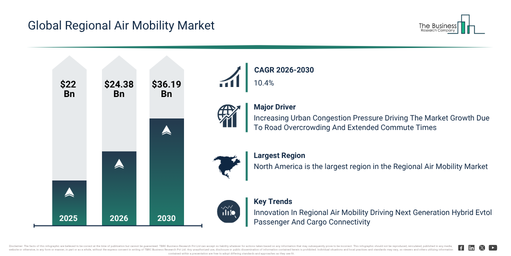
The regional air mobility market size has experienced rapid expansion in recent years. It is forecast to grow from $22 billion in 2025 to $24.38 billion in 2026, exhibiting a compound annual growth rate (CAGR) of 10.8%. This historical growth can be attributed to factors such as increasing demand for enhanced regional connectivity, a growing requirement for quicker transportation alternatives, rising investments in aviation infrastructure development, expanding regional airport networks, and increasing government initiatives supporting regional air transportation.
The regional air mobility market is projected to experience substantial expansion in the coming years. Its valuation is set to reach $36.19 billion by 2030, exhibiting a compound annual growth rate (CAGR) of 10.4%. This anticipated growth stems from the increasing integration of electric and hybrid aircraft technologies, a heightened need for eco-friendly regional transport, the wider rollout of autonomous aviation systems, augmented capital expenditure in advanced air mobility infrastructure, and the expanded incorporation of digital aviation management platforms. Key trends observed during this period encompass the greater use of sophisticated regional aircraft for better short-haul connections, the continued evolution of electric vertical takeoff and landing (eVTOL) aircraft for regional transit, the enhanced incorporation of digital air traffic management systems to optimize operations, the broader establishment of adaptable air mobility networks in areas lacking service, and the increased creation of hybrid propulsion aircraft for more effective regional travel.
Get A Free Sample Report With In-Depth Market Insights:
Regional Air Mobility Market Industry Drivers: What’s Behind The Revenue Growth?
Growing urban congestion pressure is anticipated to drive the expansion of the regional air mobility market. This refers to an overabundance of vehicles and people in urban areas, resulting in slower traffic, extended travel durations, and diminished transportation effectiveness. The increase in this pressure stems from swift urbanization, as individuals relocate to cities for employment and improved prospects, thereby boosting population density and vehicle numbers on existing limited road networks, culminating in congested roads and sluggish traffic movement. It fuels the growth of the regional air mobility market by creating a greater need for quicker, more effective, and congestion-free transport options that circumvent surface road jams and substantially cut down travel durations for both urban and intercity journeys. For example, in May 2024, the Department for Transport, a UK ministerial department, reported that in 2023, vehicles covered 330.8 billion miles on Great Britain’s roads, representing a 2.2% rise compared to 2022. Consequently, the escalating urban congestion pressure is stimulating the expansion of the regional air mobility market.
Regional Air Mobility Market Segmentation: How Does The Market Break Down By Category?
The regional air mobility market covered in this report is segmented –
1) By Vehicle Type: Fixed Wing Aircraft, Rotorcraft, Hybrid Aircraft
2) By Propulsion Type: Conventional Fuel Based, Hybrid Electric, Fully Electric, Hydrogen Powered
3) By Range: Short Range (Up To One Hundred Fifty Kilometers), Medium Range (One Hundred Fifty To Five Hundred Kilometers), Extended Range (Above Five Hundred Kilometers)
4) By End User: Commercial, Government And Defense, Private Piloted, Autonomous
Subsegments:
1) By Fixed Wing Aircraft: Turboprop Aircraft, Regional Jet Aircraft, Electric Fixed Wing Aircraft, Hybrid Electric Fixed Wing Aircraft
2) By Rotorcraft: Conventional Helicopters, Electric Vertical Takeoff And Landing Aircraft, Hybrid Electric Vertical Takeoff And Landing Aircraft, Tiltrotor Aircraft
3) By Hybrid Aircraft: Lift Plus Cruise Aircraft, Tilt Wing Aircraft, Compound Aircraft, Blended Wing Body Aircraft
Regional Air Mobility Market Trends Shaping Long-Term Demand
Companies operating within the regional air mobility market are concentrating on developing innovative solutions, such as hybrid electric vertical take-off and landing (eVTOL) aircraft. Their aim is to bolster intercity connections, lower carbon emissions, and enhance operational effectiveness across passenger and cargo transport. Hybrid eVTOL aircraft represent advanced air mobility systems, integrating electric propulsion with traditional turbine or fuel-based engines, frequently aided by hydrogen fuel cells. This configuration enables them to perform vertical take-off and landing while offering an expanded range, greater payload capacity, and better energy efficiency when contrasted with conventional helicopters and short-haul planes. For example, in March 2023, the UK-based advanced air mobility firm Lyte Aviation Ltd. unveiled its LA-44 SkyBus and SkyTruck program. This program features a 40-seat hybrid eVTOL aircraft designed for both passenger and cargo operations. The aircraft utilizes a hybrid propulsion system, combining turbine engines running on sustainable aviation fuel with electric motors powered by hydrogen fuel cells, achieving a range of up to 1,000 km and a top speed of 300 km/h. This setup significantly boosts fuel efficiency compared to traditional helicopters. Furthermore, the design incorporates a 4.5-tonne payload capacity, capability for underslung cargo, and compatibility with current aviation infrastructure, establishing it as a flexible option for regional passenger services and urgent logistics.
Regional Air Mobility Market Competitive Overview And Top Companies
Major companies operating in the regional air mobility market are AURA AERO SAS, Airbus SE, Archer Aviation Inc., BETA Technologies Inc., Cranfield Aerospace Solutions Ltd., Costruzioni Aeronautiche Tecnam S.p.A., Daher Aerospace SAS, EHang Holding, Embraer S.A., Eve Air Mobility, Horizon Aircraft Ltd., Joby Aviation Inc., Lilium Jet, Odys Aviation Inc., Pilatus Aircraft Ltd., SkyDrive Inc., Vertical Aerospace Ltd., Volocopter GmbH, Boeing, Textron Inc., Heart Aerospace, Electra.aero, Supernal
View The Full Regional Air Mobility Market Report:
Regional Air Mobility Market Geographic Analysis: Where Is Demand Rising Fastest?
North America was the largest region in the regional air mobility market in 2025. Asia-Pacific is expected to be the fastest-growing region in the forecast period. The regions covered in the regional air mobility market report are Asia-Pacific, South East Asia, Western Europe, Eastern Europe, North America, South America, Middle East, Africa.
Reach Out To Our Team:
The Business Research Company: https://www.thebusinessresearchcompany.com/
Americas: +1 310-496-7795
Asia: +44 7882 955267 & +91 8897263534
Europe: +44 7882 955267
Email us at: marketing@tbrc.info
Follow us on:
LinkedIn: https://in.linkedin.com/company/the-business-research-company
YouTube: https://www.youtube.com/channel/UC24_fI0rV8cR5DxlCpgmyFQ
Global Market Model: https://www.thebusinessresearchcompany.com/global-market-model

Wasay has over a decade of experience in market research, data modelling, and analytics, with prior experience at GlobalData and Decision Tree Consulting Services. At The Business Research Company , he leads research operations across syndicated studies, customized consulting engagements, and the Global Market Model platform. His professional experience includes supporting organizations such as Boston Consulting Group, KPMG, and Ernst & Young. Wasay holds a degree in Electronics and Communications Engineering, postgraduate management qualifications from International Management Institute Belgium and Indian School of Business and Entrepreneurship, and completed the Integrated Program in Business Analytics from Indian Institute of Management Indore.